Choose a Sailboat Propeller: Fixed vs Folding vs Feathering
A prop is one of the few upgrades that can make your boat feel like it lost 1,000 pounds—then punish you later if it’s sized wrong. For most auxiliary sailboats running ~10–55 hp (and the common ~20–40 hp range on 30–45 ft cruisers), the “right” prop is the one that balances drag under sail, thrust in chop, reverse authority, and engine loading so you can actually hit rated WOT rpm.
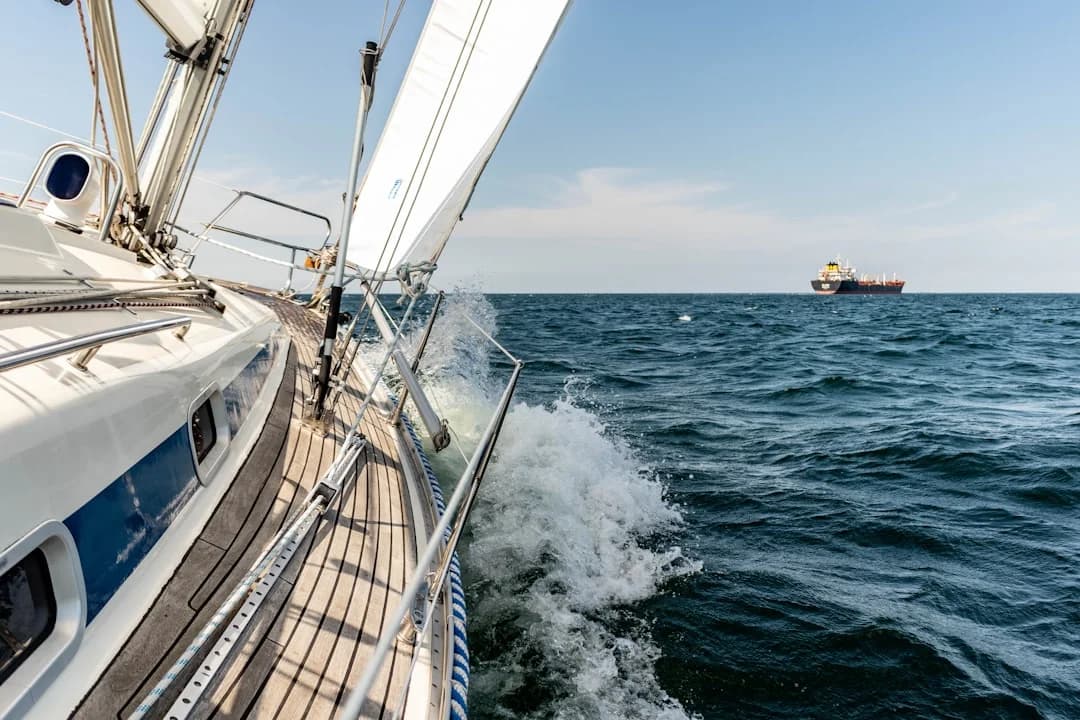
Photo by Pawel Kadysz on Unsplash
Fixed vs Folding vs Feathering: What Changes and Why
Hydrodynamics in plain terms: drag, thrust, and slip
A fixed prop keeps its blades open all the time, so under sail it’s basically a small underwater winch handle you’re dragging around. A folding propeller sailboat setup closes its blades when you’re sailing, reducing frontal area and typically cutting drag a lot compared with a fixed 2- or 3-blade. A feathering propeller sailboat design rotates blades to align with the flow, presenting a thin profile—often similar low drag to folding, with different handling under power.
The performance limiters most owners don’t name are propeller slip and cavitation. Slip is the gap between theoretical advance (pitch) and what the boat actually does, especially when you load the prop in chop. Cavitation is when the pressure drops and the prop starts making vapor bubbles; thrust falls off, vibration rises, and your “more pitch fixes everything” theory dies quickly.
Blade behavior under sail and under power
Under sail, you care about two states: shaft locked or freewheeling, and what the blades do in each state. Many folding props want a brief burst in reverse to fold cleanly, while some feathering props need correct indexing to align properly. Gearboxes vary: some manufacturers want the shaft locked; others allow freewheeling, and the difference can change drag and wear.
Under power, fixed props engage instantly and predictably, while folding props can have a slight “open-up” moment—usually small, but noticeable in tight quarters. Feathering props tend to engage cleanly ahead and astern because the blades are already in a controlled pitch orientation, which matters when you need reverse now, not after a polite pause.
Two-blade vs three-blade: what really shifts
Two blades generally mean less drag and slightly better sailing feel, but you give up thrust when the boat is heavy, the bottom is fuzzy, or the sea state turns ugly. Three blades usually improve low-speed thrust, reduce vibration, and hold the boat to a target rpm better in chop—at the cost of more drag if the prop is fixed. That’s why three blade folding propeller and three-blade feathering setups are so common on cruising boats with ~20–40 hp diesels.
Expect tradeoffs, not miracles. The prop that’s fastest under sail is rarely the one that backs like a tug, and the one that crash-stops hardest often drags the most. If someone tells you otherwise, they’re either selling props or they’ve never backed into a slip with a crosswind and an audience.
Photo by Margo Evardson on Unsplash
Speed Under Sail: Drag, Knot Gains, and How to Measure
Expected gains: what 0.2–0.8 knots really means
Real-world reports for reducing propeller drag under sail commonly land around ~0.2–0.8 knots in light-to-moderate air, depending on hull, aperture, and what you’re replacing. On a 35-footer that normally ghosts at 5.2 knots in 8–10 knots of true wind, a 0.5-knot gain is not trivia; it’s the difference between making a tide gate and buying a sandwich at the wrong marina.
Here’s the passage math sailors actually use. Over 60 NM, a 0.5-knot speed increase saves about 1.1 hours (60/5.0 = 12.0 hr vs 60/5.5 = 10.9 hr). Over 120 NM, that’s roughly 2.2 hours, which often decides whether you arrive in daylight or practice your foredeck work by headlamp.
This is where checking the nautical miles for your planned route earns its keep. Put in your route distance, then run “what-if” arrival times at +0.3 and +0.5 knots to see if drag reduction changes your weather window or current plan. It’s a simple tool, but it keeps decisions honest.
A repeatable on-water test plan (before/after)
Most prop “tests” are a single reach with a big grin and no data. Do it like a grown-up: sail in a steady breeze band, hold the same sail plan, and record stabilized numbers on both tacks. Use 2-minute stabilized legs, record SOG, COG, and if you have it, TWA/TWS from instruments; then average both tacks to reduce current bias.
Run 3 cycles (6 legs total), and don’t change anything except the prop. Make sure your shaft state is consistent: engine off, and either locked or freewheeling per gearbox guidance, every time. Mixing shaft states can easily swamp a 0.2-knot difference and leave you “proving” whatever you hoped to prove.
What skews results: aperture, alignment, and blade count
A tight aperture can create turbulence that makes a “low drag” prop less low-drag than the brochure claims. A folding prop with blades tucked behind a chunky strut, or operating in disturbed flow from a skeg, won’t always test as clean as you expect. Shaft angle matters too: higher shaft angles can increase disturbed flow and noise, which you’ll feel as vibration even if the GPS says you’re marginally faster.
Also, a three-blade folding prop can be faster overall for a cruiser than a two-blade in real water. The reason isn’t top speed; it’s acceleration out of tacks, less leeway in chop, and better ability to keep speed when the boat gets knocked off balance. A prop that helps you regain 0.3 knots quickly after each tack can beat a slightly cleaner prop that leaves you wallowing.
Photo by Roberto Patumi on Unsplash
Motoring Power & Engine Health: Sizing to Hit Rated WOT RPM
Diameter vs pitch: what each changes on your boat
For most cruising auxiliaries, you’ll see props roughly 12–18 in diameter with ~8–16 in pitch, constrained by aperture, shaft angle, and gear ratio. Diameter is your main lever for blade area and thrust at low speed, especially when the boat is heavy or punching into waves. Pitch is your main lever for how hard the prop loads the engine as rpm rises; too much pitch is how you “lug” a diesel while convincing yourself it sounds fine.
Gear ratio matters because it sets prop rpm. Two boats with the same 30 hp engine can need very different props if one has a 2.14:1 reduction and the other is closer to 2.6:1. That’s why copying your dock neighbor’s prop is a lazy plan with expensive consequences.
A practical starting point is to record your current prop markings (diameter x pitch), engine model, gear ratio, and boat displacement. Then treat changes as controlled steps: a 1-inch pitch change is often a meaningful adjustment, and a diameter change may be limited by clearance rules and aperture.
The WOT RPM rule and diagnosing over-propping
The diesel health rule I care about is simple: you should reach manufacturer-rated WOT rpm under full load within about 100–200 rpm. Many auxiliaries are rated in the ~2800–3600 rpm band (Yanmar 3YM/4JH families vary by model), and missing by more than 200 rpm often indicates over-propping (too much pitch and/or diameter). Over-propping raises cylinder temps, increases soot, and can push EGT higher than you’d like, even if you don’t have an EGT gauge.
Under-propping is the opposite: the engine revs easily but you don’t get the speed you expect, and fuel burn per mile can be worse than it should be. It can also lead to annoying high-rpm operation and a prop that cavitates when you ask for thrust quickly. Either way, the engine is telling you the truth; your pride is optional.
Cruising rpm is typically ~70–85% of rated rpm, and your prop choice affects whether you can hold that rpm into chop without black smoke or a gradual rpm sag. If you can only maintain cruise on flat water, your prop is sized for your marina, not your coast.
Sea-trial data to confirm loading and efficiency
After a prop change, run a structured power trial. Record an rpm vs speed curve at 500 rpm steps from idle to cruise to WOT, and do it in both directions to average current. Note coolant temperature, any visible exhaust smoke, and vibration changes—especially around common cruising bands like 2200–2800 rpm on many engines.
If you have fuel flow data, great; if you don’t, you can still learn plenty. A prop that lets you hit rated WOT and gives a clean exhaust at cruise is usually a prop that will keep the engine happier over thousands of hours. If the boat feels strong at 2400 rpm but won’t climb past 3200 when rated for 3600, that’s a red flag you can’t ignore.
This is also where estimating your fuel needs based on the voyage distance helps with fuel planning. Once you know your true motoring speed at a realistic cruise rpm (not “flat-water hero mode”), you can estimate passage time and fuel needs more accurately than the cockpit folklore method.
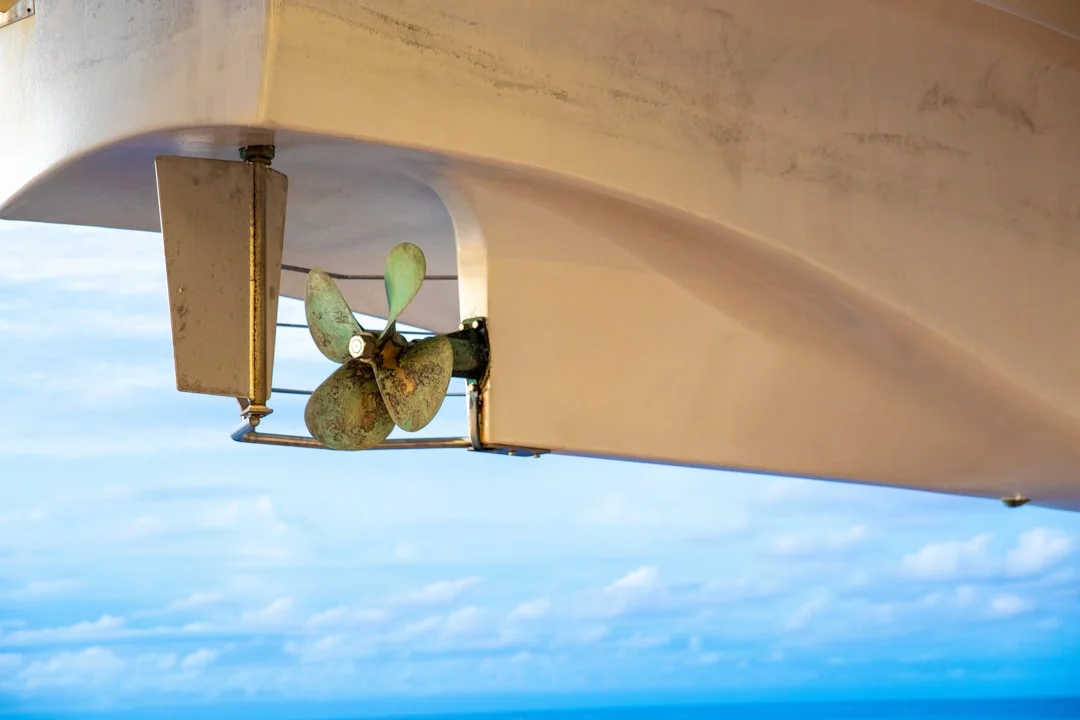
Photo by Vinicius on Unsplash
Docking & Handling: Reverse Bite, Prop Walk, and Stopping
Why reverse differs: blade geometry and engagement
Reverse is where a lot of prop decisions get made—usually right after a stressful docking. Fixed three-blades often deliver the strongest immediate astern bite, which is why they feel confident in tight marinas. Feathering props are often the most predictable in reverse because the blades rotate to a defined pitch rather than relying on a folding mechanism to “decide” it’s time to work.
Folding props vary widely by design, and some are notably weaker astern, especially if the blades don’t open symmetrically at low rpm. That doesn’t make them bad props; it just means you need a different technique. If you routinely med-moor, back into tight slips, or dock in 20+ knots of crosswind, reverse authority is not optional gear.
Prop walk mechanics and mitigation tactics
Prop walk sailboat propeller behavior is influenced by rotation direction, shaft angle, and hull flow—not just blade count. A right-hand prop with noticeable shaft angle often walks the stern to port in reverse; the amount changes with thrust and boat speed. Some feathering props can reduce “surprise walk” because astern thrust comes on more cleanly, while some folding props can feel inconsistent if engagement is delayed.
Mitigation is mostly technique, not hardware. Use short, firm bursts in reverse to build flow over the rudder, then neutral to let the boat carry; don’t sit at a timid 1200 rpm waiting for physics to get motivated. And plan your exit: use prop walk to your advantage when it helps, and don’t fight it when the boat is telling you what it wants.
Two vs three blades for control in crosswind/current
Three blades typically give better low-speed control because you get more thrust at lower rpm, and the prop wash builds sooner over the rudder. In chop or current, that matters: you can maintain steerage without winding the engine up into noisy, smoky territory. For many cruisers, a three-blade folding or feathering prop is the compromise that sails well and handles like a civilized boat under power.
Stopping distance is the safety metric most people ignore until they need it. If your cruising grounds involve crowded harbors, current-swept fuel docks, or short fairways, a prop that delivers reliable crash-stop behavior is worth real money. I’m fond of speed under sail, but I’m fonder of not buying someone else’s topsides.
Photo by Chris Bayer on Unsplash
Costs & Lifecycle: Purchase, Haul-Out, and 5-Year Ownership
Upfront vs installed cost: what owners forget
Prop costs are easy to price; installs are where budgets go to die. A haul-out might run $12–$25/ft plus $10–$25/ft for blocking/lay days, and yard labor is commonly $120–$200/hr. A diver install can be $150–$400 where allowed, but not every prop or fastening setup is a good candidate for underwater work.
Also budget for the “while we’re here” items: shaft zincs ($25–$120 a pair), a saildrive ring anode ($60–$250), and sometimes a cutless bearing or shaft seal inspection. If you’re changing prop types, you may also be changing anode style and consumption rate.
5-year cost comparison (typical scenarios)
Below are realistic cost bands using your anchors, plus common service items like re-pitching ($150–$450) and optional dynamic balancing ($200–$600). Your region and boat size will swing the total more than the prop brand will.
| Prop type | Typical purchase (USD) | Typical install events (5 yrs) | Recurring maintenance (5 yrs) | 5-year total estimate (USD) |
|---|---|---|---|---|
| Fixed 2-blade | $250–$650 | 1 haul-out + 1–2 labor hrs OR diver | Anodes $25–$120/yr; occasional tune | $1,200–$3,200 |
| Fixed 3-blade | $450–$1,000 | 1 haul-out + 1–2 labor hrs OR diver | Anodes $25–$120/yr; possible recondition $150–$450 | $1,400–$3,700 |
| Folding 2-blade | $1,200–$2,200 | 1 haul-out + 2–4 labor hrs | Anodes $25–$120/yr; grease/bushings/pins as needed | $2,400–$5,800 |
| Folding 3-blade | $2,200–$4,200 | 1 haul-out + 2–5 labor hrs | Anodes $25–$120/yr; periodic service parts; balancing $200–$600 optional | $3,700–$8,800 |
| Feathering 3-blade | $2,800–$5,500 | 1 haul-out + 3–6 labor hrs | Anodes $25–$120/yr; greasing/service cycle; occasional rebuild parts | $4,600–$10,800 |
| Saildrive folding (special hub/anode) | $1,800–$3,800 | 1 haul-out + 2–5 labor hrs | Ring anodes $60–$250/yr; correct hub/anode matching | $3,600–$9,500 |
When re-pitching beats replacing
If your boat is close—say you’re missing rated WOT by 150–250 rpm—a re-pitch/recondition service ($150–$450) can be smarter than replacing an otherwise good prop. Dynamic balancing ($200–$600) can also tame vibration if the prop is sound but slightly off, or if a previous strike left it imperfect. Replace when you have structural damage, worn mechanisms on geared props, or when compatibility changes (shaft size/drive type) force your hand.
Practical tip: If the engine can’t reach rated WOT within ~100–200 rpm, fix that first. A “fast” prop that makes the diesel lug is just converting money into soot.
Photo by lucas Favre on Unsplash
Saildrive vs Shaft Drive: Compatibility, Clearance, and Corrosion
Measurement checklist to avoid ordering mistakes
Start with drive type, because it dictates everything else. For a shaft drive, measure shaft diameter (common are 3/4 in, 7/8 in, 1 in, 1-1/8 in) and confirm taper and key dimensions per ISO 4566. For saildrives, you’re often dealing with proprietary splines/hubs and specific anode interfaces, so “close enough” is how you buy two props.
Here’s the checklist I use before anyone orders anything: shaft diameter, taper standard (ISO 4566), key size, thread size/pitch, rotation (RH/LH), gearbox reduction ratio, current prop diameter/pitch, and available aperture dimensions. Add any constraints like a skeg, folding clearance, and rudder proximity. Take photos with a ruler; memory is a liar.
Clearance rules and vibration risk
Prop-to-hull clearance is not a superstition; it’s a vibration and efficiency issue. A common minimum guidance is ≥10% of prop diameter, so a 16 in prop wants at least ~1.6 in tip clearance, and more is better. If you can’t get clearance, you may be forced to reduce diameter and compensate with blade area (more blades) or different geometry.
Saildrives often run ~14–17 in three-blade props, partly because the leg geometry and available space tend to suit them. Shaft drives on similar boats can run similar diameters but are more constrained by aperture shape and shaft angle. If your aperture is tight, a geared prop might physically fit but perform noisily due to disturbed flow.
Anodes, galvanic corrosion, and standards to cite
When you change prop type, you often change metals and fasteners. Many props are manganese bronze or NAB, while folding props frequently add stainless pins and composite (Delrin-type) bushings. Mixed metals aren’t automatically a problem, but they demand disciplined anode selection and monitoring, especially on saildrives where the leg is a corrosion-sensitive assembly.
This is where standards are useful as guardrails. ABYC E-2 addresses cathodic protection practices, and it’s a good reference when diagnosing rapid anode loss or pitting that shows up after a prop change. For shafting practices and general expectations, ABYC P-6 is the right credibility anchor; it won’t choose your prop, but it reinforces that fit, fastening, and alignment are safety-critical.
Do not get creative with saildrive anodes. Use the correct ring anode type and mass ($60–$250 depending on model), and make sure the prop hub design matches the leg’s anode system. If anodes disappear in a month, don’t “upgrade to bigger zinc” blindly—start by checking for stray current and incorrect bonding decisions.
Choosing Between Brands and Setups: Decision Matrix
Cruising vs performance weighting (what to optimize)
Most owners benefit from writing down priorities and giving them weights. Racers care about drag and acceleration; cruisers care about reverse authority, chop thrust, and reliability. Once you score options honestly, the choice usually becomes obvious—and you stop arguing with your wallet.
Here’s a practical scoring matrix (10 = best) for the three prop families, assuming a typical 30–45 ft cruiser with ~20–40 hp and a realistic mix of sailing and motoring.
| Option | Sailing drag (10=least) | Reverse authority | Thrust in chop | Maintenance simplicity | Typical cost band |
|---|---|---|---|---|---|
| Fixed (2–3 blade) | 3–5 | 7–9 (3-blade higher) | 6–9 | 9 | $ |
| Folding (2–3 blade) | 8–10 | 4–7 | 6–9 (3-blade higher) | 6–7 | $$–$$$ |
| Feathering (3 blade common) | 8–10 | 7–9 | 7–9 | 5–7 | $$$ |
Brand comparison considerations: Max-Prop vs Flexofold vs Gori
Brand choice is less about hype and more about mechanism, serviceability, and support where you cruise. When sailors ask me about Max-Prop vs Flexofold vs Gori, I ask where they haul out, who services props locally, and whether they need strong reverse for tight marinas. Then we talk about blade area, anode design, and how easy it is to adjust pitch or service bushings.
| Brand family (examples) | Drag under sail | Reverse behavior | Chop thrust | Maintenance/serviceability | Typical cost band |
|---|---|---|---|---|---|
| Max-Prop (feathering) | 9 | 8–9 | 8 | Moderate complexity; periodic service | $$$ |
| Flexofold (folding) | 9–10 | 5–7 | 7–9 (3-blade strong) | Generally straightforward; inspect pins/bushings | $$–$$$ |
| Gori (folding) | 9–10 | 5–7 | 7–9 | Mechanism-specific; ensure parts/support | $$–$$$ |
Typical setups that work in the real world
For many 30–35 ft boats with ~20–30 hp, a two-blade folding prop is often the “sailing first” choice—if reverse demands are modest. For 36–45 ft cruisers with ~30–40 hp, a three blade folding propeller or a three-blade feathering prop is frequently the best all-around setup, because it keeps thrust and control in chop without dragging like a fixed three-blade.
If you prioritize sailing speed and light-air feel, folding usually wins. If you prioritize predictable reverse and close-quarters confidence, feathering often earns its price. If you prioritize simplicity and low purchase cost, fixed props remain valid—just don’t pretend they’re not a handbrake under sail.
Frequently Asked Questions
For a 1 in ISO 4566 tapered shaft, what measurements (taper length, key size, thread) must match exactly to avoid hub fretting or poor seating on a new folding propeller sailboat installation?
For an ISO 4566 tapered shaft, you must match shaft diameter, taper specification/length, key width and height, and thread diameter/pitch for the prop nut. The hub must seat fully on the taper with correct key fit; a “nearly right” taper is how you get fretting, poor torque transfer, and eventually a loose prop. Also confirm the correct locking method (cotter pin or tab washer) and torque procedure per the prop maker’s instructions.
How do you confirm over-propping using sea-trial data—what WOT RPM shortfall (>200 RPM), exhaust smoke signature, and cruise-RPM behavior indicate excessive pitch or diameter?
If you’re more than >200 rpm below rated WOT under full load, you should suspect over-propping. Typical symptoms include sluggish acceleration, visible black smoke when you add throttle, and an inability to hold normal cruise rpm (often 70–85% of rated) when pushing into chop—rpm sags and soot builds. Confirm with an rpm-vs-speed curve in both directions; if speed gains flatten early while rpm stalls, loading is likely excessive.
On a saildrive propeller folding setup, how do you select the correct anode type and mass, and what symptoms (rapid anode loss, pitting) suggest galvanic corrosion issues per ABYC E-2 practices?
Use the saildrive manufacturer-approved ring anode type and ensure it matches the prop hub/anode interface; saildrives aren’t tolerant of improvisation. If you see rapid anode loss (weeks, not months), pitting on the leg or prop hardware, or a sudden change after a prop swap, treat it as a corrosion problem, not an anode brand problem. ABYC E-2 points you toward checking bonding, marina electrical environment, and stray current sources before you start changing metals and hoping.
What test conditions and GPS averaging method best isolate propeller drag under sail (locked vs freewheeling shaft, same TWA/TWS band), and how should results be normalized across runs?
Use the same sail plan and hold a steady wind band, then run 2-minute stabilized legs on both tacks, recording SOG/COG and ideally TWA/TWS. Do 3 cycles, average port and starboard tack results to reduce current effects, and keep shaft state consistent—locked or freewheeling exactly the same each run per gearbox guidance. Normalize by comparing average speed at similar TWA/TWS, not by cherry-picking your best surf.
How do blade count and prop type affect reverse walk on a shaft-drive boat with noticeable shaft angle—what handling drills reduce prop walk during tight fairway backing?
Prop walk comes primarily from rotation direction and shaft angle, with blade count and prop type influencing how abruptly thrust comes on. Three blades often give more immediate thrust, which can make walk feel stronger, while feathering props can feel more predictable because astern pitch is controlled. The best drills are: practice short, firm reverse bursts to build rudder flow, return to neutral to let the boat carry, and rehearse using walk intentionally to swing the stern—because fighting it continuously is how you run out of fairway.
Practical selection flow (the one that saves money): confirm drive type and clearance (aim ≥10% diameter tip clearance), decide what matters most (drag vs reverse vs chop thrust), size to hit rated WOT within ~100–200 rpm, then validate with a structured sea trial. Budget the real costs—haul-out, labor, anodes, and a service cycle—over 5 years, not just the prop price tag. And if you’re still unsure on passage timing impacts, plan your route using a sea distance calculator so the decision ties back to the way you actually cruise.
About the Author
Related Articles

Bahamian Moor Guide: Tandem Anchors & Snubbers
Learn bahamian moor setup, tandem anchoring, and proper snubbers for crowded anchorages. Get step-by-step tips—read and rig it right.
By Breezada Team
Best Radar Reflector for Sailboat: Active vs Passive
Compare active vs passive radar reflectors for sailboats, mounting tips, and real-world results. Choose the best radar reflector—read now.
By Breezada Team

Sail Trim for Beginners: Main + Jib Cruising Guide
Learn sail trim for beginners with simple main + jib settings, telltales, twist, traveler & vang. Get quick wind-based trims—read now.
By Breezada Team
Sailboat Bimini Guide: Dodger & Enclosure Choices
Learn how to choose a sailboat bimini, dodger & cockpit enclosure—materials, fit, costs, and DIY vs pro. Get the right setup today.
By Breezada Team