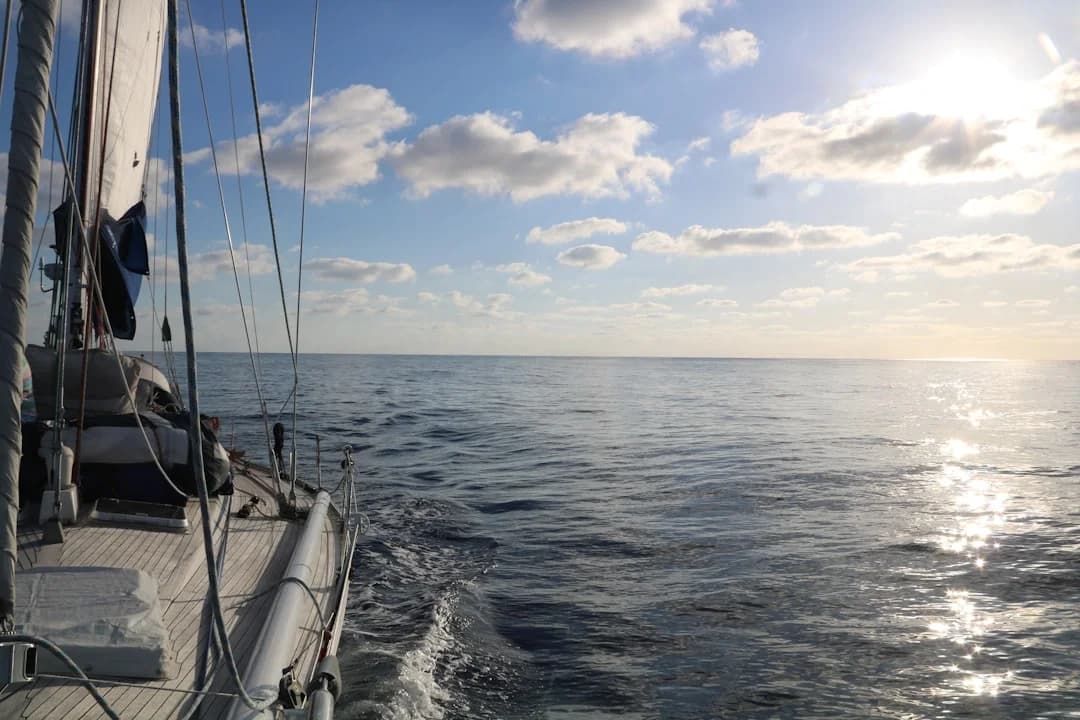
The monohull vs catamaran debate is one of sailing's longest-running arguments — and one where the honest answer is "it depends." Both designs are proven bluewater platforms. Both have circumnavigated the globe. The right choice comes down to how you sail, where you sail, and what trade-offs you're willing to accept.
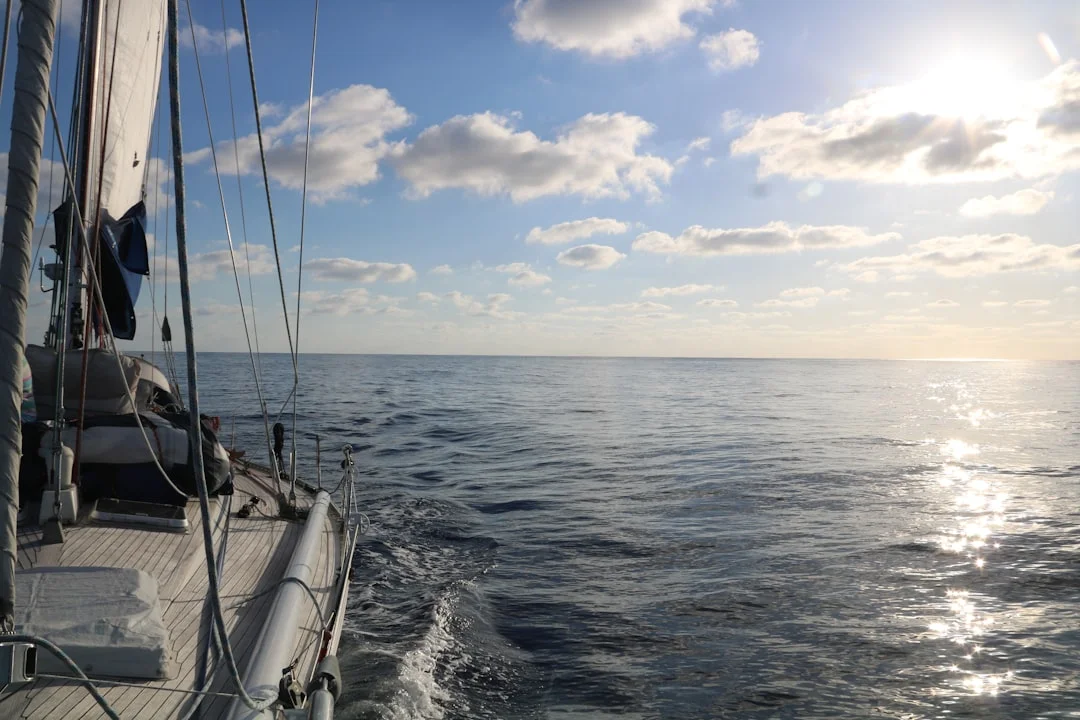
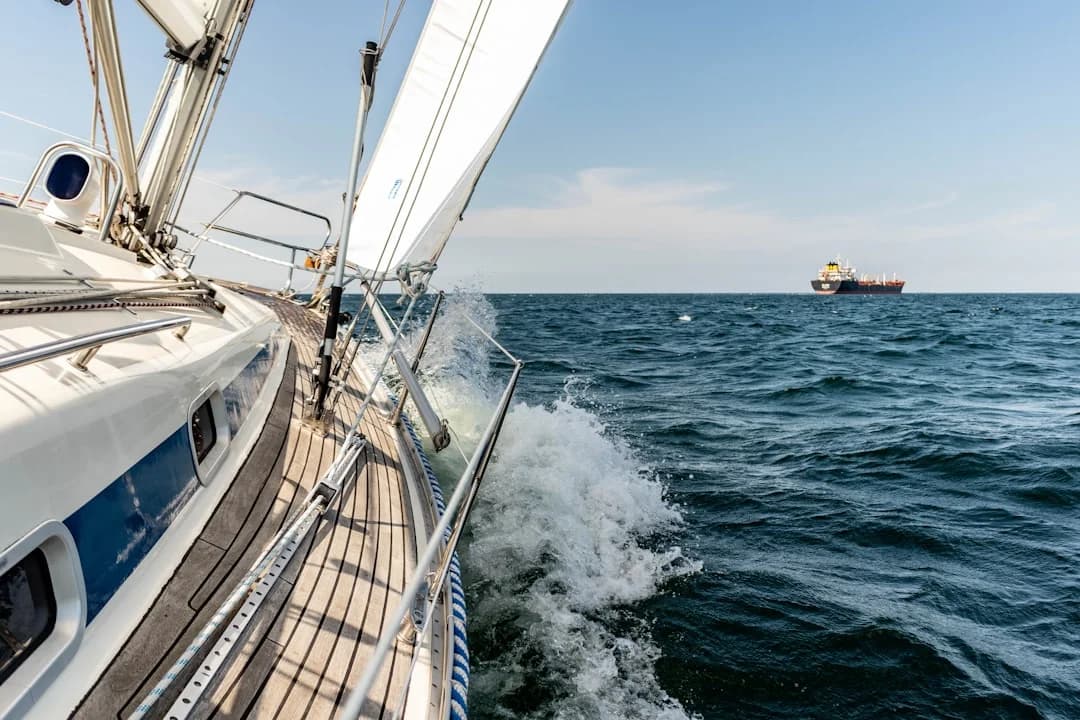
A monohull in its element — heeled over and driving hard on a beam reach
The Fundamental Design Difference
A monohull has one hull. A catamaran has two. That sounds obvious, but everything else flows from this single fact.
A monohull achieves stability through a heavy keel — a lead or iron ballast bolted to the bottom of the boat, typically weighing 30-45% of the total displacement. When the wind pushes the boat over, the keel's weight pulls it back upright. This is called positive stability, and it works through a wide range of heel angles. A well-designed monohull can be knocked flat and will right itself.
A catamaran achieves stability through beam — the wide distance between its two hulls. A 40-foot catamaran might be 22 feet wide, compared to 13 feet for a monohull of the same length. This beam provides enormous initial stability: the boat sits flat and resists heeling. But unlike a monohull, if a catamaran is pushed past its stability limit, it can capsize and will not self-right. This is the design's most significant vulnerability, and anyone considering a cat needs to understand it clearly.
In practice, modern cruising catamarans with their conservative sail plans and high bridgedeck clearance are extremely difficult to capsize. It takes a genuinely extreme event — a breaking wave in a storm, or a catastrophic sail handling mistake. But the physics remain: a monohull forgives mistakes that a catamaran does not.
Sailing Performance
Monohull Performance
Monohulls sail closer to the wind. A typical cruising monohull can point 35-40 degrees off the true wind, while most cruising catamarans struggle below 45-50 degrees. This matters more than casual sailors realize — when your destination is upwind, a monohull's ability to point higher translates into fewer tacks and a shorter sailed distance.
Monohulls also perform better in light air relative to their size. The keel acts as a lifting foil that reduces leeway, and the narrower hull generates less drag at slow speeds. In the 3-8 knot wind range, a monohull will often keep moving when a catamaran sits dead in the water, too heavy to accelerate in the puffs.
The heel, though — that's the trade-off. Monohulls sail at 15-25 degrees of heel in moderate conditions. Everything on the boat tilts. Cooking becomes an exercise in one-handed balance. Sleeping on the leeward side means being pressed against the hull; sleeping on the windward side means gravity pulling you out of the bunk. Crew who are new to sailing often find sustained heeling exhausting and disorienting.
Catamaran Performance
Catamarans are faster on a reach and downwind. Their low wetted surface area and wide beam let them surf swells that a monohull would just wallow through. On a broad reach in 15-20 knots of wind, a 40-foot cruising cat will typically make 8-9 knots where a similar monohull makes 6-7 knots.
The flat sailing is the catamaran's killer feature for cruising comfort. No heel means normal life aboard. You cook on a level stove, sleep in a level bunk, and walk around without grabbing handholds. For families with young children or crews who include non-sailors, this is often the decisive factor.
But catamarans pay a price in heavy weather. Their high windage (from the bridgedeck, wide beam, and typically larger superstructure) makes them harder to handle in strong winds. They hobby-horse in steep, short seas. And when sailing upwind in 20+ knots, the windward hull can slam into waves with alarming force — a motion that's both uncomfortable and hard on the structure.
You can calculate the distance between ports to compare how the upwind angle difference affects real route planning. On a 500 nm passage with significant upwind work, a monohull might sail 550 nm while the catamaran sails 620 nm — a meaningful difference in time and fuel.
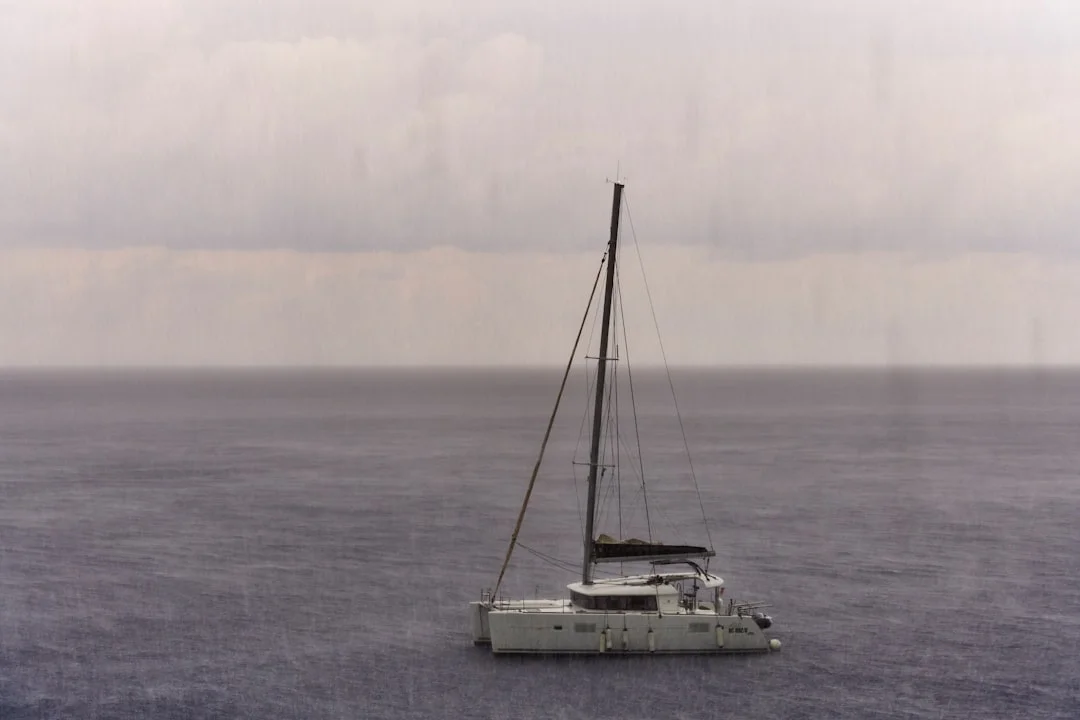
A catamaran's wide beam provides stability but increases windage in rough conditions
Living Space and Comfort
This is where catamarans pull decisively ahead. A 40-foot catamaran offers roughly the same living space as a 50-55 foot monohull. The numbers are striking:
| Feature | 40 ft Monohull | 40 ft Catamaran |
|---|---|---|
| Beam | 12-13 ft | 21-24 ft |
| Interior volume | ~350 sq ft | ~600 sq ft |
| Cabins | 2-3 | 3-4 |
| Heads | 1-2 | 2-4 |
| Saloon headroom | 6'2"-6'4" | 6'4"-6'8" |
| Cockpit area | ~50 sq ft | ~100 sq ft |
| Bridgedeck / aft deck | N/A | ~80 sq ft |
The catamaran's two hulls create naturally separated private spaces. Port hull for the owners, starboard for guests — each with their own head and shower. For charter operations, this layout is ideal. It's one reason the charter industry is now overwhelmingly catamaran-based.
Monohulls have a cozier, more "boat-like" interior. The saloon wraps around a central table with settees on both sides. Storage is tucked into every available space. Some sailors prefer this compact efficiency — everything is within arm's reach, and the boat feels like a proper vessel rather than a floating apartment.
For long-term liveaboard cruising, space often wins. If you're weighing the realities of living aboard, our honest breakdown of liveaboard pros, cons, and costs covers what daily life actually looks like — and a catamaran's extra square footage makes a real difference when the boat is your only home.
Draft and Anchoring
Catamarans draw dramatically less water. A 40-foot cruising catamaran typically draws 3.5-4.5 feet, compared to 5.5-7 feet for a monohull of similar size (more with a fin keel). This opens up hundreds of anchorages, gunkoles, and shallow lagoons that monohulls simply cannot reach.
In the Bahamas, where much of the best cruising is in 5-8 feet of water, a shallow-draft catamaran is the obvious choice. In the reef-studded waters of the South Pacific, the ability to slip into a lagoon where monohulls anchor outside is a genuine safety and comfort advantage.
The trade-off: many older marinas and mooring fields were designed for monohulls. A 24-foot-wide catamaran pays double slip fees (if they can accommodate it at all), and raft-up situations that monohulls handle easily are impossible for cats. In the Mediterranean, where Med mooring stern-to in tight harbors is standard, catamarans can be awkward to maneuver and expensive to berth.
Anchoring itself differs too. Monohulls sit quietly on a single anchor, swinging in a predictable arc. Catamarans, with their high windage, can sail around their anchor in shifting conditions — sometimes dramatically. Many cat owners use a bridle (a V-shaped line from both bows to the anchor chain) to reduce this behavior. For more on anchoring technique, including scope calculations and overnight tips, see our complete anchoring guide.

The heel is part of the appeal for monohull sailors — and the main complaint for everyone else
Cost Comparison
Catamarans cost more. At every stage.
| Cost Category | 40 ft Monohull | 40 ft Catamaran |
|---|---|---|
| New purchase | $250,000-450,000 | $400,000-750,000 |
| Used (10 yr old) | $120,000-220,000 | $250,000-450,000 |
| Annual insurance | $2,000-4,000 | $3,500-7,000 |
| Haulout | $800-1,500 | $2,000-4,500 |
| Marina slip | $500-1,200/mo | $800-2,400/mo |
| Bottom paint | $1,500-3,000 | $2,500-5,000 |
| Antifouling | Single hull | Two hulls + bridgedeck |
A comparable catamaran typically costs 60-80% more to buy and 40-60% more to maintain than a monohull. The two-hull design means two of everything: two engines, two saildrives, two rudders, two sets of through-hulls. When something breaks — and something always breaks — you're maintaining duplicate systems.
Fuel efficiency is closer than many assume. While catamarans have less drag under sail, they also carry more weight and have more windage when motoring. In flat calm, a catamaran motoring at 7 knots burns roughly the same fuel as a monohull at the same speed — sometimes slightly less, sometimes slightly more, depending on displacement and hull form.
Charter revenue, however, tips the economics. A catamaran earns significantly more on the charter market than a monohull. If you plan to offset ownership costs through chartering when you're not aboard, a catamaran is the better investment. Charterers overwhelmingly prefer cats — the space, the stability, and the multiple private cabins command premium rates.
Safety at Sea
Both designs are safe when sailed within their limits. The safety argument is more nuanced than partisans on either side admit.
Monohull safety advantages:
- Self-righting after knockdown (the keel brings it back)
- Lower windage reduces risk of being overpowered
- Better upwind performance for clawing off a lee shore
- Proven in every ocean condition imaginable
- Smaller profile means less load on ground tackle in storms
Catamaran safety advantages:
- Extremely difficult to capsize in normal conditions
- If holed, the second hull provides flotation — a cat rarely sinks
- Wider platform is more stable for crew movement on deck
- Less heeling means fewer falls and injuries aboard
- Higher bridgedeck clearance keeps the boat drier
The statistical reality: both types occasionally get into serious trouble, and in nearly every case, the root cause is human error — poor weather decisions, inadequate seamanship, or structural failure from deferred maintenance. The hull configuration is far less important than the quality of the crew's judgment.
For offshore passages, use Breezada's sea distance calculator to plan your waypoints, and choose your weather windows carefully regardless of which hull type you're sailing.
Which Is Better for Your Sailing Style?
Choose a Monohull If You:
- Love the feel of a boat heeled and driving under sail
- Sail primarily upwind or in variable conditions
- Cruise in areas with tight marinas (Med, Northern Europe)
- Have a tighter budget
- Value self-righting capability for offshore work
- Enjoy racing or want performance under sail
- Prefer a single-engine, simpler system
Choose a Catamaran If You:
- Prioritize comfort and space aboard
- Sail with families, children, or non-sailors
- Cruise in shallow waters (Bahamas, Pacific atolls, Caribbean)
- Plan to charter the boat for income
- Hate heeling — genuinely hate it, not just find it inconvenient
- Want to entertain guests or liveaboard long-term
- Need to carry significant gear, water toys, or provisions
Consider a Trimaran If You:
For those who want catamaran-like stability with closer-to-monohull performance, trimarans occupy an interesting middle ground. The NEEL and Dragonfly ranges offer folding or fixed-beam designs that point better than cats and heel less than monohulls. They're niche, but growing.
At anchor in a calm bay, the monohull vs catamaran debate fades — both are where they belong
The Conversion Factor
Here's something nobody talks about in comparison articles: many experienced sailors start on monohulls and switch to catamarans in their 50s and 60s. Their knees can't take the heel anymore. Their partners are tired of bruised shins and tilted cooking. They want space for grandchildren. The catamaran isn't a compromise for these sailors — it's an upgrade that lets them keep sailing when a monohull would have pushed them ashore.
The reverse conversion happens too, though less often. Catamaran owners who catch the offshore racing bug, or who want to sail hard upwind in the Roaring Forties, or who simply miss the visceral connection of a heeled boat carving through waves — they go back to monohulls.
Neither direction is a downgrade. They're different boats for different phases of life and different sailing ambitions.
The Market Reality
The used boat market tells an interesting story. Ten years ago, the global cruising fleet was roughly 85% monohull. Today, new boat sales are closer to 50/50 in the 38-50 foot cruising range, and catamaran production is growing faster. Charter fleets are now 70-80% catamaran.
This shift affects resale value. Good used catamarans (Lagoon 400/450, Leopard 45, Fountaine Pajot Elba 45) hold their value better than comparable monohulls because demand outstrips supply. If you can check the distances between popular cruising grounds, you'll notice the routes favored by the charter fleets — Caribbean, Mediterranean, Southeast Asia — are all areas where catamarans excel: warm water, moderate winds, plenty of anchorages.
Monohulls offer far more choice on the used market, especially in the $100,000-250,000 range. A well-maintained Hallberg-Rassy 40, Amel Super Maramu, or Oyster 435 represents exceptional value — proven offshore designs with decades of ocean miles behind them. Finding a comparable quality catamaran at that price point is nearly impossible.

Mixed fleet at anchor — monohulls and catamarans coexisting peacefully, as they always have
The Honest Bottom Line
If someone puts a gun to my head and forces a recommendation, here it is: for coastal cruising and chartering, get a catamaran. For offshore sailing and circumnavigation on a budget, get a monohull.
But the real answer is to sail both before you buy. Charter a catamaran for a week in the BVI, or try both hull types on a yacht charter in Greece where the Cyclades winds will test any rig. Then charter a monohull in the same area. Pay attention to what bothers you and what delights you. The theoretical arguments fade quickly when you're actually living aboard. For inspiration on where to test either hull type, our guide to the best sailing routes in the world covers top cruising grounds from the Caribbean to the Pacific.
The worst mistake is buying a boat type because an internet forum convinced you it's objectively superior. There is no objectively superior hull form. There is only the boat that fits your sailing, your body, your crew, and your budget. Everything else is just tribalism with nautical vocabulary.
Frequently Asked Questions
Is a catamaran safer than a monohull?
Neither is inherently safer. Monohulls self-right after knockdowns, making them more forgiving in extreme conditions. Catamarans are nearly impossible to capsize in normal sailing and provide secondary flotation if one hull is breached. The biggest safety factor is crew competence, not hull type. Statistical analysis of offshore incidents shows no meaningful difference in serious casualty rates between well-maintained monohulls and catamarans sailed by experienced crews.
Can a catamaran cross an ocean?
Absolutely. Catamarans regularly cross the Atlantic (the ARC rally typically includes 20-30% catamarans) and circumnavigate the globe. The Lagoon 450, Leopard 45, and Fountaine Pajot Helia 44 have all completed multiple ocean crossings. The key is choosing a bluewater-capable design with adequate bridgedeck clearance (at least 24 inches), strong structural engineering, and conservative sail plans — not every production catamaran is built for open ocean.
How much more does a catamaran cost than a monohull?
Expect to pay 60-80% more for a new catamaran compared to a monohull of similar length and quality. A new 40-foot monohull runs $250,000-450,000; a comparable catamaran costs $400,000-750,000. Ongoing costs are 40-60% higher due to double engines, wider haul-out facilities, double slip fees, and more bottom paint. The gap narrows somewhat on the used market, but quality used catamarans are in high demand and hold value well.
Do catamarans sail well upwind?
Modern cruising catamarans sail adequately upwind, but they cannot match monohulls. A typical cruising cat points 45-50 degrees off the wind versus 35-40 degrees for a monohull. In practice, this means more tacking and longer sailed distances when the destination is dead ahead. Performance catamarans with daggerboards (like the Outremer range) close this gap significantly but at higher cost and complexity.
Which is better for liveaboard cruising?
For most liveaboard couples and families, a catamaran offers a better quality of daily life — more space, level living, separation between private and social areas, and shallow draft for tucking into quiet anchorages. However, monohulls are significantly cheaper to buy and maintain, which matters enormously when the boat is your only home. Many successful liveaboards choose well-found monohulls in the 38-45 foot range and use the savings for a larger cruising fund.
About the Author
Related Articles
Sailboat Bimini Guide: Dodger & Enclosure Choices
Learn how to choose a sailboat bimini, dodger & cockpit enclosure—materials, fit, costs, and DIY vs pro. Get the right setup today.
By Breezada Team
Code Zero vs Genoa: Jib & Spinnaker Guide
Compare Code Zero vs genoa, jib, and spinnaker by wind range and angle. Choose the right headsail for your boat—read the guide now.
By Breezada Team
Starlink Mini on a Boat: Plans, Power & Offshore Use
Learn Starlink Mini on a boat—plans, power draw, and offshore performance. Compare Roam vs Mobile Priority and get setup tips. Read now.
By Breezada Team
Boat Courtesy Flag & Q Flag Etiquette for Yachts
Learn boat courtesy flag and Q flag etiquette for yachts—what to fly, where to hoist it, and common mistakes. Get the checklist before landfall.
By Breezada Team