Sailing Through a Lock: Lines, Fenders, Fees, Crew
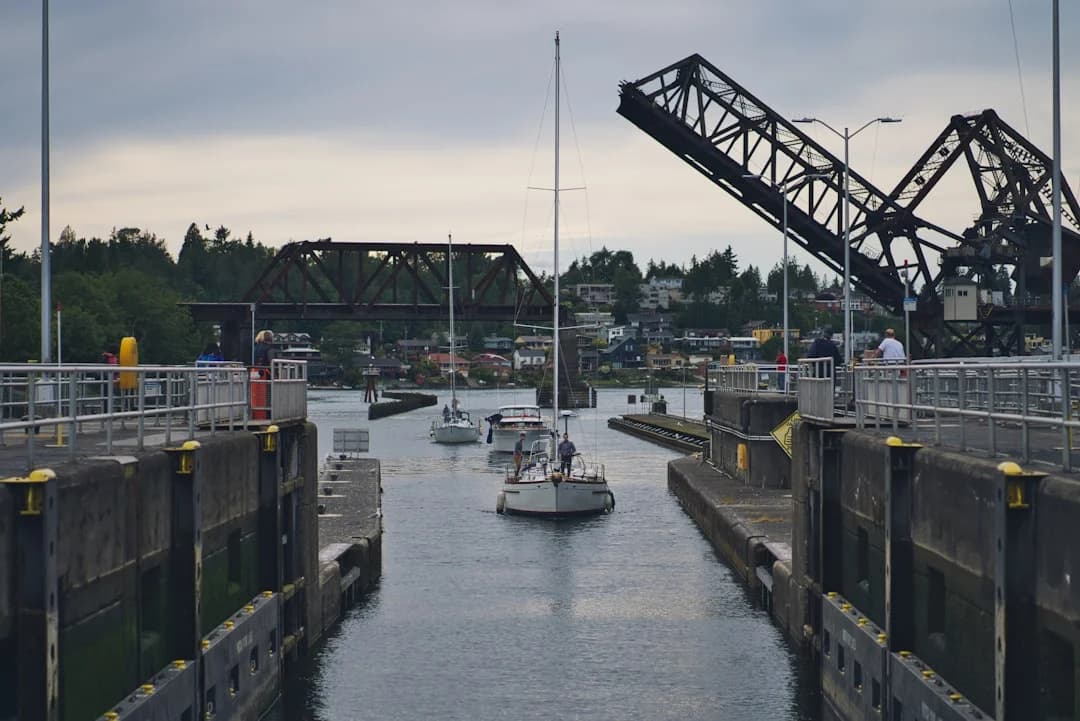
Lock transits look tame from the cockpit until the gates close and the water starts moving. Then you learn the real lesson: sailing through a lock is not sailing at all. It’s a controlled mooring evolution in a concrete box, with surge, prop wash, and hardware that will punish sloppy line handling.
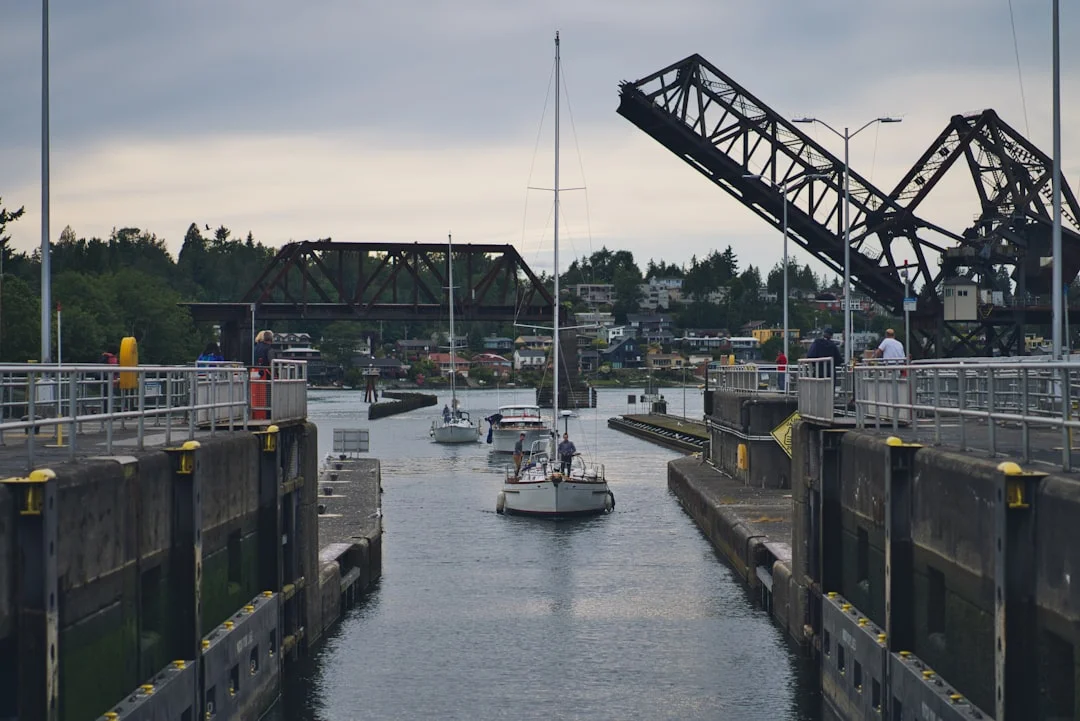
Photo by Doctor Tinieblas on Unsplash
Lock Basics: What Changes in Panama vs Europe
Chamber geometry, lift height, and where loads come from
Think of a lock as a short, high-load berth where the “dock” rises or falls under you. Your loads come from fore-and-aft surge, not from steady sideways pressure, and that surge is driven by filling/emptying flows and other boats’ prop wash. In Europe, many small-yacht locks lift only 2–5 m, which tempts crews to be casual, until a line snatches and somebody gets burned.
Panama is a different scale of problem, even for a small sailboat. The Canal’s Neopanamax system handles a total elevation change of about 26 m (≈85 ft) between ocean level and Gatun Lake. Even if you’re not in a Neopanamax chamber, the hydraulic forces around big infrastructure are real, and your 40-footer is still just a cork in a bathtub.
Floating bollards vs fixed bollards and lock-side fittings
European canals often give you fixed bollards, cables, or slimy ladder rungs that force active line tending as the boat changes level. That means someone is easing or taking up every meter, and chafe points migrate as the lead angle shifts. In Panama, small craft may use lock-side fittings and procedures assigned by the authority; sometimes that includes raft-ups depending on policy and traffic, which changes the game from “boat-to-wall” to “boat-to-boat with wall contact.”
Bollard type dictates technique. Floating bollards are the closest thing to civilized: your line can slide up and down with the bollard, so you’re controlling fore-aft motion rather than continuously re-leading. Fixed points demand constant attention, and if your crew is slow by even 10–20 seconds during a rapid level change, you can end up high and tight—or low and hung up.
Turbulence zones: fill/empty ports, prop wash, and surge
Most “mystery slams” happen in predictable places: near the culverts/ports where the chamber fills or empties, and near the stern of anything running a lot of throttle. In larger river locks—especially lifts over 10 m—surge can build and rebound off the walls like a badly designed swimming pool. If your springs aren’t doing real work, your bow will hunt forward, then snap back, and your cleats will feel it.
This is why lock rules are blunt: engine ready, steering engaged, sails down and secured. You want instant response, because a half-second of gentle thrust often prevents a full-on line snatch. The lock doesn’t care about your gelcoat, and the lock wall always wins.
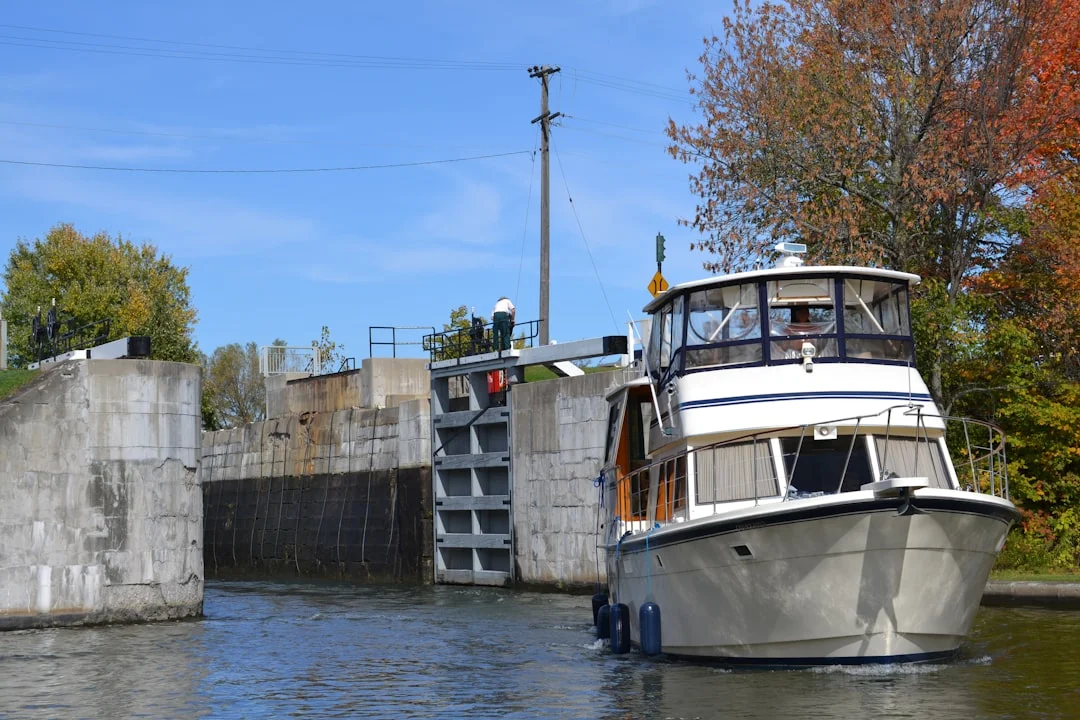
Photo by Larry Farr on Unsplash
Pre-Lock Preparation Checklist (Boat, Gear, Comms)
Deck safety, stowage, and ‘nothing overboard’ discipline
Before the approach, get religious about stowage. Dinghy painter secured, loose sheets contained, boathook lanyarded, and no “temporary” coils that can roll underfoot. In a lock, a dropped line can reach the prop in seconds, and then your day gets expensive and public.
Dress like you expect lines under load, because you should. Heavy-duty gloves, PFDs, and closed-toe shoes are non-negotiable; line burns can happen in seconds, especially with polyester under tension. I also want one sharp knife or line-cutter on deck where hands can reach it fast, not buried under a companionway avalanche.
Engine, electrics, and thruster readiness (ABYC/ISO framing)
Lock work is repeated low-speed maneuvering, which is hard on cooling and electrics. Warm the engine, confirm cooling flow, and verify crisp response from idle to ahead/astern; you’ll use “idle ahead” and “neutral” a dozen times in a single cycle. If you have a bow thruster, remember it’s a high-current machine—ABYC E-11 logic applies: you need battery reserve and sound connections, not hope and corroded lugs.
On the hardware side, lock lines belong on proper strong points. ABYC H-40 and ISO 15084 exist for a reason: cleats and chocks are designed for mooring loads, lifeline stanchions are not. If your best lead requires tying to something that wiggles when you kick it, you’re about to learn how stainless bends.
VHF and procedures: calling locks and receiving instructions
Set comms early and keep them boring. A fixed-mount VHF at the helm is ideal, with a handheld backup charged and clipped where it won’t skate across the cockpit. In many European waterways, lock/bridge working channels are commonly Ch 22 or Ch 20, but the actual channel varies—use almanacs, notices, and signage, then stick to listening discipline.
In Panama, communications run through established traffic procedures and assigned resources, and you follow instructions as given. Don’t freelance; the lock operator sees the whole chamber and you see your pulpit. Read back critical instructions, especially side assignment, entry order, and when to cast off.
Assigning roles and rehearsing commands before the approach
Do a one-minute brief every time, even with a seasoned crew. Assign helm/engine, bow handler, stern handler, and a floater for fenders/chafe/comms, and confirm who touches what line. Rehearse three commands you will actually use: “Neutral,” “Ahead idle,” and “Hold bow,” plus what “ease 1 m” looks like on your boat.
People get hurt when two crew act on one line with different assumptions. Closed-loop comms—order, repeat-back, execution—stops that. It also stops the classic lock argument: “I thought you meant the other line.”
Practical tip: Rig fenders and lines 10–15 minutes before arrival, not at the mouth of the chamber. The approach is for driving and listening, not for interpretive dance with a fender pump.
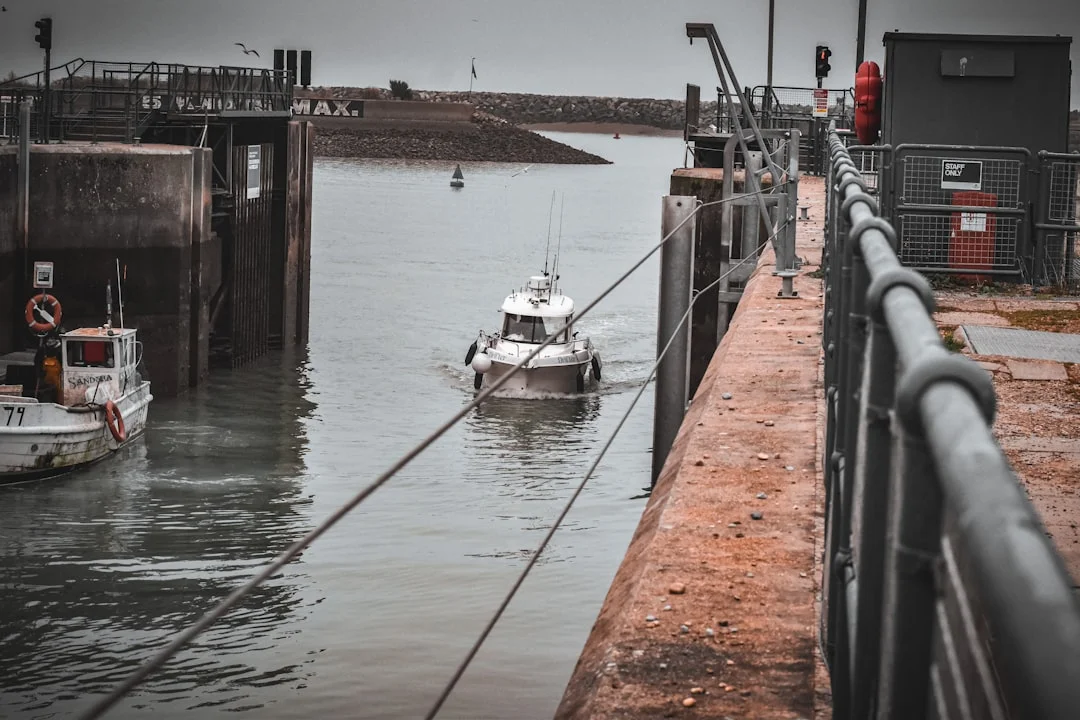
Photo by elliott on Unsplash
Lock Lines: Diameters, Lengths, Knots, Chafe Control
What lines to carry for 30/40/50 ft yachts
For most cruising boats, polyester double braid is the lock-line workhorse: good grip, predictable stretch, and it behaves around cleats without turning into a wire saw. As a baseline, I like 12–14 mm (≈1/2–9/16 in) for 30–40 ft yachts, and 14–16 mm (≈9/16–5/8 in) for 40–50 ft. That’s thick enough to hold and thin enough to handle when wet and angry.
Length matters more than people admit. A minimum practical lock line is 20–30 m (65–100 ft), but for high-lift locks or rafting flexibility, 35–50 m (115–165 ft) per line prevents frantic re-reeving. If you’re budgeting, polyester double braid runs about $5–$13 per meter, depending on brand and construction.
Here’s a practical “lock kit” sizing table that matches what I see work on real boats. It’s not sacred, but it will keep you out of the under-gunned category.
| Boat LOA | Recommended diameter (polyester double braid) | Useful length per line | Notes |
|---|---|---|---|
| 30–40 ft | 12–14 mm | 20–30 m | Add 1–2 longer lines if locks exceed 10 m |
| 40–50 ft | 14–16 mm | 35–50 m | Longer lines reduce re-leading during surge/rafts |
| 50+ ft | 16 mm+ (case-by-case) | 50 m+ | Often benefits from dedicated spring sets |
Rigging method by bollard type (floating vs fixed)
With floating bollards, the goal is simple: one long line led cleanly from a strong midship point so it can rise and fall without binding. Put a round turn on the bollard and manage the tail on deck; you’re controlling fore-aft position, not “tying the boat to the wall.” If you cleat it off like a dock line and walk away, it’ll choose the worst possible moment to load up.
With fixed bollards or cables, you must tend continuously as level changes. That means easing in small increments—0.5–1 m at a time—keeping enough tension to control drift, but never so much you can’t adjust quickly. When the lead angle gets ugly, re-lead early, not late, and add chafe protection before the line starts smoking.
Spring lines and fore-aft control under turbulence
Springs are your shock absorbers. A forward spring (from midship/aft leading forward) prevents the bow surging ahead; an aft spring prevents sliding back toward the gate. In turbulent locks, I’d rather have two good springs than four mediocre breast lines, because surge is what breaks things and bruises ribs.
Your engine is part of the spring system. Short bursts at idle ahead or astern take inertia off the lines, especially when a neighbor’s prop wash hits. If the boat is moving, don’t “hold harder”—use thrust to stop motion gently, then let the line resume steady load.
Chafe gear placement: fairleads, cleats, and sliding contact
Chafe is an engineering problem: abrasion plus heat plus changing angles over meters of rise/fall. Put chafe gear where the line moves—at fairleads/chocks and at any point where the line slides around a cleat or rubs concrete. Leather, reinforced hose, and tubular webbing sleeves all work; pick what stays put under motion, not what looks tidy at the dock.
Don’t throw heavy hardware at lock staff. Use a monkey’s fist or light heaving line to pass a messenger, then send the real line up or down under control. And when securing, favor a round turn + two half-hitches on a post when appropriate; avoid riding turns that can lock up when a load spikes.
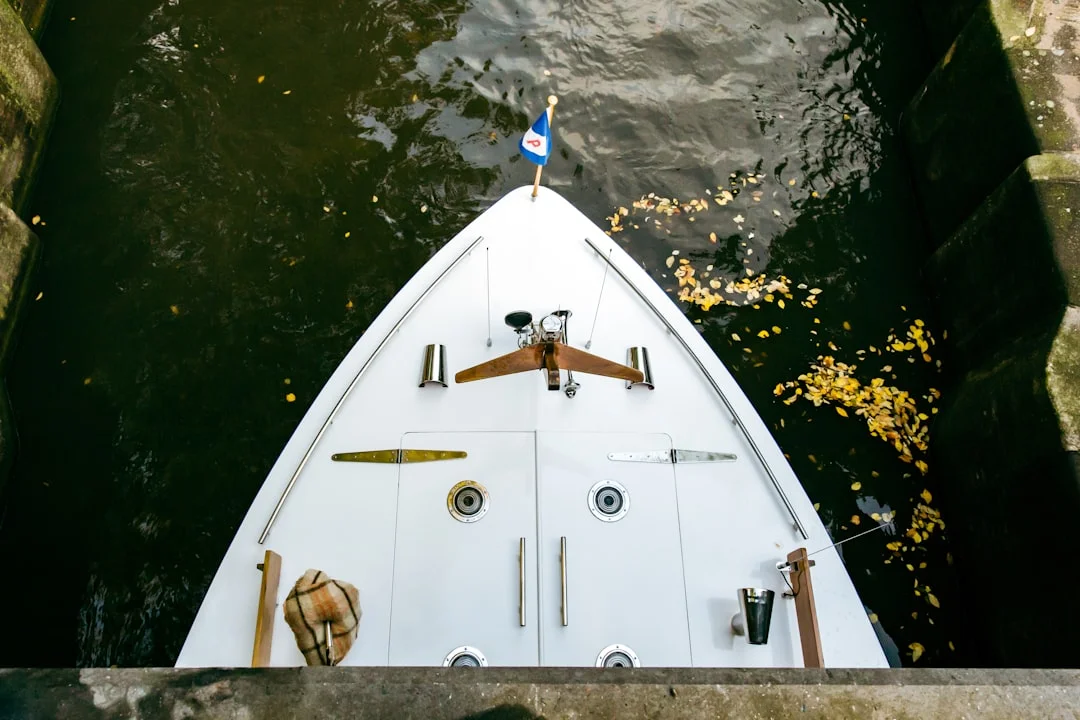
Photo by Frank Leuderalbert on Unsplash
Fenders for Lock Walls and Raft-Ups (Sizes & Placement)
Minimum vs robust fender inventories for locks
Locks punish small fenders. Rough concrete, seams, and protrusions can climb a soft fender and pin your topsides right where the rubrail ends. As a rule of thumb, carry at least 6–10 cylindrical fenders plus 1–2 ball fenders for lock work; for rafting or abrasive walls, I’m happier with 8–12+ total plus a board.
Size matters more than brand labels. Typical cylindrical sizing that actually works: 15 × 56 cm (6 × 22 in) for 25–30 ft, 20 × 76 cm (8 × 30 in) for 30–40 ft, and 25 × 81 cm (10 × 32 in) for 40–50 ft. For ball fenders, think 38–56 cm (15–22 in) diameter when you need something that won’t squirt out under pressure.
Placement by hull shape, freeboard, and wall roughness
Prioritize the working side, and build a “sacrificial” vertical line near max beam and the aft quarter. On fin-keel monohulls, the aft quarter is where prop wash and turbulence shove you sideways, so a big cylinder there saves gelcoat and dignity. High-freeboard boats need higher leads; low-freeboard boats need protection nearer the toerail where the wall meets wavelets and rebound.
Plan to adjust continuously. As the boat rises or falls 2–5 m (or more), fenders compress differently and their contact patch moves. The floater’s job is to slide, re-tie, and re-space—if they’re standing still, they’re missing something.
Fender boards/planks for abrasive surfaces and rafting
A fender board spreads load over a longer area and bridges rough surfaces. In locks with abrasive concrete, I consider a board mandatory when you see exposed aggregate, ladder edges, or heavy scuff marks at the waterline. If you’re rafting, a board also reduces point loading between boats when you surge fore and aft.
Budget-wise, boards aren’t a financial catastrophe. DIY is typically $40–$150, while commercial options run $150–$400, and both are cheaper than a topsides repair. For fenders, an 8 in × 30 in cylinder is commonly $35–$90 mid-range or $90–$150 premium, and ball fenders run about $80–$220.
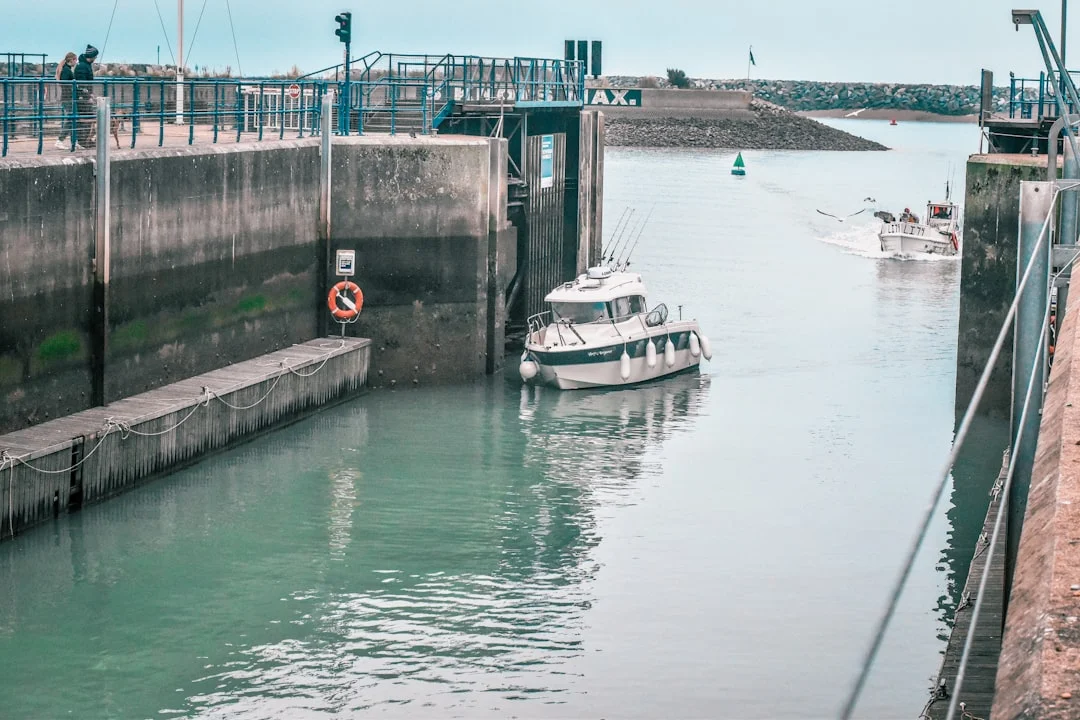
Photo by elliott on Unsplash
Crew Roles, Commands, and Human-Factors Safety
Minimum team and where each person stands
A lock transit runs best with four roles: helm/engine operator, bow handler, stern handler, and a floater managing fenders, chafe, and comms. On a small crew you can combine jobs, but don’t combine bow and stern tending unless you enjoy sprinting on a moving deck. The helm stays planted with clear sight lines and hands ready for neutral and short thrusts.
Crew positioning is a safety system, not a habit. Stay outside the bight, keep feet out of coils, and never lean between boat and wall, even when the gap looks polite. Clustered crew can also affect stability—ISO 12217 is the formal reference, but the simple rule is: don’t stack three adults on one rail while the boat is being shoved around.
Standardized short commands and closed-loop confirmation
Use short phrases and insist on repeats. Noise, echo, and stress make long sentences useless, and a misunderstood “ease” can turn into a snap load. These commands work across most boats and languages:
- “Ahead idle”
- “Neutral”
- “Astern idle”
- “Hold bow”
- “Ease bow 1 m”
- “Take up stern”
- “Up slack midship”
Closed-loop means the handler repeats the order, then reports when it’s done. It feels formal the first time, and then you realize it prevents the classic mistake: bow easing while stern takes up, leaving the boat to pivot into the wall like it’s trying to hug concrete.
Common failure points: burns, jams, missed bollards
Line burns are the top injury, and they happen fast—again, seconds. Gloves help, but the real prevention is technique: never wrap a hand, never take a riding turn you can’t dump, and never stand where a loaded line can sweep you. Keep one accessible knife on deck, because sometimes the safest move is to cut and sort it out later.
Jams usually come from bad wraps, poor lead angles, or cleating off a line that must slide. Missed bollards happen when a crew member hesitates, so pre-rig a messenger or have a boathook ready, and don’t throw heavy shackles. Finally, remember lights and conduct: when the engine is engaged you’re effectively power-driven, so ABYC H-41 and the USCG Navigation Rules/COLREGS logic applies, especially at dawn, dusk, or in narrow approaches.
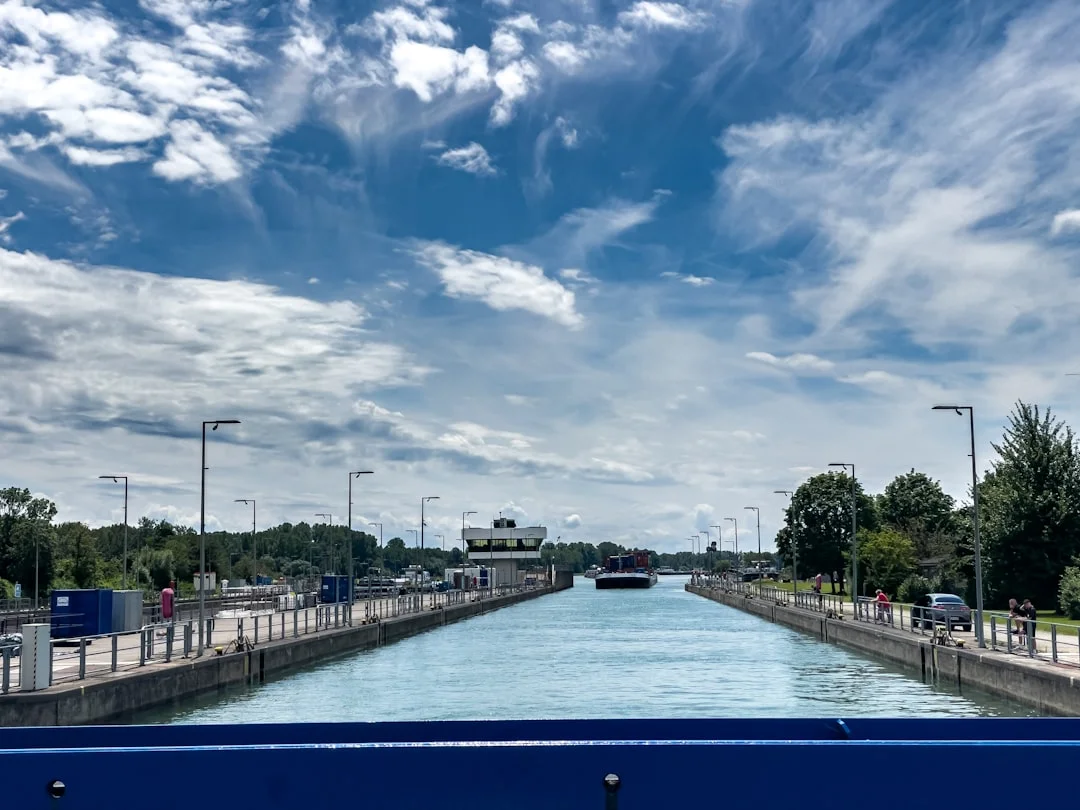
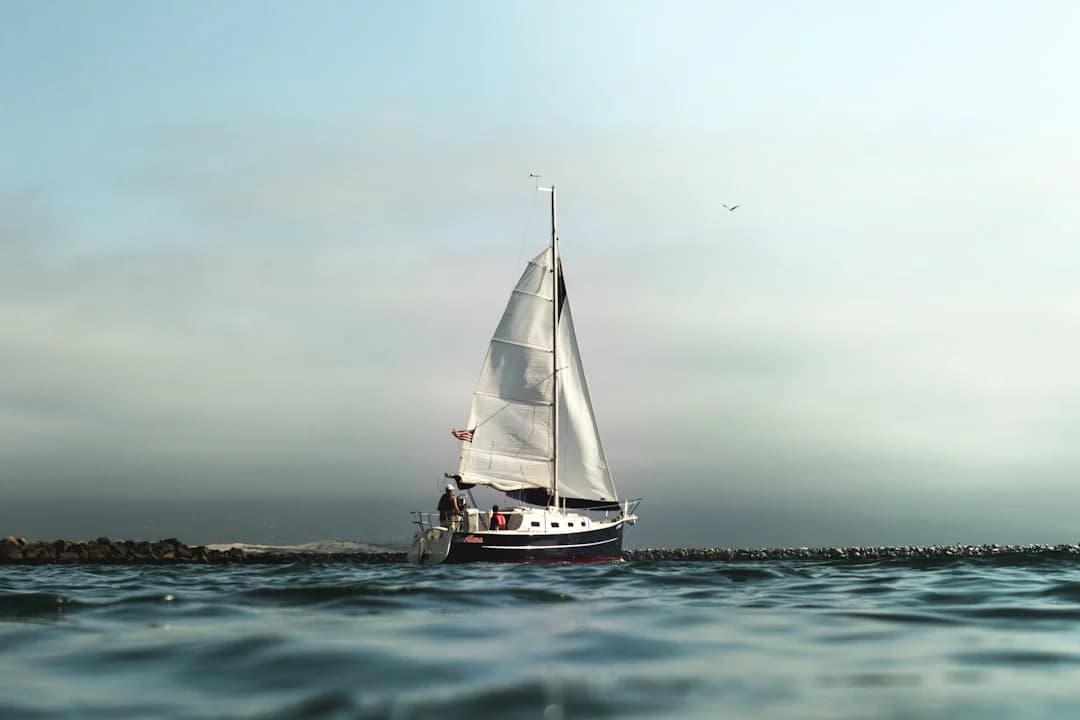
Photo by Bernd 📷 Dittrich on Unsplash
Step-by-Step Lock Transit: Approach to Exit (With Route Planning)
Approach: speed control, windage, and calling the lock
Rig early, slow down early, and make one clean approach. In most locks you want steerage at idle ahead, not bursts of speed, because the walls amplify mistakes. Call the lock on the correct VHF channel (often 22 or 20 in parts of Europe), state vessel name, position, direction, LOA, and request entry instructions; then listen more than you talk.
If you’re timing arrivals, treat locks like tide gates. Use a quick tool to check the nautical miles to your next lock to estimate the run to the lock approach, then build an arrival window that accounts for current, windage, and waiting areas. Ten extra miles of detour or a 1–2 knot adverse current can turn “we’ll be there at noon” into “we’ll be there whenever the snacks run out.”
Entry and securing: first line on, then springs, then fine-tune
Enter under control, line handlers ready, and the floater watching fenders. The first objective is one line on quickly—usually a midship lead if available—so you can stop lateral drift and stop the boat wandering. Once you have that, add springs to control fore-aft surge, then fine-tune with bow and stern lines.
In Panama, small craft may be secured to lock-side fittings or raft up with other yachts depending on policy and assignment. Follow the advisor or authority instructions exactly, because procedures can change with traffic and maintenance. If you’re rafting, agree beforehand which boat is “talking boat” on VHF and which crew is passing lines.
During rise/fall: managing slack, surge, and prop wash
Your job during the lift is to prevent sudden motion. On floating bollards, manage slack so the line slides but doesn’t run away; on fixed points, ease or take up in 0.5–1 m increments as level changes. Watch the turbulence zones near culverts/ports and be ready for surges that are worse in lifts over 10 m or when commercial traffic is nearby.
Use the engine like a shock absorber. A moment of neutral stops prop wash from pinning you to the wall, while a gentle idle thrust can keep tension steady and prevent snatch loads on cleats. If another boat’s prop wash is rolling your hull, speak up early—pride is cheaper than gelcoat.
Exit: staged release, avoiding cross-currents and gate suction
Don’t cast off everything at once. Stage the release: keep a spring until you have forward motion and steering, then let it go cleanly without throwing coils. Expect cross-currents near the gates, and keep speed low enough to stop inside a boat length, because someone ahead may stall or fumble a line.
If you’re heading straight into a river current or wind funnel, have a plan before the gates open. This is another place to calculate the distance between ports and likely waiting areas: if you know the next safe waiting area is 3 nm away, you’ll think differently about fuel, daylight, and fatigue than if it’s 0.5 nm.
Contingencies: missed bollard, jammed turn, surge event
If you miss a bollard, don’t lunge for it at full stretch. Go to neutral, keep the boat off with fenders, and re-attempt with a boathook or messenger line. If a line jams, the fix is almost never “pull harder”; instead, ease to remove load, re-lead, add chafe gear, and only consider cutting as a last resort when safety is at stake.
In a surge event, prioritize preventing fore-aft slams into gates or other boats. Hold springs, use idle thrust to damp motion, and communicate with the lock operator if you need a pause or assistance. The calm crew looks boring; the calm crew also finishes with the same paint they started with.
Fees and Paperwork: Panama Transit vs European Canal Permits
Paperwork is its own kind of seamanship: it’s mostly patience, plus a small ability to read forms while sweaty. Panama is typically a one-time transit cost with layers; Europe is often a vignette/licence model where length and duration drive price. Either way, the fastest way to blow a budget is to show up unprepared and start buying gear at the last minute.
Below is the most useful comparison I can give without pretending fee schedules never change. Verify current authority tariffs and requirements, because they do, and they do it right after you print your checklist.
| Category | Panama Canal (yacht transit) | Europe (canals/rivers with locks) |
|---|---|---|
| Fee model | Transit fee + possible buffer/deposit + services | Vignette/licence often based on LOA + duration |
| Typical total range | $2,000–$6,000+ (varies by LOA and services) | Example: France VNF typically ~€100–€1,000+ depending on length/validity |
| Common add-ons | Agent, advisor/line handlers as applicable, extra lines/fenders | Regional passes, port dues, occasional lock/bridge fees |
| Comms | Canal traffic procedures; assigned resources/instructions | VHF working channels often Ch 22/20 (varies); signage and notices |
| Paperwork timeline | Plan ahead; schedules and slot logistics matter | Often purchased online or at offices; keep proof aboard |
Gear spending is where most cruisers quietly bleed cash, but it’s also where incidents get prevented. An 8 in × 30 in fender at $35–$90 beats a repair yard quote, and a handheld VHF at $80–$300 beats missing an instruction when the helm can’t leave the controls. Gloves at $20–$80 aren’t glamorous, but they’re cheaper than a bandage kit and a ruined day.
Practical tip: Budget for lock work like you budget for anchoring in a squall: assume you’ll need more line length, more fenders, and more patience than you planned. The lock will not negotiate.
Frequently Asked Questions
For a 40 ft monohull in a 10+ m lift lock, what minimum line length (35–50 m) prevents re-reeving, and where should chafe gear be installed to stop fairlead heat damage?
For a 40 ft monohull in bigger lifts, 35–50 m (115–165 ft) lines are the practical minimum to avoid re-leading when the level changes quickly or you’re forced into an awkward lead. Install chafe gear at every moving contact point: bow/stern chocks, fairleads, and anywhere the line slides around a cleat or rubs the wall. Leather, reinforced hose, and tubular webbing sleeves all work, but only if they’re secured so they don’t migrate under load.
How do you rig to floating bollards so the line slides without locking—round turn vs cleat hitch, and what failure modes cause a jam during rapid level change?
With floating bollards, take a round turn on the bollard and manage the working end from the boat so the line can slide as the bollard rises/falls. A hard cleat-off that prevents movement is what creates jams and sudden overload. Common failure modes are riding turns that cinch tight under a spike, poor lead angles that saw into a fairlead, and letting slack run so fast it nests and locks when tension returns.
What fender setup best protects a fin-keel monohull on abrasive concrete: number (8–12+), sizes (20×76 cm or larger), and when is a fender board mandatory?
On abrasive concrete, plan on 8–12+ fenders and lean toward larger cylinders—20 × 76 cm (8 × 30 in) or bigger for 30–40 ft boats, and 25 × 81 cm (10 × 32 in) for 40–50 ft. Put the biggest protection at max beam and the aft quarter where turbulence pushes hardest, and add 1–2 ball fenders (38–56 cm / 15–22 in) for irregular contact. A fender board becomes mandatory when the wall is rough enough to grab fenders, has protrusions/ladder edges, or when rafting turns point loads into hull damage.
In a raft-up lock transit, how should forward/aft springs be arranged between yachts to control fore-aft surge, and which boat should keep engine in gear to damp motion?
Arrange springs so the raft behaves like one long vessel: at least one forward spring and one aft spring between boats, led to strong points, to stop the boats surging independently. Keep breast lines snug enough to prevent shearing, but let springs do the surge control. Typically, the boat with the best visibility and propulsion control—often the “outside” or lead boat by agreement—keeps the engine ready and uses short idle thrusts to damp motion, while everyone avoids creating prop wash against the wall.
What VHF workflow reduces errors in European locks (often Ch 22/20): call format, read-back, and how to manage instructions when helm cannot leave the controls?
Use a simple call: lock name (if known), your vessel name, position, direction, LOA, and request for instructions, then switch to listening. When you receive instructions (side, order, timing), do a read-back of the critical elements so misunderstandings get corrected immediately. If the helm can’t leave the controls, assign the floater to handle the radio and repeat instructions aloud using closed-loop confirmation, so the helm never has to choose between steering and guessing.
About the Author
Related Articles

French Canals Boat Trip Guide Beyond Canal du Midi
Plan a french canals boat trip beyond the Midi with routes, costs, licenses & lock tips. Compare regions and map your itinerary—start now.
By Breezada Team

Marine Toilet Smells: Eliminate Odors in Hoses & Vents
Stop marine toilet smells fast—diagnose hoses, vents, joker valves, and cleaning routines. Follow this guide and fix odors for good today.
By Breezada Team

Anchor Light Rules for Sailboats & Best LED Options
Learn anchor light rules (COLREGS/USCG) and choose the best LED anchor light. Avoid common mistakes—use our quick checklist today.
By Breezada Team
Composting Toilet Sailboat: Manual vs Electric vs Composting
Compare marine head options—manual, electric, composting—costs, rules, and odor control. Choose the right setup for your boat. Read now.
By Breezada Team