Sailing Cyclades Itinerary: 7–10 Days + Meltemi Tips
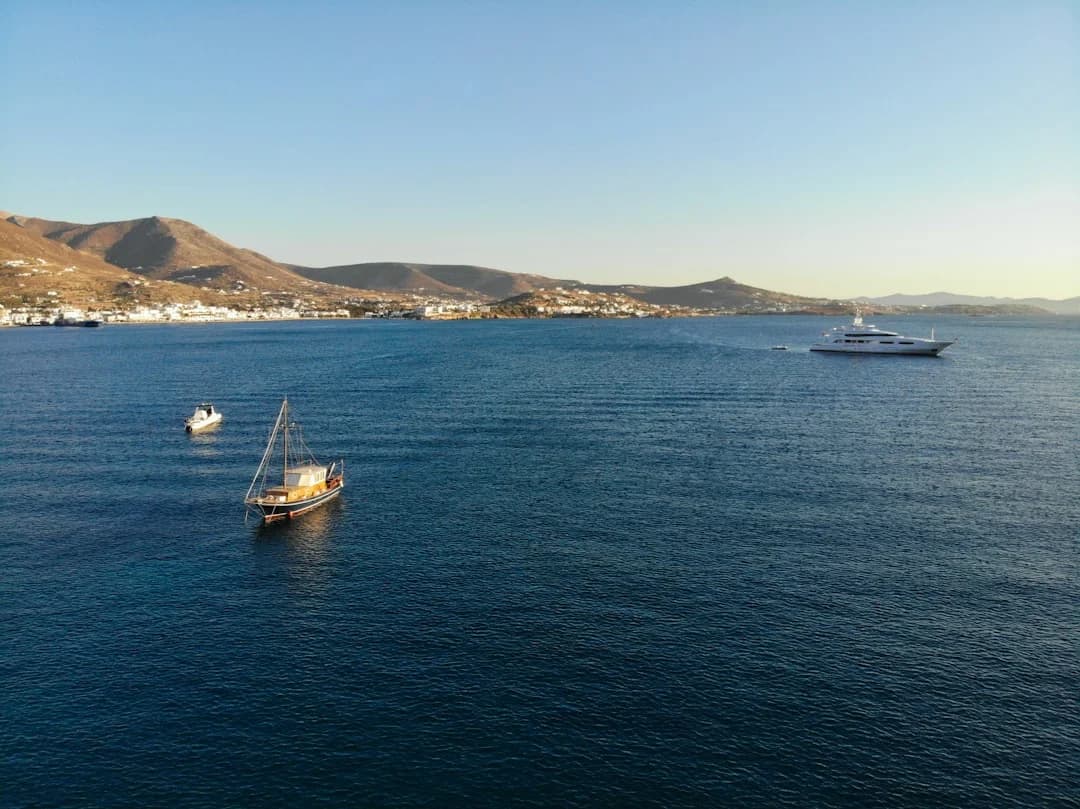
Sailing Cyclades Itinerary: 7–10 Days, Meltemi Tips
Meta description: Plan a sailing Cyclades itinerary with 7–10 day routes, safe anchorages, and Meltemi tactics. Get distances, costs, and checklists—start now.
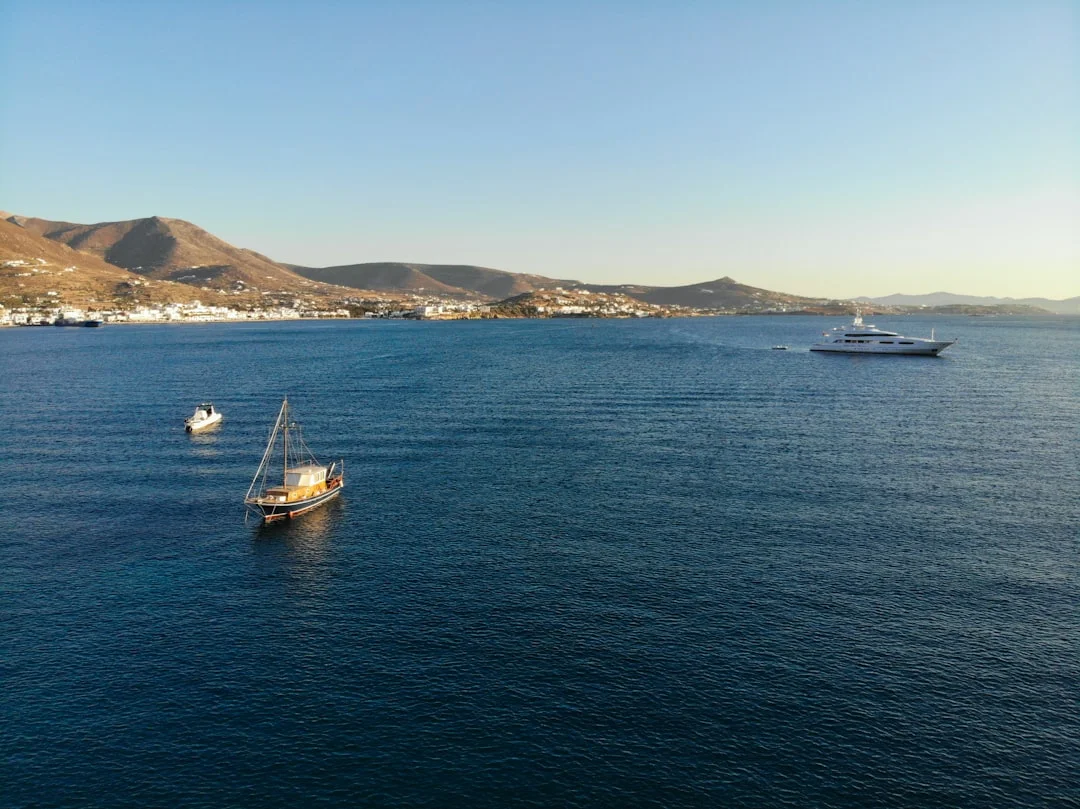
Photo by Dimitris Kiriakakis on Unsplash
Cyclades at a Glance: Clusters, Distances, and Sea State
Why the Meltemi (Etesian) Sets Your Daily Limits
In the Cyclades, your itinerary is mostly a wind problem wearing sunglasses. The Meltemi (Etesian winds) is typically a June–September feature, with the most frequent strong spells in July–August. On a normal summer day, 15–25 kt is common, and when it decides to be serious you’ll see 25–35+ kt in the open channels.
The sea state is what ambushes crews: Aegean chop stacks up short and steep, and comfort falls off faster than the wind speed suggests. A 40–45 ft charter boat that’s happy at 18 kt in flat water can feel like a rented shopping cart at 25 kt with head seas. If you’re planning by “brochure hull speed,” you’re planning to arrive tired and late.
Island Clusters That Create Lee Routes (and No-Go Channels)
Think in clusters you can hide behind: Paros–Antiparos, Naxos + Small Cyclades, Sifnos–Serifos, and Milos form workable lee-hops on many Meltemi days. The Mykonos/Delos corner and some inter-island gaps are where the wind accelerates and the seas get sharp, fast. Those channels aren’t “advanced sailing,” they’re just exposure.
A practical mental map is: keep your long legs inside 20–30 NM when 25+ kt is forecast, and use big islands as breakwaters. If you need a distance sanity check, calculate the distance between ports for comparing “straight line optimism” versus the real routing you’ll do to stay in lee water. It’s also useful for planning fuel when you inevitably motor-sail around ferry lanes.
Route Planning: Distance-to-Time Math You’ll Use Every Day
Your baseline ETA method is simple: NM ÷ average speed = hours underway. In Cyclades chop, plan 5–7 kt average on 36–46 ft monohulls and 40–45 ft cats, not the 8.5 kt you once saw surfing with the spinnaker. Worked example: 25 NM at 6 kt ≈ 4.2 hours—then add margin for reefing, detours around traffic, and the last-mile anchoring circus.
Head seas and reefed sailing can knock a “6 kt plan” down to 4.5–5.5 kt, which adds 30–60 minutes on a 25 NM leg. That’s the difference between picking your anchoring spot in daylight and anchoring by headlamp while your crew debates divorce law. If you want a quick double-check, check the nautical miles for your planned route, then add 10–20% time for a Meltemi day.
Practical tip: In July–August, treat 25 kt true as the day you tighten the plan. Shorten legs to 20–30 NM, depart 06:00–10:00, and pre-pick a bailout harbor within 10–15 NM of your midpoint.
7-Day Cyclades Sailing Itinerary: Paros–Sifnos–Milos Loop
Day-by-Day Legs with NM Targets and Early-Start Strategy
This 7 day Cyclades sailing itinerary assumes a Paros/Antiparos base (or nearby) and a Meltemi-smart loop to the west. Planning speed is 5–7 kt, with departures targeted 06:00–10:00 before the wind ramps. Keep most legs 20–30 NM so you’re not stuck mid-channel when it’s 25–30+ kt and lumpy.
Use this as a framework, not a prison sentence:
| Day | Primary leg (example) | NM target | Underway at 6 kt | Wind note |
|---|---|---|---|---|
| 1 | Base → Antiparos/Paros lee anchorage | 5–12 | 1–2 h | Shake-down, test ground tackle |
| 2 | Paros/Antiparos → Sifnos (lee side options) | 20–30 | 3.5–5 h | Early start to beat peak gusts |
| 3 | Sifnos → Milos | 20–28 | 3.5–4.7 h | Watch acceleration in open water |
| 4 | Milos: rest/anchor day | 0–10 | 0–2 h | Weather buffer without schedule pain |
| 5 | Milos → Serifos (or Kythnos depending) | 18–28 | 3–4.7 h | Choose leeward approach |
| 6 | Serifos/Sifnos area → Paros | 20–30 | 3.5–5 h | Leave margin for return logistics |
| 7 | Local sail + fuel/water + checkout | 0–10 | 0–2 h | Don’t gamble the last afternoon |
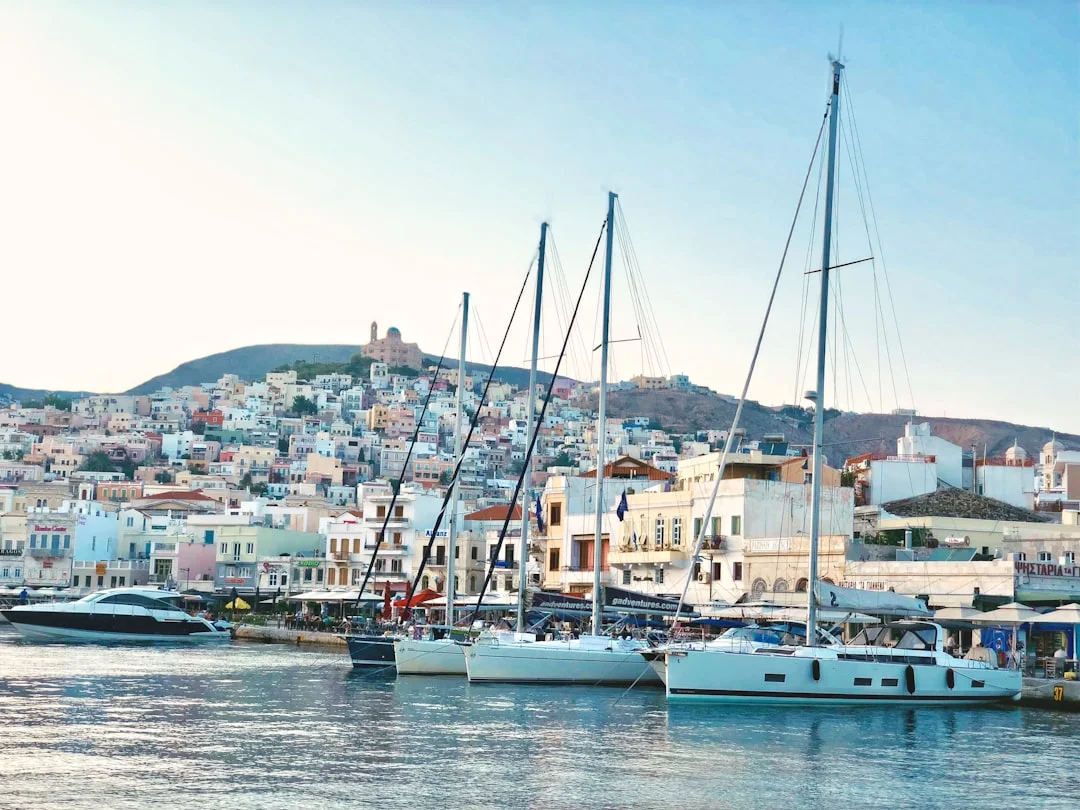
Photo by Despina Galani on Unsplash
Bailout Harbors Within 10–15 NM (Meltemi-Smart Defaults)
Every day should have at least two exits that don’t require heroics. When the forecast bumps to 25–35+ kt, the “bailout” stops being Plan B and becomes the adult decision. In practical terms, you want something within 10–15 NM that you can enter in daylight without threading unlit fish farms.
On Paros/Antiparos days, the bailout is usually “stay in the lee and enjoy breakfast,” which is surprisingly popular with crews. Between Sifnos–Serifos–Kythnos, keep a short list of ports and bays that offer protection from N to NE, not just “it looked pretty on Instagram.” If your intended anchorage becomes a lee shore with a 10–20° wind shift, you need a quick alternative that’s closer than your pride.
Mykonos Option: When It’s Worth the Exposure—and When It Isn’t
Mykonos is a great stop on a calm forecast and a mediocre stop when you’re trying to keep a charter crew happy in 30 kt. The area is exposed, ferry traffic is dense, and the wind can accelerate in the gaps, turning a “quick hop” into a wet punishment. If you go, go early, arrive early, and budget marina costs that can run €40–€120+/night in busy periods.
When is it worth it? Shoulder season, or a window where daytime winds are closer to 15–20 kt and you can make the run in 2–4 hours without pounding. When is it not? When you’re already stretching legs to 35+ NM and your crew thinks reefing is a type of snorkeling. For route comparisons, Breezada’s sea distance calculator is useful to see how much extra mileage you’ll add by taking lee routes instead of the direct, exposed line.
10-Day Cyclades Itinerary: Add Small Cyclades + Weather Buffer
Two 10-Day Variants: West-Heavy (Milos) vs. South/East-Heavy
A 10 day Cyclades sailing itinerary buys you the best safety upgrade there is: time. With 10 days, you can build around the 20–30 NM rule and still include a “wow” island without having to force a long crossing in 25–35+ kt. Plan average 5–7 kt, but assume a couple legs will sag to 5 kt when the chop stands up.
Two solid variants work well in Meltemi season:
| Variant | Best for | Typical focus | Long-leg risk | Notes |
|---|---|---|---|---|
| West-heavy | Dramatic anchorages | Sifnos–Serifos–Milos | Lower | More lee options, easier bails |
| South/East-heavy | Small Cyclades feel | Naxos + Koufonisia/Schinoussa | Medium | More channel timing, fewer big harbors |
If your crew wants swimming and relaxed nights, the west-heavy plan usually wins in July–August. If they want the Small Cyclades vibe, it can be brilliant—just accept you’ll sometimes wait out a day instead of bashing a channel.
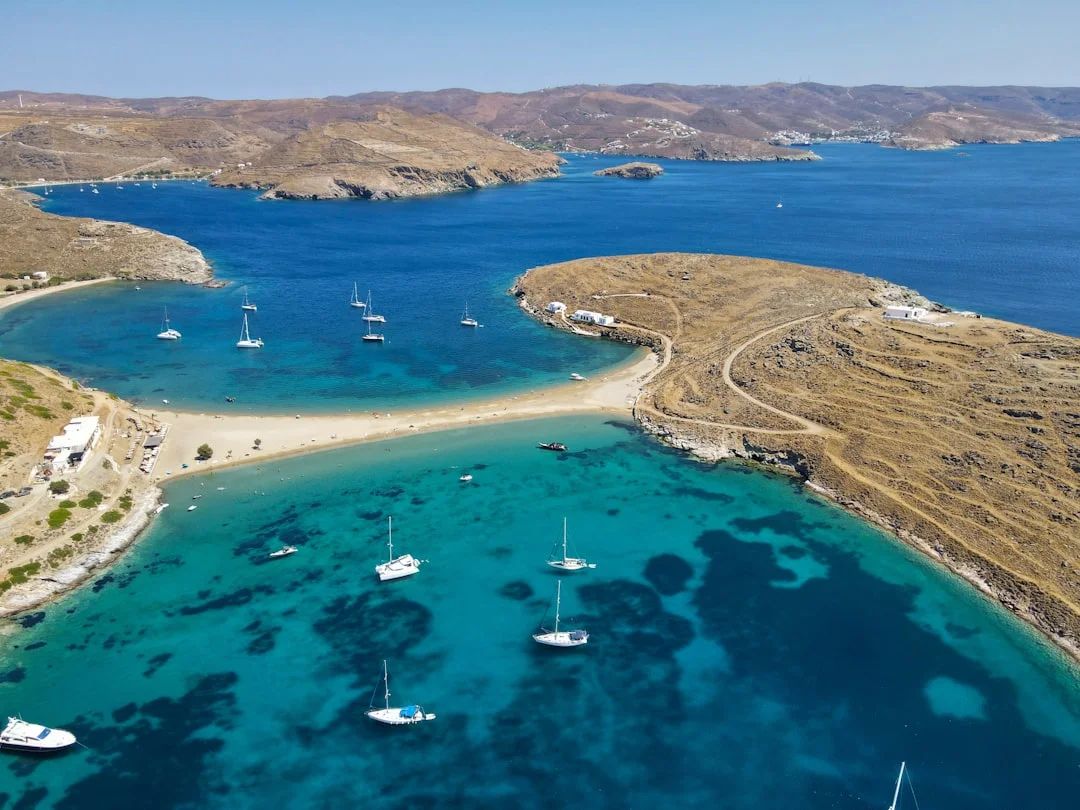
Photo by Dimitris Kiriakakis on Unsplash
Buffer-Day Logic: The Cheapest Safety Upgrade You Can Buy
Put a buffer day where it actually helps, not where it looks tidy on a spreadsheet. I like one full buffer day around day 4–6, plus a “short reposition” day under 15 NM so you can reset without fatigue. The cost of a buffer day is basically extra provisioning and maybe an extra €10–€40 quay fee, versus the cost of forcing a crossing and breaking something expensive.
Decision rule: if the forecast shows ≥25 kt sustained and the channel is known for steep seas, switch to leeward hops or stay put. If there’s no all-weather bailout within 10–15 NM of your route, don’t go—deadlines are how charter boats end up with bent pulpits and unhappy insurance calls. Keep the final 48 hours conservative, so you’re not sprinting back to base in a building northerly.
Mykonos to Santorini: When the Iconic Run Makes Sense
The Mykonos to Santorini sailing itinerary looks great on a map, but maps don’t show slamming. It can mean longer exposure, busier ferry corridors, and fewer “easy-in” harbors if the wind jumps to 30+ kt. In July–August, that’s not rare; it’s Tuesday.
If you want Santorini, aim for a window where the Meltemi moderates toward 15–20 kt, and plan a conservative average—5.5–6.5 kt—with an early departure. If the forecast spikes, reroute behind a larger island: for example, swap an exposed channel crossing for a lee leg tucked behind Naxos before committing south. Run the distances through Breezada’s sea distance calculator so you’re not guessing how much time the “safer but longer” line actually costs.
Best Anchorages in the Cyclades: Protection, Depths, Holding
Protection by Wind Sector: N, NE, and NW Are Not the Same
The Meltemi is usually a northerly story, but N vs NE vs NW changes which bays are comfortable and which become a trap. A bay that’s perfect in NNE 20–25 kt can turn rolly or downright unsafe if it clocks NW around high terrain. Add katabatic gusts spilling off hills at night, and you’ll see 10–15 kt extra in the bullets.
Most Cyclades anchorages you’ll use sit in 4–10 m, but crowded bays often push you to 12–20 m if you want swing room. The “just drop in 5 m” plan dies quickly when 30 boats arrive at 16:30. Choose anchorages with an exit you can execute in the dark if you must, because lee-shore risk is real when the gusts stack.
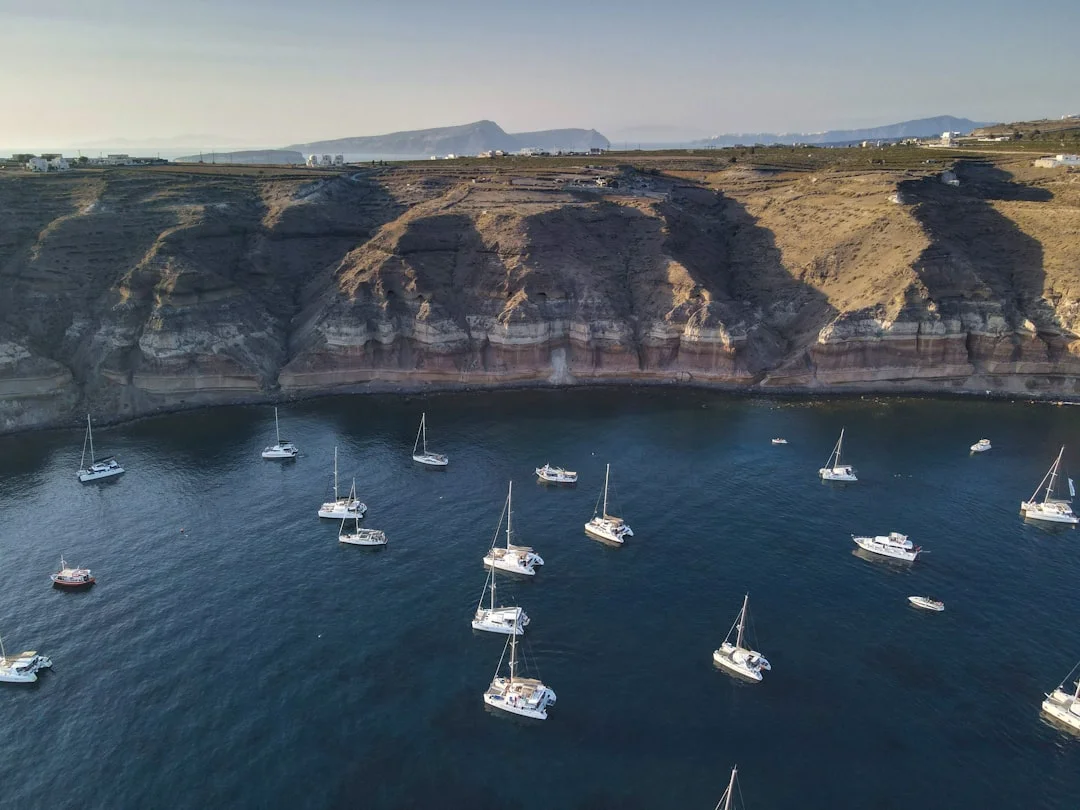
Photo by Dimitris Kiriakakis on Unsplash
Holding Diagnostics: Sand vs. Weed, Set Technique, and Reset Triggers
Bottom is often mixed: sand patches with weed ribbons, and the weed can fool you into thinking you’re set. Your job is to confirm, not to hope. A modern scoop anchor in the Rocna/Mantus/Ultra class, typically 16–25 kg on a 35–45 ft boat, does well in sand if you actually set it, and does poorly if you drop it on salad.
Scope rules are simple and not optional: 5:1 in settled conditions, 7:1 when gusts are forecast. Scope is measured from the bow roller to seabed, so add bow height—often ~1–1.5 m on a 40-footer. Example: 8 m depth + 1.5 m bow height = 9.5 m, and at 7:1 that’s 66.5 m of rode, not “about 50.”
Set routine: lower under control, straighten the chain, then reverse steadily until the boat loads up. Confirm with transits, then set an anchor alarm with a radius that reflects your chain length, not your optimism. Reset triggers: chain skipping, anchor not biting after a proper set, or you see your transits walk during a gust cycle.
Crowding Strategy: Arrival Times, Swing Room, and Anchor Etiquette
Crowding is predictable: arrivals spike 15:00–18:00, and the best sand patches get taken early. If you want an easy set in 6–8 m, arrive before 14:00 or accept you’ll be out in 12–15 m. In strong northerlies, that deeper water means heavier loads and more chain, so confirm the boat actually carries 60–80 m of chain and that it matches the gypsy.
Etiquette is practical, not polite: don’t anchor on someone’s chain line, don’t run your rode through the middle of the bay, and don’t pretend your boat “doesn’t swing much.” In 25–30 kt, everyone swings, even cats—just differently. If you’re unsure, ask what scope the other boat has out, because guessing wrong is how you end up doing anchor-unwinding at 02:00.
Meltemi Tactics: Timing, Reefing, and Leeward Routing
Micro-Weather: Acceleration Zones and Katabatic Gusts
Forecasts give you the big picture; channels deliver the punchline. Between islands, wind accelerates like it’s being squeezed through a nozzle, and you can see 5–10 kt more mid-channel than near shore. The sea state follows fast: steep chop, short period, and that signature Cyclades slam that rearranges your galley lockers.
Katabatic gusts off high terrain often show up in the evening and can add 10–15 kt in short bursts. That’s why a “comfortable” anchorage can start snatching at your chain around midnight. Don’t anchor under cliffs expecting peace—anchor expecting gust cycles, and rig a snubber or bridle to tame shock loads.
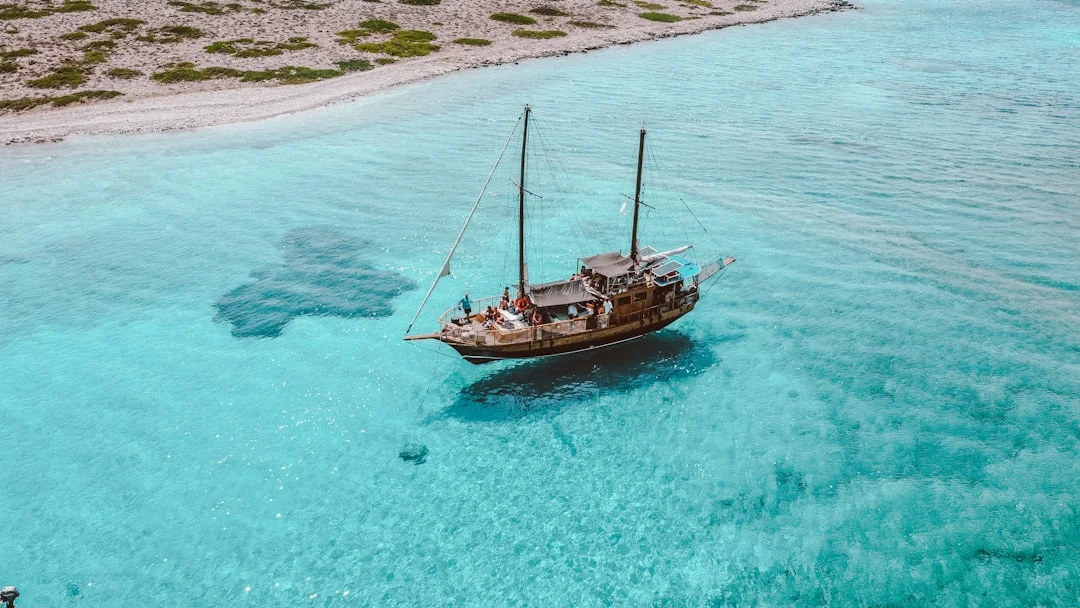
Photo by Johnny Africa on Unsplash
Reef Early: Practical Thresholds for Charter Boats
Charter boats are sturdy, but they’re also tired: stretched halyards, baggy mains, and winches that haven’t been loved. Reefing early reduces heel, leeway, and autopilot misery, and it keeps the crew functional. On many common charter rigs, a practical starting point is 1st reef around 15–18 kt, and 2nd reef around 20–25 kt, adjusted for boat, sail cut, and sea state.
If you wait until you’re “overpowered,” you’ll be reefing in the worst motion with the most load on the gear. That’s when people get hurt and batten cars explode, usually right before a crowded harbor approach. Reef while it’s still easy, and your average speed will often improve because the boat stops hobby-horsing and the rudder works again.
Comfort and Crew Workload: When to Convert Miles to Motorsailing
There’s a point where the “pure sail” plan costs more than it saves. In 25+ kt true with steep chop, many crews are happier motorsailing to keep the bow down and the speed steady, even if it burns diesel. A typical 40 ft monohull burns 3–5 L/h at 5–6 kt in flat water, and noticeably more in head seas, so budget accordingly.
The go/no-go framework I use is boring and effective: daylight arrival, bailout within 10–15 NM, and a crew that can reef, steer, and keep lookout without getting cooked. Add COLREGS awareness (USCG Navigation Rules / COLREGS 33 CFR 83) in ferry corridors: maintain a proper lookout, keep safe speed for conditions, and avoid creating close-quarters situations you can’t unwind.
Med-Mooring in Cyclades Ports: Anchors, Stern Lines, Depths
Standard Setup: Your Anchor + Stern Lines (and Why It Fails)
Most Cyclades town quays are Med-mooring: you drop your anchor, back toward the wall, and secure stern lines. Depths near the quay are often ~2.5–5 m, which sounds simple until you add gusts and crosswind. The standard failure is dragging while reversing because too little chain is out, or because the anchor never set before you committed.
Plan on deploying 30–50 m of chain in many ports for holding and geometry, not just because “everyone else did.” ABYC H-40 is a good best-practice frame here: strong points, shock loads, and not pretending a cleat can take any load you ask of it. On charter gear, assume the windlass is adequate, but not eager.
Photo by Sander Crombach on Unsplash
Approach Geometry: Chain Length, Clearance, and Prop Wash
Get your geometry right and Med-mooring becomes routine. Aim to finish 1.5–2.5 m off the quay for rudder and prop clearance, and to avoid becoming one with the concrete in surge. Stern lines of 12–20 m each are the “actually useful” lengths, and springs are worth rigging when there’s crosswind or ferry wash.
Drop the anchor where you’ll have room to back in without crossing half the harbor. As you reverse, keep light tension so you can feel if the anchor bites, then increase reverse power in a controlled way. If the chain is bar-tight immediately, you dropped too close or you’re short on chain, and either problem gets sporty in 25–30 kt.
Crosswind Handling and Backing Down Without Overheating Gear
Crosswind is where crews get loud and fenders become optimism. Use a clear helm plan: one person calling distance, one controlling chain, two handling stern lines, and nobody wrapping lines around hands. Back down with enough RPM to maintain steerage, not enough to perform engine abuse.
If you need to hold position for a while, watch engine temperature and exhaust flow, and keep ventilation in mind—ABYC H-41 is the reminder that exhaust systems and CO aren’t theoretical. ABYC E-11 also matters in practice: windlasses pull big current, and weak batteries make a windy Med-moor feel like a gym session you didn’t train for.
Costs, Fuel, Ports, and Paperwork for Cyclades Charters
Total Budget Model: Boat Price vs. Real Trip Cost Drivers
The charter fee is just the cover charge. Real costs include cleaning, deposit/waiver, fuel, port fees, provisioning, and the “we broke a snorkel and bought eight more” fund. For reference, a 38–42 ft monohull is often €3,000–€7,000/week, while a 40–45 ft cat commonly runs €6,500–€15,000/week depending on season and inventory.
Budgeting works best if you treat the boat as fixed cost and everything else as a daily burn. If you’re on a 7-day plan, assume €50–€150/day for shared cruising expenses (fuel + ports + water + ice) before you even talk restaurants. In high summer, add margin because marinas fill, and your “cheap quay night” sometimes becomes a pricier stop.
Fuel and Motoring Reality in Chop
Cyclades chop increases fuel burn because you’re pushing into short seas and often motorsailing to stabilize motion. A typical 40 ft monohull might burn ~3–5 L/h at 5–6 kt in flat water, but head seas and strong wind can push that higher. If you expect 20 engine-hours, budget 60–100 L as a baseline, then add a safety margin of 20–40 L for ugly days.
Diesel prices around €1.60–€2.20/L make fuel a real line item, not pocket change. The good news is that smart routing reduces both pounding and motoring, which is another reason lee-hopping matters. Use estimate your fuel needs based on the voyage distance for your chosen loop, then convert miles to engine hours with your realistic 5–6 kt motoring speed.
Ports/Marinas: What You Pay For (and What You Don’t)
This is where expectations need adjusting: many Cyclades stops are town quays with modest services. You might get water sometimes, power occasionally, and a helpful dockhand if the universe feels generous. Organized marinas cost more, but can be worth it for shore power and calmer nights in a blow.
Here’s the money reality in one place:
| Category | Typical range (EUR) | Notes |
|---|---|---|
| Bareboat mono (38–42 ft), weekly | €3,000–€7,000 | Shoulder to peak season swing |
| Bareboat cat (40–45 ft), weekly | €6,500–€15,000 | Big jump in July–August |
| End cleaning | €150–€300 | Usually mandatory |
| Refundable security deposit | €2,000–€5,000 | Check card holds vs cash |
| Deposit waiver, weekly | €250–€600 | Limits exposure, not always “no questions” |
| Skipper, per day | €180–€250/day | Plus their food/cabin considerations |
| Hostess/cook, per day | €150–€220/day | Helps on longer trips |
| Town/quay fee, nightly | €10–€40 | Often basic, sometimes no power |
| Busy marina, nightly | €40–€120+ | Location-dependent; Mykonos is rarely cheap |
| Diesel, per liter | €1.60–€2.20 | Higher in remote spots sometimes |
Paperwork varies by island and operator, and Port Police procedures can be inconsistent. Keep copies of crew list and charter docs handy, and don’t assume the same routine everywhere. If you arrive late and tired, that’s when “quick formalities” become an evening project.
Safety Checklist: Ground Tackle, Systems, and Ferry Lanes
Charter Handover Checks That Matter in Meltemi
Before you leave the dock, check what will save your week when it’s 25–35 kt outside. Confirm the boat’s CE design category under ISO 12217, and look at the safety inventory with your eyes, not your hope. Test reefing lines, vang, traveler, and furlers, because the Meltemi doesn’t care about your deposit waiver.
Ground tackle is non-negotiable: verify 60–80 m chain, 8–10 mm size, and that the gypsy matches the chain calibration. On many charter boats the windlass is 700–1,200 W, and it will pull hard current, so ABYC E-11 battery health matters. If possible, power the windlass under load at the dock and make sure it doesn’t stall or free-spin.
Anchoring/Storm Prep: Snubbers, Chafe, and Windlass Limits
Set up for gust cycles: use a snubber on monohulls or a bridle on cats to reduce shock loads and noise. That’s ABYC H-40 in practical terms—manage load paths, reduce peak forces, and protect attachment points. Check chafe at fairleads and bow rollers, because 8–10 hours of snatching can saw through surprisingly stout line.
Anchoring routine should be consistent: set firmly, confirm with transits, then set an anchor alarm with a sane radius. In crowded bays, alarms that are too tight create false panic every time a boat swings, but alarms that are too loose are just decorative. In 8–10 m depth with a 7:1 plan, you’re already in the 60–75 m rode neighborhood including bow height, so know your limits before you drop.
Navigation in Busy Corridors: COLREGS, AIS, and Night Arrivals
Ferries and high-speed craft are a daily feature, not a novelty. Apply COLREGS (USCG Navigation Rules 33 CFR 83) the grown-up way: maintain a proper lookout, cross traffic lanes at right angles when practical, and keep a speed that lets you maneuver without drama. AIS is useful, but don’t let it replace eyeballs; targets can be wrong, delayed, or misinterpreted.
Plan to avoid night arrivals in unfamiliar Cyclades ports, especially when the Meltemi is blowing and the basin is full. If you must arrive late, slow down, assign dedicated lookout, and don’t be shy about circling outside until you understand the layout. Decision trigger that has saved more holidays than any gadget: if sustained 25–30+ kt with steep chop is forecast on your intended channel and you lack a bailout within 10–15 NM, stay put and reroute leeward tomorrow.
Frequently Asked Questions
For a 40 ft monohull averaging 6 kt in chop, how do you compute an ETA range for a 25 NM leg when 25–30 kt Meltemi is forecast and you expect reefed speeds and detours around ferry lanes?
Start with baseline time: 25 NM ÷ 6 kt = 4.2 hours. Then assume reefing, head seas, and ferry-lane offsets reduce average to 5–5.5 kt, making it 4.5–5.0 hours, and add 10–20% margin for sail handling and approach time. In practice, I’d brief the crew on a 5 to 5.5 hour door-to-door window and plan departure early enough to arrive before the 15:00–18:00 anchoring rush.
In 8–10 m depth with gusts forecast, how much chain/rode do you need for 7:1 scope when measuring from the bow roller (including ~1–1.5 m bow height), and what do you do if the charter boat only carries 60 m of chain?
Use total depth from bow roller: 8–10 m + 1–1.5 m = 9–11.5 m. At 7:1, that’s 63–80.5 m of rode, so 60 m of chain may be short in 10 m water on a gusty night. If you only have 60 m, anchor shallower (if safe), pick better shelter, increase holding with a snubber and careful set, or move to a quay/harbor—because pretending 60 m is enough in 11.5 m with gusts is how anchors “mysteriously” drag at 03:00.
What are the practical signs your anchor is set in weed over sand in the Cyclades, and what reverse-thrust test (RPM/time) is reasonable without overloading charter gear?
Signs include a bouncy, inconsistent feel through the chain, the boat skating sideways under light reverse, and the anchor “snapping free” when a gust hits rather than loading smoothly. If you can see the bottom, you’ll often notice the anchor rode leading into weed, not a clean sand patch. A reasonable test is a controlled reverse set for 20–40 seconds at moderate RPM (enough to load the chain steadily, not enough to cavitate), and if it doesn’t bite cleanly, reset immediately before the bay fills in.
During Med-mooring in 3–5 m quay depth, how much chain should you typically deploy (30–50 m guidance) to prevent dragging while backing, and how do you avoid crossing anchors in crowded basins?
In 3–5 m depth, 30–50 m of chain is a common working range because you need both holding power and correct geometry as you reverse in. To avoid crossing anchors, drop your anchor on the same “lane” as the boats beside you, keep your chain straight under light tension while reversing, and don’t drop too close to the quay. If you’re unsure where your neighbor’s anchor lies, ask before you drop—two minutes of conversation beats two hours of anchor surgery.
How should you route across an inter-island channel with frequent high-speed ferries using COLREGS principles, AIS targets, and a “safe speed” plan while maintaining leeward shelter as long as possible?
Stay in lee water along the island as long as it’s safe and legal, then cross the channel on a clear, deliberate line—ideally close to 90° to the traffic flow—so your intentions are obvious. Use AIS to identify fast targets early, but verify visually and keep a dedicated lookout as required by COLREGS 33 CFR 83. Set a safe speed that preserves maneuverability in chop (often slower than you’d like), and avoid last-minute course changes that create close-quarters situations with ferries that can’t or won’t deviate much.
Meltemi-first planning recap: build 7–10 day routes around 20–30 NM legs, 06:00–10:00 departures, and leeward island-hopping rather than bucket lists. Do the anchor engineering (scope math, chain limits, set verification), practice port skills (Med-moor geometry, crosswind roles), and keep a clear stay-put rule when the channels are ugly. Pick one itinerary variant, pre-select bailout harbors, and brief reefing and mooring jobs before you cast off—your future self will be calmer, drier, and still on speaking terms with the crew.
About the Author
Related Articles
Man Overboard Recovery Under Sail: Quick-Stop vs Figure-8
Learn man overboard recovery under sail using Quick-Stop vs Figure-8. Compare steps and choose the best method—read now and practice safely.
By Breezada Team
Sailing San Juan Islands: Routes, Tides & Moorings
Plan your sailing San Juan Islands trip with routes, tide tips, and moorings. Get the guide and chart your itinerary today.
By Breezada Team
How to Pick Up a Mooring Buoy: Med Mooring Tips
Learn how to pick up a mooring buoy with buoys & lazy lines, step-by-step. Get confident and dock faster—read the guide now.
By Breezada Team
Best Dinghy for Cruising Sailboat: Setup Guide
Learn the best dinghy setup for cruising sailboats—choose, equip, and stow it right. Read the guide and upgrade your tender today.
By Breezada Team