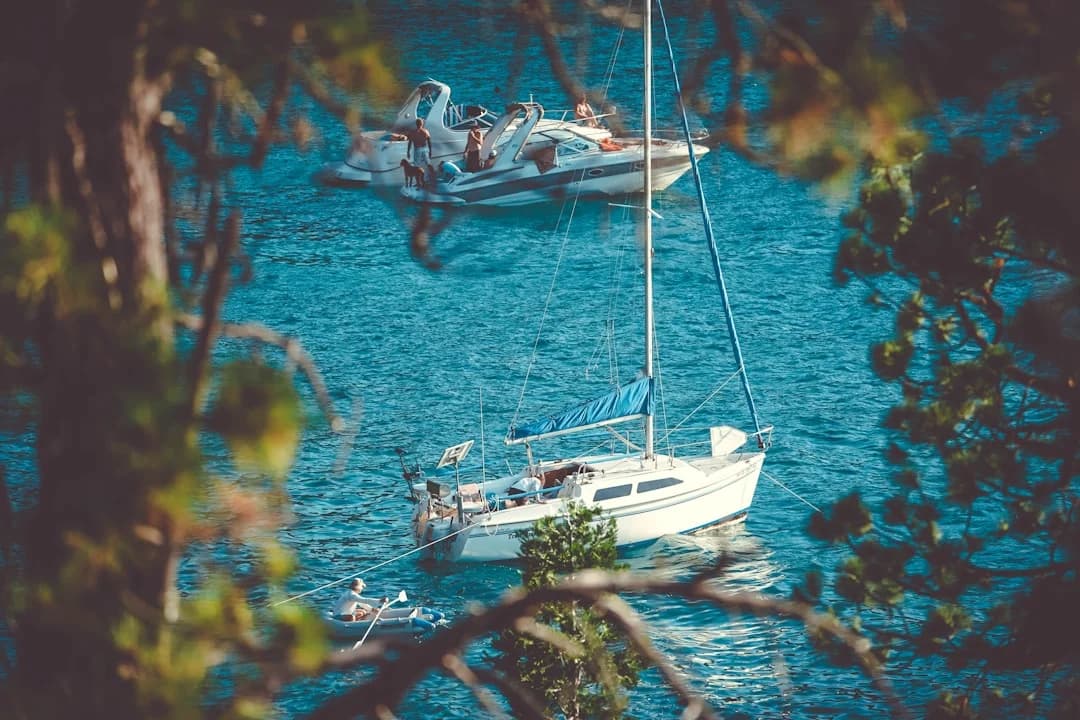
The best anchor for a sailboat is almost never the one that came with the boat. Most production yachts leave the factory with an undersized, last-generation anchor that holds well enough in a flat calm and drags at 2 a.m. when the wind shifts. Choosing the right anchor is one of the cheapest upgrades you can make — and one of the few pieces of gear that directly decides whether you sleep or stand watch all night.
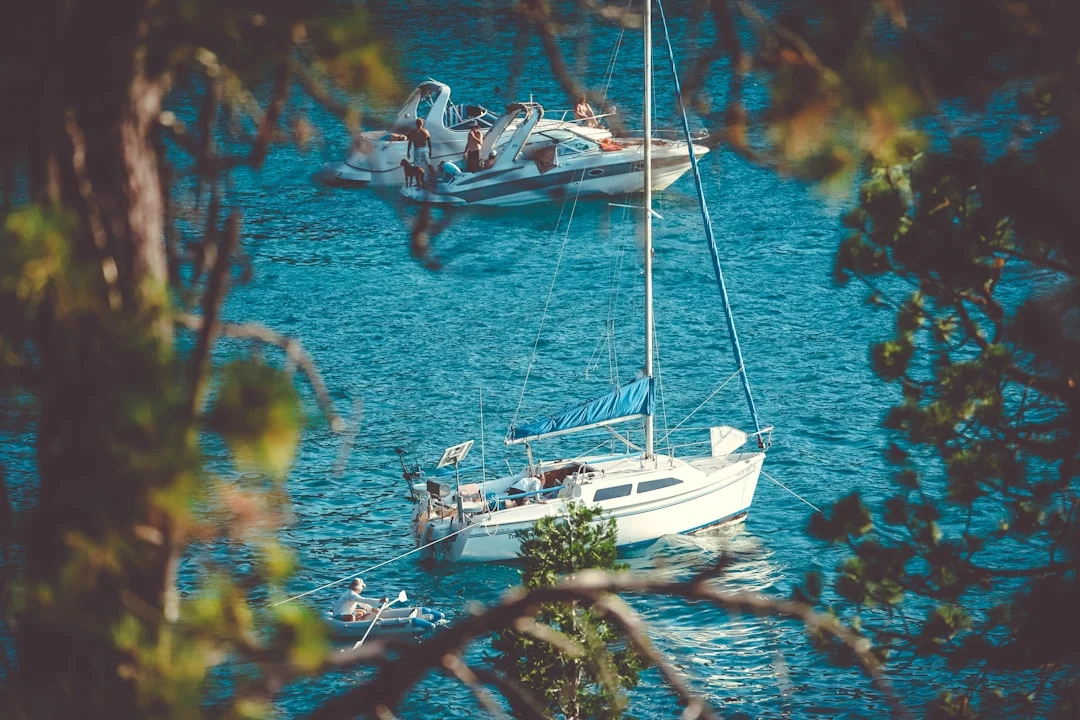
Photo by Eric Ward on Unsplash
This guide walks through anchor types, how to size them correctly for your boat, what bottom they actually hold in, and how to build a ground tackle system that matches. By the end you should know which anchor belongs on your bow — and why the one hanging there now probably needs to go.
Why Your Factory Anchor Probably Isn't Enough
Boat builders are not anchor specialists. They fit whatever the spec sheet says will pass a sea trial, which usually means a mid-range CQR or Delta sized for "average" conditions. "Average" is the dirty word. An anchor rated to hold a 38-foot boat in 30 knots on sand will slide out of thin weed in 18 knots and embarrass you in front of the whole anchorage.
The rule experienced cruisers live by is simple: buy one size up from the manufacturer's recommendation, and pick a new-generation design. The weight penalty on the bow is small — usually 4-6 kg — and the security margin is enormous. If you're stepping up from coastal day-sailing to overnight anchoring, this is not optional.
There's a second problem. The anchor is only part of the system. The shackle, the chain, the rode length, the snubber, and the bow roller all have to work together. A $900 Rocna on 20 meters of undersized chain is worse than a cheap Delta on 60 meters of well-specced chain. We'll come back to that.
The Six Anchor Types You'll Actually See
You can ignore roughly 40 anchor designs sold online. In practice, most cruising sailboats carry one of six types. Here's how they stack up.
| Anchor Type | Best Bottom | Weak In | Generation |
|---|---|---|---|
| CQR / Plough | Sand, mud | Weed, rock | Old (1933) |
| Delta | Sand, mud, clay | Dense weed | Old (1992) |
| Bruce / Claw | Mixed, rock | Soft mud | Old (1972) |
| Danforth / Fortress | Sand, mud | Rock, grass | Old (1939) |
| Rocna / Manson Supreme | Sand, mud, weed, clay | Soft silt | New-gen (2004) |
| Spade / Ultra / Mantus | Sand, mud, weed, rock | Very soft mud | New-gen (1996-2010) |
The new-generation anchors — Rocna, Spade, Mantus, Ultra, Manson Supreme — are what you want on your bow in 2026. They share a few features: a concave fluke that scoops rather than skids, a roll bar or ballasted tip that self-rights the anchor on the bottom, and a sharp point that penetrates weed and hard sand. Independent testing (West Marine, SAIL magazine, Yachting Monthly) has put these designs through thousands of pulls across multiple bottom types, and they consistently out-hold the classics by a factor of 2-4 in the conditions where you actually care.
The old plough anchors (CQR, Delta) still work. They set reliably in good bottom and they've circumnavigated for 50 years. But they need more scope, they drag through weed, and they don't self-right if they land upside-down. If you already have one, it's a fine secondary. For a primary, pick new-gen.
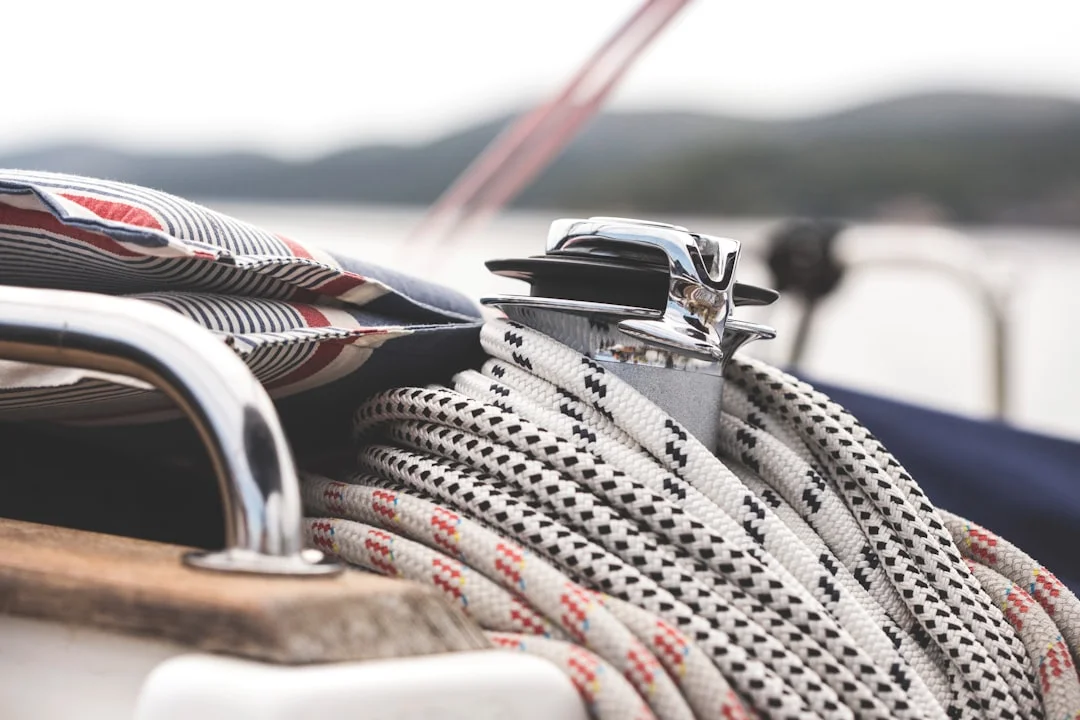
Photo by Milada Vigerova on Unsplash
What About Fisherman / Luke Anchors?
Steel-spike fisherman anchors hold superbly in rock and heavy kelp, which is why high-latitude cruisers (Iceland, Patagonia, Newfoundland) often carry one as a spare. For a warm-water sailor, they're overkill and awkward to stow. Skip unless you're planning genuinely remote anchorages.
How to Size the Right Anchor for Your Sailboat
Sizing is the one place where over-specifying is free. An anchor doesn't know if you told it to hold a 40-foot boat; it just digs in until it stops. Bigger digs deeper.
The starting point is length and displacement:
- 25-30 ft (8-9 m), ~4,500 kg: 10-15 kg new-gen anchor
- 31-36 ft (9.5-11 m), ~6,500 kg: 15-20 kg new-gen anchor
- 37-42 ft (11.5-13 m), ~9,000 kg: 20-25 kg new-gen anchor
- 43-48 ft (13-14.5 m), ~13,000 kg: 25-33 kg new-gen anchor
- 49-55 ft (15-17 m), ~18,000 kg: 35-40 kg new-gen anchor
Those are minimums. Bump one step up if any of these apply:
- You anchor regularly in winds over 25 knots
- Your bottom is weed or soft silt, not clean sand
- You're cruising ocean coasts, not protected estuaries
- You plan overnight stays rather than lunch stops
- You sleep aboard and want to sleep through squalls
A 38-foot cruising boat doing the Med in summer should carry a 20-25 kg Rocna or equivalent. That's not excessive — that's the number you'll see on almost every well-found liveaboard boat in the anchorage.
Ground Tackle — The Chain, Rode, and Shackle Nobody Talks About
The anchor gets the glory. The chain does the work. In a blow, the heaviest part of the chain lies on the seabed and acts as a catenary — a weighted curve that absorbs shock loads and pulls horizontally on the anchor stock, which is the direction it holds best.
If your chain is undersized, the catenary disappears as the wind builds. The pull angle on the anchor goes from horizontal (good) to vertical (bad), and the anchor pops out. This is how most drag-in-the-night stories end. The anchor didn't fail. The chain did.
Chain sizing, by boat length:
| Boat Length | Chain Size | Minimum Length |
|---|---|---|
| Up to 30 ft | 6 mm / 1/4" | 30 m / 100 ft |
| 30-40 ft | 8 mm / 5/16" | 50 m / 165 ft |
| 40-50 ft | 10 mm / 3/8" | 70 m / 230 ft |
| 50-60 ft | 12 mm / 7/16" | 80 m / 265 ft |
Go G4 high-test galvanized at minimum. G4 (also sold as "HT") is twice as strong as the old BBB or proof coil at the same weight — meaning you can downsize the diameter and save 30 kg of bow weight, or keep the same diameter and double your working load limit. Either way, you win. Stainless chain looks great and is a pain: it doesn't galvanize-refresh, it can crevice-corrode out of sight, and it costs five times the price. Galvanized is what works.
Length matters more than people think. The classic rule is 5:1 scope (five meters of rode for every one meter of depth). In 10 m of water, that's 50 m. In 15 m, it's 75 m. Add another 2 m for the height of your bow roller above the water, and another 5 m buffer so you're not scraping the bitter end. Most cruisers carry 60-80 m of chain on a 40-foot boat, and they use most of it more often than you'd guess.
Shackles and swivels: use a galvanized Crosby-type shackle, the same size as the chain or one size up, with the pin moused with stainless wire so it can't back out. Skip the swivels. Modern anchors don't need them, and a failed swivel is one of the three most common anchor-loss causes. If the chain is twisted, dive on it or drop it and re-set.
Snubbers: a 1-2 m length of three-strand nylon (14-16 mm) with a chain hook, taken from the cleat out to the chain just past the bow roller, does three things: it takes load off the windlass, it absorbs shock stretch, and it dampens the "pulling the boat around the anchor" behavior in gusty anchorages. Every cruising boat has one. If yours doesn't, make one this weekend.
Knowing a handful of solid knots is part of this system too — a bowline, a rolling hitch, and a round turn with two half hitches cover every snubber and rode problem you'll meet. Our guide to the 10 most useful sailing knots walks through each one.
Matching the Anchor to the Bottom
Chart symbols tell you what's down there before you drop. The BA symbol column on a nautical chart — S (sand), M (mud), Cy (clay), Wd (weed), R (rock), Co (coral) — is one of the most under-used pieces of information on the chart. Sand and clean mud are the easy wins. Weed, silt, and rock demand a technique.
- Sand is the gold standard. Any modern anchor sets first try. Watch for scouring as the tide runs.
- Firm mud holds almost as well, but the set takes longer. Set slowly, pause, then back down.
- Soft silt / black mud (common in river mouths) is tricky. Anything with a small fluke sinks through. Use a Fortress if you carry one.
- Weed is the nightmare. Sharp-tipped anchors (Spade, Mantus) bite through. Rounded-tip anchors slide across the top. If you're in a weedy bottom and your CQR won't hold, you're not doing anything wrong — it's just the wrong tool.
- Rock is a low-percentage bet. Nothing sets reliably in hard rock. Look for a patch of sand between boulders and place the anchor there. Use a trip line if you might have to cut and run.
If you don't have a chart with bottom type for the area you're heading to, a basic nautical chart read is half this problem solved. Our guide to reading nautical charts covers bottom symbology and scale reading for exactly this situation.
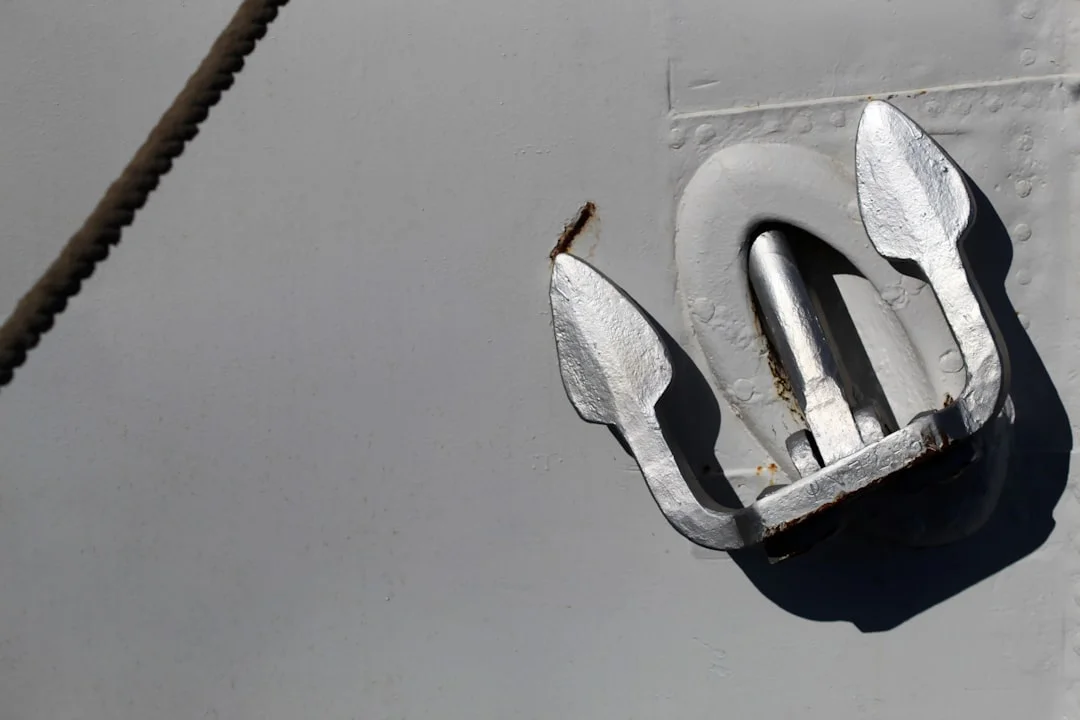
Photo by Anne Nygård on Unsplash
Setting the Anchor Properly
The wrong anchor, set right, often holds better than the right anchor, set wrong. Technique matters.
- Pick your spot. Look at what's around you — other boats' swing circles, the depth, the bottom type, any shoals to leeward. Give yourself space.
- Stop the boat. Genuinely stop. No drift.
- Lower — don't drop. Let the chain pay out in a controlled line. Dumping it on the anchor makes a pile that won't set.
- Back down slowly. 1-2 knots astern, chain paying out to your target scope (5:1 minimum, 7:1 in a blow).
- Lock the windlass. Snub off to a cleat.
- Back down hard. Idle in reverse, then a solid 1500 RPM for 30 seconds. Watch a fixed transit ashore. If you're moving, the anchor isn't set. Pull it up and re-do.
That's the whole procedure. New sailors often skip step 6 because it feels aggressive. It isn't — it's the only way to know the anchor is actually dug in instead of sitting on top looking hopeful. If you're planning longer passages or your first voyage on a new boat, our buyer's guide to choosing your first sailboat covers bow layout and windlass setup — both of which affect how smoothly this procedure goes when you do it at night in a cross-wind.
Scope — The Number Everyone Gets Wrong
Scope = length of rode paid out ÷ depth of water (measured from bow roller, not waterline).
- 3:1 — lunch stop in a flat calm. Fine for an hour.
- 5:1 — minimum overnight in settled weather with all-chain rode.
- 7:1 — overnight in building weather, or in mixed chain-and-rope rode.
- 10:1 — what you want in a storm or when the forecast has gone wrong.
The common mistake is measuring depth from the surface. Measure from your bow roller to the seabed. On most sailboats that adds 1.5-2 m, which matters when depths are shallow and scope ratios look generous.
Also: the anchorage depth changes with the tide. If you drop on a low tide in 4 m with 20 m of chain (5:1) and the tide rises 3 m overnight, your scope is now 20:7 — less than 3:1. Always calculate at high water. If you don't know the tidal range for where you're anchoring, check before you commit to the spot. A quick route planning pass with Breezada's sea distance calculator also gives you distance and passage time to the nearest bailout anchorage, which is exactly what you want to know if the night goes wrong.
A Two-Anchor System — When You Need One
Most cruisers carry a primary (big, new-gen, on the bow roller) and a secondary (smaller, different type, in a locker or on the stern). The secondary earns its stowage space in three specific situations:
- Bahamian moor — two anchors from the bow, 180° apart, to limit swing in a crowded anchorage or tidal channel.
- Stern anchor — one off the bow, one off the stern, to keep the boat oriented into swell when wind and swell disagree.
- Kedge — a second anchor rowed out in the dinghy to pull yourself off a grounding, or to hold position in a blow if the primary drags.
For the secondary, many cruisers pick a Fortress FX-23 or similar — aluminium, disassembles for flat stowage, sets beautifully in soft mud where even a Rocna struggles. It's a different tool for a different job, and at 7 kg it stows in a cockpit locker.
Windlass or Hand-Hauled?
If your chain weighs more than about 40 kg, you want a windlass. Hauling 80 m of 10 mm chain up from 15 m of water by hand is possible but miserable, and after two or three days of cruising you'll stop anchoring because of it. That's a bigger problem than the windlass cost.
Modern electric windlasses (Lewmar, Maxwell, Lofrans) run 12 V or 24 V, draw 80-150 amps when lifting, and move chain at about 15-25 m/min. Size the windlass for three times the weight of the full chain + anchor combined — anything less and you'll cook it in the first real blow.
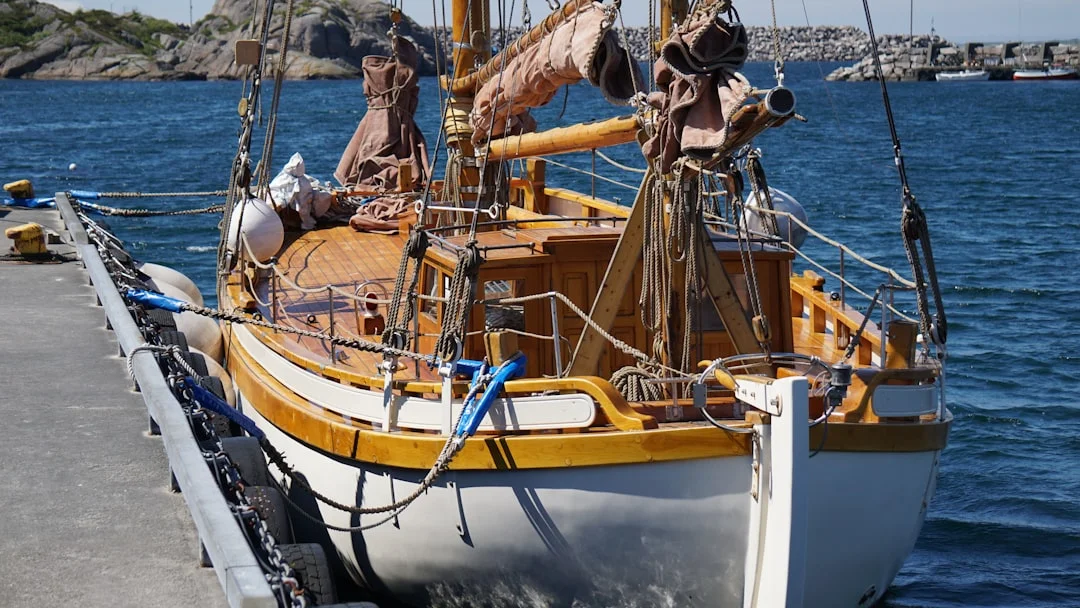
Photo by Cristian Soceanu on Unsplash
What to Buy, Concretely
If you have a 35-42 ft cruising sailboat and want a one-shot answer:
- Primary anchor: 20-25 kg Rocna, Mantus M2, or Spade S100
- Primary chain: 60 m of 8 mm G4 galvanized
- Snubber: 2 m of 14 mm three-strand nylon with a chain hook
- Shackle: Crosby G-209A, sized to match the chain, pin moused with stainless wire
- Secondary: Fortress FX-23, stowed with 5 m chain leader and 50 m of 14 mm three-strand nylon
Total cost, roughly: $1,400-$2,000 depending on brand and country. That's the same as one good dinner out per night for a fortnight in the Med — and it's the difference between sleeping and not sleeping for the rest of the boat's life. If you're budgeting a season's cruising and want to know how many anchorages you'll actually hit between legs, you can calculate distances between ports to plan how many nights at anchor you should prepare for.
Maintenance — The Part Nobody Does Until It Bites
Anchors and chain rust. Galvanizing wears off where the chain drags over the bow roller, where the anchor sits in the roller, and where the chain links rub against each other in the locker. Once the zinc is gone, steel rusts fast — sometimes within a single season in tropical water.
Every 2-3 years, re-galvanize the chain. A hot-dip re-galvanizing shop will charge roughly 1/3 the cost of new chain and return it with another 2-3 year lease on life. Lay the chain out on the dock, inspect every link for deformation or cracking, and discard anything suspect before you ship it out. Do the same for the anchor — most major brands accept anchors for re-galvanizing, and a Rocna at 10 years old looks new again.
Before every passage, check the shackle pin and the mousing wire. A pin that's backed out by 1 mm tells you it'll come out entirely by week three. Replace the wire, check the pin is snug, move on.
Frequently Asked Questions
What is the best anchor for a sailboat in 2026?
For most cruising sailboats, the best anchor is a new-generation design — a Rocna, Spade, Mantus, or Manson Supreme — sized one step larger than the manufacturer's recommendation. These designs self-right on the bottom, bite quickly in weed, and hold roughly 2-4× better than older ploughs in independent testing. Pair it with G4 high-test galvanized chain, a nylon snubber, and a moused shackle, and you have a system that works in almost every anchorage you'll visit.
How big an anchor do I need for a 40-foot sailboat?
A 40-foot cruising sailboat (around 8,000-10,000 kg displacement) should carry a new-generation anchor of 20-25 kg as a minimum. Bump to 25-33 kg if you anchor regularly in weed, strong currents, or winds over 25 knots. The weight penalty on the bow is small, and the holding margin is large — there is no practical reason to under-size a primary anchor for overnight cruising.
How much chain do I need for anchoring?
For a 35-45 ft sailboat, carry 60-80 meters of 8-10 mm G4 galvanized chain. That gives you 5:1 scope in 10-12 m of water with spare for deeper anchorages, plus a 5 m buffer you never pay out. Less than 50 m of chain on a cruising boat is a recipe for being forced into marinas on nights you'd rather be anchored out.
Do I need a swivel between the anchor and chain?
No. Modern anchor designs — Rocna, Spade, Mantus — are built to self-align as they load, and a twisted chain can be cleared by dropping the anchor back down and re-setting. Anchor swivels add a failure point, don't significantly reduce twist, and are implicated in a surprising number of lost-anchor stories. Use a plain galvanized shackle with the pin moused with stainless wire.
What scope should I use when anchoring overnight?
Use 5:1 as a minimum in settled weather, 7:1 when the forecast shows anything building, and 10:1 if you're in a storm or an exposed anchorage. Measure scope as length of rode paid out divided by depth from the bow roller (not the waterline) at high tide. Scope is the single most important variable in anchor holding — more than anchor type, more than chain size.
Is an all-chain rode better than chain plus rope?
For a cruising boat, all-chain is the standard — it resists chafe over coral and rock, stays on the seabed to keep the pull angle horizontal, and doesn't float up in weed. Mixed chain-and-rope rodes are fine for a kedge or secondary anchor where weight is a concern, but your primary should be all-chain unless you have a very specific reason otherwise. Add a nylon snubber to get stretch and shock absorption back into the system.
About the Author
Related Articles
Composting Toilet Sailboat: Manual vs Electric vs Composting
Compare marine head options—manual, electric, composting—costs, rules, and odor control. Choose the right setup for your boat. Read now.
By Breezada Team
How to Fuel a Boat: Fuel Dock Etiquette & Safety
Learn how to fuel a boat safely with fuel dock etiquette, diesel vs gas tips, and spill prevention. Follow our step-by-step checklist before you pump.
By Breezada Team

Float Plan Template: What to Include & Update
Use this float plan template with examples, check-ins, and shore contact tips. Copy the form and update it before every trip—stay SAR-ready.
By Breezada Team
Used Sailboat Survey Checklist: Sea Trial Red Flags
Use this used sailboat survey checklist to spot sea trial red flags, estimate survey costs, and negotiate smarter. Download the checklist now.
By Breezada Team