
Reefing a sail means reducing its area to match increasing wind. It is one of the most important skills any sailor can learn — and one of the most commonly delayed. The old adage holds: if you're thinking about reefing, you should have reefed ten minutes ago. Here's exactly when to do it, why it matters, and how to reef step by step on any cruising sailboat.

Photo by Kristel Hayes on Unsplash
What Does Reefing a Sail Mean?
Reefing is the controlled reduction of sail area while a sail remains set. Rather than dropping a sail entirely, you fold or roll away a portion of it — keeping the boat moving, but under less canvas. Think of it as shifting gears in a car. When the engine is screaming in second gear on the highway, you don't turn the engine off; you shift up. Reefing works the same way: you reduce power without shutting down the drive.
On a typical cruising sailboat, the mainsail is reefed using slab reefing (also called jiffy reefing), where the bottom of the sail is gathered and tied along the boom. Most boats have two or three reef points — sets of cringles and reef lines that allow progressive reduction. The headsail (jib or genoa) is usually reefed by roller furling: you roll it around the forestay from the cockpit.
The result is a smaller, flatter sail that generates less heeling force and less weather helm, allowing the helmsman to maintain control as conditions build.
When to Reef: Reading the Wind and the Boat
There is no single magic number. But here are practical guidelines that experienced offshore sailors rely on:
Wind Speed Thresholds
| Condition | True Wind Speed | Typical Sail Plan |
|---|---|---|
| Light air | 0–10 knots | Full main + full genoa |
| Moderate breeze | 10–15 knots | Full main + full jib (or partially furled genoa) |
| First reef territory | 15–20 knots | 1st reef in main + partially furled headsail |
| Second reef territory | 20–25 knots | 2nd reef in main + small jib |
| Heavy weather | 25–30 knots | 3rd reef (or trysail) + staysail or storm jib |
| Storm conditions | 30+ knots | Storm sails or bare poles |
These are rough guides for a typical 35- to 45-foot cruising boat. A lighter, sportier boat may need its first reef earlier. A heavy displacement bluewater yacht might carry full sail to 18 knots. Your boat's displacement, rig type, and sail cut all shift these numbers.
Signs It's Time — Even Without a Wind Instrument
You won't always have a wind gauge giving clean readings. Here's what the boat is telling you:
- Excessive heel — if the rail is going under or the crew is clinging to the high side, you're overpowered
- Weather helm increases — the tiller or wheel pulls hard toward windward; the rudder is fighting the rig
- Boat speed plateaus or drops — overpowered boats sometimes slow down because they're heeling too much and dragging the hull sideways
- Water over the leeward deck — spray on the foredeck is normal, green water washing the cockpit is not
- The crew is uncomfortable — people are bracing, not moving freely. This one matters more than you think
- Gusts are 10+ knots above the steady wind — even if the average wind feels manageable, repeated hard gusts mean you need less canvas up
The general rule: reef before you need to. It is always easier, faster, and safer to shake out a reef when the wind dies than to reef when you're already overpowered and the boat is on its ear.

Photo by Karla Car on Unsplash
Why Reef: Safety, Speed, and Sail Shape
Reefing isn't just about surviving a blow. A properly reefed boat often sails faster than an overpowered one. Here's why:
1. Reduced heel = more waterline length. When a monohull heels past 20–25 degrees, it presents less hull to the water and more topsides to the wind. The hull shape distorts, increasing drag. Bring the boat upright with a reef and you may actually gain half a knot.
2. Better sail shape. An overpowered mainsail twists open at the top, dumping energy into turbulence rather than forward drive. A reefed sail — smaller, flatter, and better trimmed — generates a cleaner aerodynamic profile. Power where you want it, not where the wind shoves it.
3. Less weather helm. Excessive heel moves the center of effort (CE) of the rig to leeward and forward of the center of lateral resistance (CLR) of the hull, forcing the boat to round up. The helmsman compensates with more rudder, which acts as a brake. Reef the main, and the CE-CLR balance improves — the rudder works less, drag drops, the boat tracks better.
4. Crew safety. An overpowered boat is a dangerous boat. It's harder to move around on deck, harder to tack or gybe, and harder to react to surprises — a lobster pot, a ferry, a sudden shift. Reefing restores control. If you're planning an offshore passage — say, Gibraltar to the Canary Islands — knowing how to reef quickly and cleanly is non-negotiable.
5. Gear preservation. Sailcloth, stitching, battens, sheets, blocks, and the rig itself all suffer under prolonged overloading. A torn sail at 25 knots is a far bigger problem than a reef at 18.
How to Reef a Mainsail: Step-by-Step (Slab/Jiffy Reefing)
This is the standard method used on the vast majority of cruising boats with a slab-reefed main. Your boat may have single-line or two-line reefing — the principle is the same.
Before You Start
Make sure you know where everything leads. On a boat you haven't sailed before, trace every reef line from the sail cringle, through the boom, to its cockpit clutch or winch. Do this in calm water, not at 22 knots.
Step-by-Step Procedure
Step 1 — Prepare the crew. Announce that you're reefing. Assign roles: one person on the halyard and tack, one person on the reef line (clew), the helmsman holding course. On a shorthanded boat, the helmsman does it all from the cockpit — which is why single-line reefing was invented.
Step 2 — Head up slightly or ease the mainsheet. You need to reduce load on the sail to make the next steps easier. Heading up 10–15 degrees toward the wind — not all the way into irons — unloads the leech. Alternatively, ease the mainsheet and traveler to depower without changing course. If you need to maintain course (e.g., running downwind in a building breeze), ease the vang instead.
Step 3 — Ease the main halyard. Lower the mainsail until the tack reef cringle reaches the boom. On most boats this means easing roughly 1.5 to 2.5 feet of halyard, depending on how deep the reef is. The luff of the sail should come down smoothly along the mast track or in the mast groove.
Step 4 — Secure the tack. Hook the tack cringle onto the ram's horn (a hook mounted at the gooseneck end of the boom) or pull down the tack reef line until the cringle is pinned tight against the boom. This new tack point must be rock solid — it becomes the new bottom-forward corner of your sail.
Step 5 — Tension the reef line (clew). Winch or pull the reef line — which runs from the boom, up through the clew reef cringle on the leech, and back down to the boom (or straight to the cockpit on a single-line system). Pull it tight until the new clew is snug against the boom and the foot of the sail is flat. A loose reef line means a baggy, inefficient sail.
Step 6 — Re-tension the halyard. Crank the halyard back up until the luff is tight. A saggy luff makes for a poor sail shape. The luff should have the same tension it had before reefing.
Step 7 — Trim the mainsheet. Bear away to your original course and re-trim. You'll probably need more mainsheet tension than before, since the sail is smaller and you can point more efficiently.
Step 8 — Tidy the bunt. The loose fold of sailcloth hanging below the boom — the bunt — should be neatly gathered and secured with sail ties or bungee cords threaded through the reef points (the small grommets along the reef line). This isn't just aesthetics; a flapping bunt can snag on hardware, block visibility, and eventually tear.
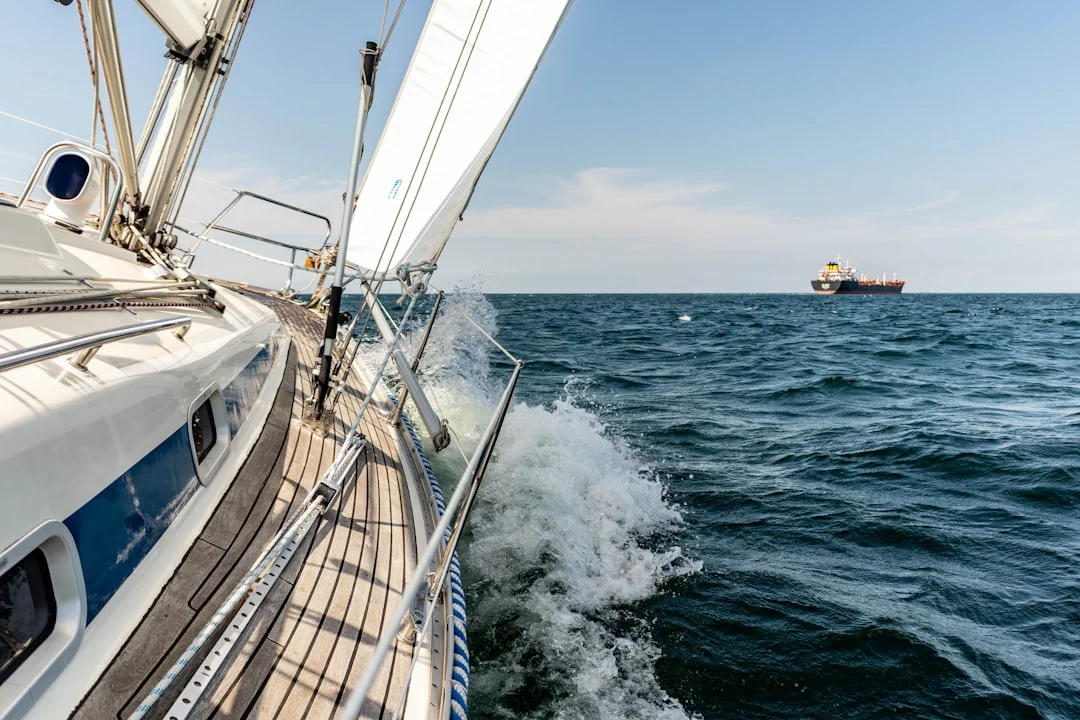
Photo by Michael Held on Unsplash
Taking Out a Reef (Shaking Out)
When the wind drops and you want full sail again, reverse the process:
- Ease the reef line completely
- Ease the halyard slightly, unhook the tack cringle
- Hoist the halyard to full
- Remove sail ties from the bunt
- Trim and sail
Always wait until you're confident the wind has genuinely eased — not just a temporary lull between gusts. Shaking out a reef only to reef again ten minutes later is exhausting and demoralizing.
How to Reef a Headsail: Roller Furling
Most modern cruising boats use a roller-furling headsail, which makes partial reefing straightforward — at least in theory.
To reef: From the cockpit, ease the jib sheet and pull on the furling line. The sail wraps around the forestay. When the desired amount is furled away, cleat the furling line and re-trim the sheet. You can calculate the distance between waypoints on your passage to decide how much canvas you'll need for each leg.
The catch: Partially furled headsails rarely set as well as purpose-cut smaller sails. When you roll away 30–40% of a 150% genoa, the remaining sail shape is baggy and the draft is too far aft. Performance suffers, especially upwind. This is why serious offshore boats carry a dedicated staysail or multiple headsails on a removable inner forestay.
Practical tips for roller furling:
- Don't over-furl — leaving just a narrow strip of sail flogging is worse than either having the sail properly set or fully furled
- Consider adding foam luff padding to your furling headsail; it fills the gap when the sail is partially rolled and dramatically improves the shape
- If the furler jams under load, head up to depower before fighting it. Never wrap a sheet around a winch and grind with the sail loaded — you'll destroy the furling drum
If you're still building your sailing skills and learning techniques like tacking and sailing upwind, reefing the headsail by roller furling is a great place to start. It's cockpit-controlled, low-risk, and immediately effective.
In-Mast and In-Boom Furling: Special Considerations
Some cruising boats use in-mast furling mainsails, which roll into the mast like a roller-furling jib. Others use in-boom furling, which rolls into the boom. Both eliminate the need for slab reefing — you just furl from the cockpit.
The advantages are obvious: no going to the mast, no tack hooks, no sail ties. But there are trade-offs:
- Sail shape is compromised — in-mast sails can't have full-length battens, so they don't set as well as a traditional main
- Jamming under load — if the sail wraps unevenly inside the mast or boom, clearing the jam in 25 knots of wind is a serious problem
- Maintenance — furling mechanisms inside hollow spars are harder to inspect and service
If your boat has furling, practice using it at various wind strengths and points of sail. Knowing the system's quirks before a squall arrives is vastly preferable to learning them during one.

Photo by Evan Smogor on Unsplash
Common Reefing Mistakes
Even experienced sailors make these errors. Watch for them:
1. Reefing too late. The most common mistake by a wide margin. At 25 knots with the boat on its ear, the loads on every line are dramatically higher, crew movement on deck is dangerous, and the maneuver takes three times as long. Reef early, reef easy.
2. Not tensioning the halyard after reefing. A saggy luff destroys windward performance. After hooking or pulling down the tack and tensioning the clew, always re-crank the halyard.
3. Leaving the bunt untied. That flapping fold of Dacron will chafe on spreaders, lifelines, and hardware. It'll also catch water like a scoop in rain or spray. Tie it up.
4. Easing only the main without touching the headsail. Sail balance matters. If you reef the main but leave a full genoa flying, the CE shifts forward, you develop lee helm, and the boat wants to bear away — the opposite of what you want in rising wind. Reef both sails proportionally to maintain balance.
5. Not practicing. Reefing is a muscle-memory procedure. If the first time you reef is in a 25-knot squall at night, things will go wrong. Practice in 15 knots on a sunny afternoon. Run through it repeatedly until every crew member knows the sequence.
How to Practice Reefing
The best way to build reefing confidence is deliberate practice. Here's a drill:
- Pick a calm day with 12–15 knots of breeze
- Sail on a beam reach
- Talk through the procedure out loud as you do it
- Reef the main one point, time the maneuver — aim for under 3 minutes with a two-person crew
- Sail for 10 minutes, assess the trim
- Shake the reef out
- Repeat, trying to improve your time and smoothness
Do this drill every few months, and especially before any offshore passage. If you're working toward a sailing certification, reefing under controlled conditions is almost always part of the practical exam — and for good reason.
You can use Breezada's sea distance calculator to plan a practice route along the coast where conditions are likely moderate, then use the real-time experience to build your reefing skills.
Night Reefing: A Few Extra Precautions
Reefing at night is the same procedure, but everything is harder. A few things that help:
- Rig the reef lines during your watch briefing — know where they are before you need them
- Use a headlamp on red mode — preserves night vision while still letting you see the sail
- Clip on — always wear a harness and tether when going forward at night, full stop
- Communicate clearly — the person on the halyard needs to hear "down" and "made fast" over the wind
- Over-reef slightly — at night, it's better to be slightly under-canvassed than to find out at 0300 that you need a second reef
Reefing Gear Checklist
Before any passage, confirm that all reefing hardware is functional:
| Item | Check |
|---|---|
| Reef lines (1st, 2nd, 3rd) | Run freely, no chafe, proper length |
| Tack hook / ram's horn | Secure, correct size for cringle |
| Halyard clutch | Holds under full load, releases smoothly |
| Reef cringle reinforcement | No torn stitching at tack or clew |
| Sail ties or bungee cords | Enough to tidy the bunt (6–8 per reef) |
| Roller furling drum & line | Smooth rotation, line not frayed |
| Winch handles | Accessible from the reefing station |
Frequently Asked Questions
How many reefs does a typical cruising sailboat have?
Most cruising sailboats have two or three reef points in the mainsail. Two reefs are standard on boats under 40 feet; a third deep reef is common on bluewater boats over 40 feet. Each reef reduces the mainsail area by roughly 20–30%, so a double-reefed main is about 40–55% of its full size. Some boats also carry a trysail — a small, heavy-duty storm sail that replaces the main entirely in survival conditions.
Can you reef a sail while sailing downwind?
Yes, but it's trickier. Downwind, the mainsail is loaded and pressed against the rigging, making the halyard harder to ease and the sail harder to control as it comes down. The safest approach is to head up to a broad reach or beam reach before reefing, which unloads the leech and lets the sail slide down more easily. If you must reef on a dead run (say, in a building following sea where turning feels risky), ease the vang first to reduce leech tension, then proceed carefully.
What's the difference between reefing and furling?
Reefing reduces a sail's area while keeping it set. Furling rolls or folds a sail away entirely — the headsail around the forestay, or the mainsail into the mast or boom. In practice, a roller-furling headsail blurs the line because you can partially furl it (which is effectively reefing). Slab reefing the mainsail is the traditional and most reliable method, while in-mast or in-boom furling offers convenience at the cost of sail shape and mechanical complexity.
Should I reef the main or the headsail first?
For most boats and conditions, reef the mainsail first. Reducing the main reduces heel and weather helm most effectively, since the main is the higher sail and generates more heeling moment. That said, if you're sailing with a large overlapping genoa and a moderate main, furling in 20–30% of the genoa first may be quicker and easier since it's cockpit-controlled. The key is maintaining balance: both sails should be reduced roughly proportionally.
How long does it take to reef a sail?
With a practiced crew and a well-set-up boat, a single slab reef takes 2–4 minutes from the decision to reef to sailing again with trimmed sails. Single-line reefing systems can be even faster — under 2 minutes. On a boat with unfamiliar rigging, or with an inexperienced crew, it can take 10–15 minutes. This is exactly why practicing in moderate conditions is so valuable. Speed comes from familiarity with the sequence, not from rushing.
Is it possible to reef a spinnaker?
Not in any practical way. Spinnakers are designed for light-to-moderate downwind sailing and have no reef points. When the wind builds beyond a spinnaker's range — typically 15–18 knots apparent for a cruising chute — you douse the spinnaker entirely and switch to a poled-out jib or sail under mainsail alone. Some boats use asymmetric spinnakers with a top-down furler, which lets you roll the sail away from the cockpit, but that's furling, not reefing.
About the Author
Related Articles
How to Dock in a Slip: Finger Piers, Wind & Current
Learn how to dock in a slip with finger piers—bow-in or stern-in—handling wind, current, and prop walk. Get the step-by-step plan now.
By Breezada Team

San Francisco Bay Sailing: Winds, Tides & Hazards Guide
Plan safer San Francisco Bay sailing with wind patterns, tides, currents, fog and key hazards. Use this guide to pick a route and go sail today.
By Breezada Team
Sailboat Engine Won't Start: Diagnostic Flowchart
Troubleshoot a sailboat engine that won't start with a step-by-step flowchart for batteries, starter, fuel, air, glow plugs & alarms. Fix it now.
By Breezada Team
Sailboat Bottom Paint Guide: Types, Costs & Prep
Learn sailboat bottom paint types, costs, and prep steps—plus how often to repaint. Get the right antifouling plan for your boat today.
By Breezada Team