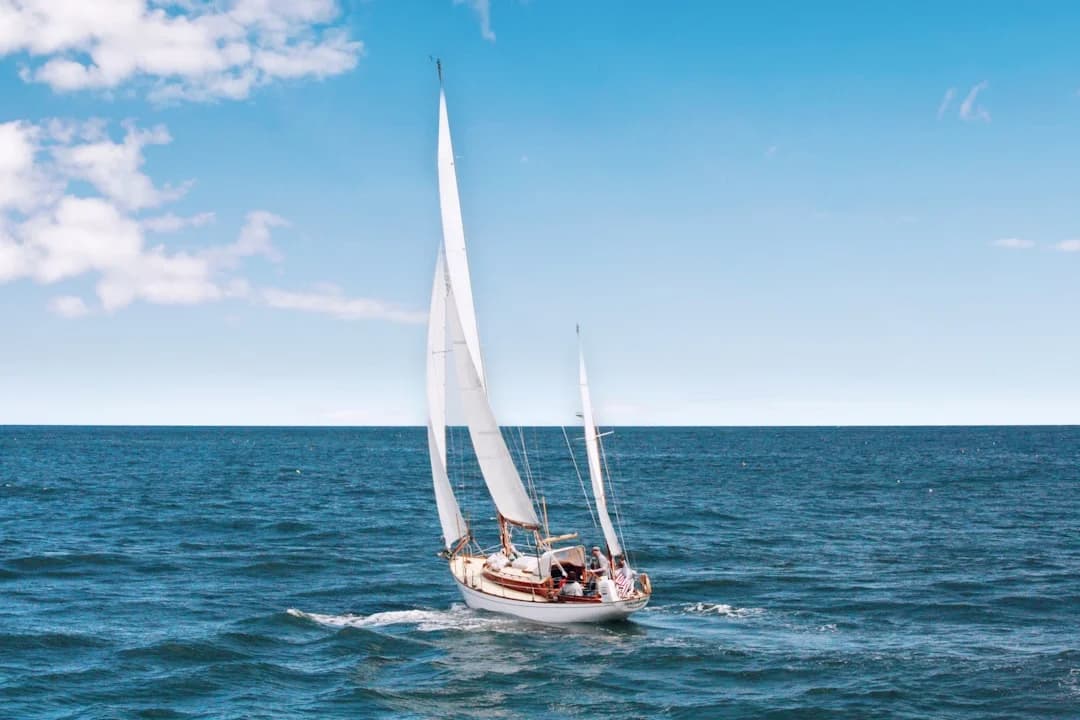
You can't sail directly into the wind — no sailboat ever built can do that. But you can sail remarkably close to it, zigzagging your way upwind through a technique called tacking. It's the single most important skill that separates a competent sailor from someone who just goes where the breeze pushes them. Understanding how to sail against the wind means understanding the physics of lift, the geometry of angles, and the rhythm of a boat working hard to get where it needs to go.
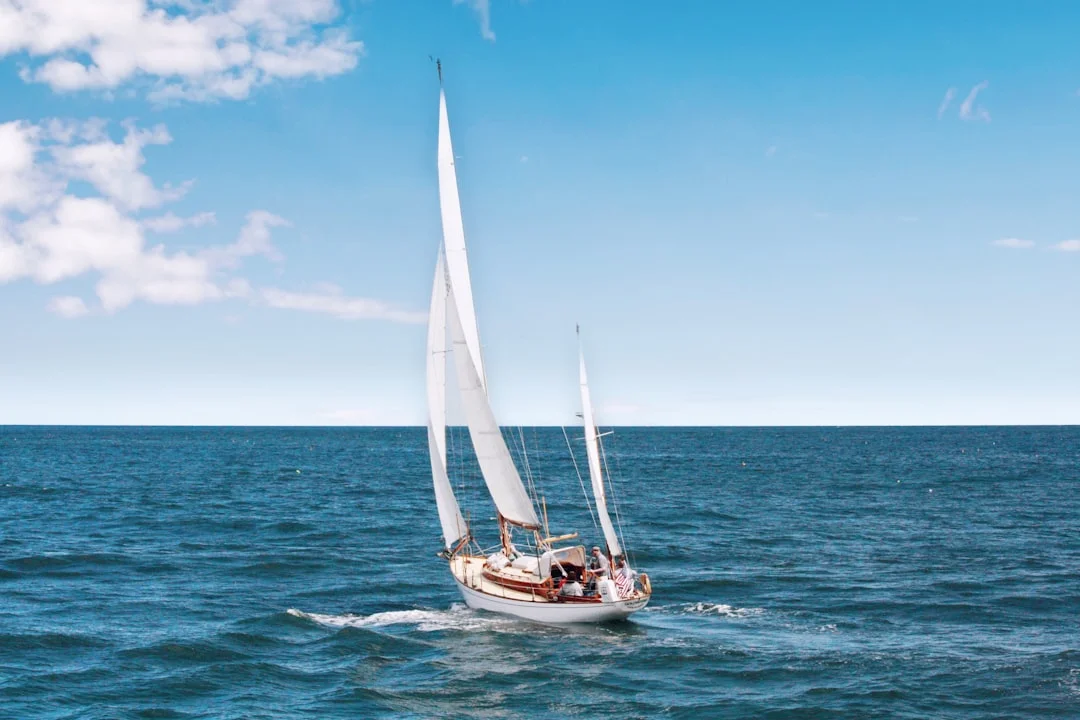
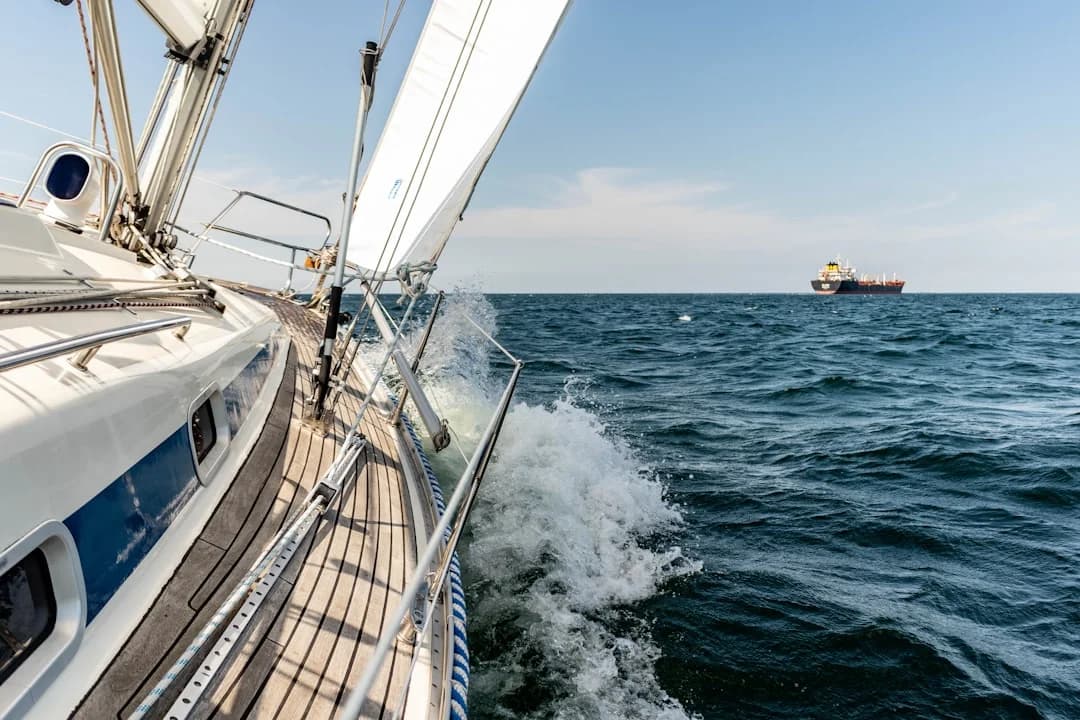
Photo by Kristel Hayes on Unsplash
Why You Can't Sail Straight Into the Wind
Every sailboat has what's called a no-go zone — a cone of roughly 35 to 50 degrees on either side of the true wind direction where the sails simply can't generate power. Point your bow directly into the wind and the sails luff uselessly, flapping like laundry on a line. The boat stalls. You drift backward. It's not a technique problem — it's physics.
The reason is aerodynamic lift. A sail works much like an airplane wing turned on its side. Wind flowing over the curved surface of a properly trimmed sail creates a pressure difference — low pressure on the leeward side, higher pressure on the windward side. This generates a force that pulls the boat forward and sideways. The keel resists the sideways component, converting most of that energy into forward motion. But for this system to work, the wind needs to hit the sail at an angle. No angle, no lift.
Modern racing yachts with tall rigs, efficient keels, and stiff hull designs can point as high as 30 to 35 degrees off the true wind. A typical cruising monohull manages about 40 to 45 degrees. Catamarans, despite their speed advantages off the wind, often struggle to point higher than 50 degrees — something worth knowing if you're weighing your options between hull types. Our monohull vs catamaran comparison covers these performance trade-offs in detail.
The size of your no-go zone depends on several factors: sail cut and condition, hull shape, keel design, sea state, and how well you trim. An old, stretched-out headsail on a full-keel cruiser might give you a no-go zone of 110 degrees total. A well-tuned J/70 with flat sails and a deep fin keel? Maybe 65 degrees. The difference matters — it determines how many tacks you'll need and how long your upwind passage takes.
Understanding Points of Sail: Close-Hauled Explained
Before we get into the mechanics of tacking, you need to understand where "close-hauled" fits in the spectrum of sailing angles.
| Point of Sail | Angle to Wind | Sail Trim | Boat Speed |
|---|---|---|---|
| In Irons (No-Go Zone) | 0–35° | Sails luffing, no power | Stalled |
| Close-Hauled | 35–50° | Sheets tight, sails flat | Moderate |
| Close Reach | 50–70° | Sheets eased slightly | Good |
| Beam Reach | 80–100° | Sheets halfway out | Fastest |
| Broad Reach | 110–150° | Sheets well eased | Fast |
| Running | 150–180° | Sails out, possibly wing-on-wing | Moderate |
Close-hauled is where you spend your time when sailing against the wind. The sails are sheeted in tight — almost centerline. The boat heels noticeably. The motion is choppier because you're punching into waves rather than riding with them. It's the least comfortable point of sail, but it's where skilled sailors earn their reputation.
When sailing close-hauled, your telltales become your best friends. Those little strips of yarn or ribbon on your jib should stream straight back on both sides. If the windward telltale lifts, you're pointing too high — bear away a few degrees. If the leeward telltale flutters, you're too low — head up. Getting this right is a constant, small adjustment — a conversation between you, the sails, and the wind.

Photo by Markos Mant on Unsplash
How Tacking Works: The Step-by-Step Mechanics
Tacking is the maneuver of turning the bow through the wind so that the wind shifts from one side of the boat to the other. You go from close-hauled on starboard tack (wind coming over the starboard/right side) to close-hauled on port tack (wind coming over the port/left side), or vice versa.
Here's the sequence broken down:
1. Prepare the Crew
The helmsperson calls "Ready about!" — this alerts the crew that a tack is coming. The crew member on the jib sheets confirms they're ready by responding "Ready!" On a shorthanded boat, you might be doing both jobs, in which case you're just talking to yourself. It happens.
2. Initiate the Turn
The helmsperson calls "Helm's alee!" (or simply "Tacking!") and pushes the tiller away from them (toward the leeward side) or turns the wheel to windward. The bow begins swinging through the wind.
3. Release and Sheet the Jib
As the bow passes through the eye of the wind, the jib will begin to back — the wind catches it on the wrong side. The crew releases the working jib sheet and quickly hauls in the new leeward sheet. Timing is critical. Release too early and you lose power before the turn completes. Release too late and the backed jib stalls the boat or pushes the bow back.
4. Settle on the New Tack
Once through the wind, the helmsperson brings the boat to the new close-hauled course. The mainsail swings across on its own — it's on a traveler or loose enough to self-tack. The crew trims the jib to the correct angle on the new side. The helmsperson finds the groove again — that sweet spot where the telltales stream and the boat drives forward without excessive heel.
The whole maneuver should take 8 to 15 seconds on a well-sailed 35-foot cruiser. Racing boats do it in under 5. A sloppy tack on a heavy cruiser can take 30 seconds or more, during which you're losing ground to windward — what sailors call VMG (Velocity Made Good).
Common Tacking Mistakes
- Turning too slowly: The boat loses momentum in the middle of the tack and gets stuck head-to-wind ("in irons"). This is the most common beginner error.
- Over-steering: Turning too far past close-hauled on the new tack, ending up on a close reach and losing windward progress.
- Late jib release: The backed jib acts as a brake and can push you back onto the old tack.
- Sheeting the new jib too tight too fast: This stalls the airflow. Sheet gradually, let the boat accelerate, then fine-tune.
If you're still building foundational sailing skills, our beginner's guide to sailing covers the basics of boat handling before you tackle upwind work.
Sail Trim for Upwind Performance
Getting your sails right when beating to windward is an art that sailors spend years refining. Here are the fundamentals.
Jib/Genoa Trim
The headsail does most of the heavy lifting upwind. Key adjustments:
- Sheet tension: Tight enough to keep the foot close to the deck, but not so tight the leech cups inward and stalls. Watch the upper telltales — if they stall before the lower ones, your sheet is too tight or your lead is too far aft.
- Lead position: The jib sheet lead (car or block position on the rail) controls the twist of the sail. Move it forward to tighten the leech, aft to open it. When all three sets of telltales break at roughly the same time as you luff up, your lead is correct.
- Halyard tension: Enough to remove horizontal wrinkles along the luff, but no more. Over-tightening creates vertical wrinkles and moves the draft too far forward.
Mainsail Trim
- Mainsheet: In moderate wind, the top batten should be roughly parallel to the boom. Over-sheeting is the most common error — it creates excessive heel without forward drive.
- Traveler: Use the traveler to control the boom's lateral position without changing the sail's twist. In light air, bring the traveler up to windward. In heavy air, ease it to leeward to depower.
- Backstay: Tightening the backstay flattens the main and opens the leech — critical in heavy air for reducing helm pressure.
- Cunningham/outhaul: Pull both on as the wind builds. The cunningham moves the draft forward (good for heavy air). The outhaul flattens the lower third of the sail.
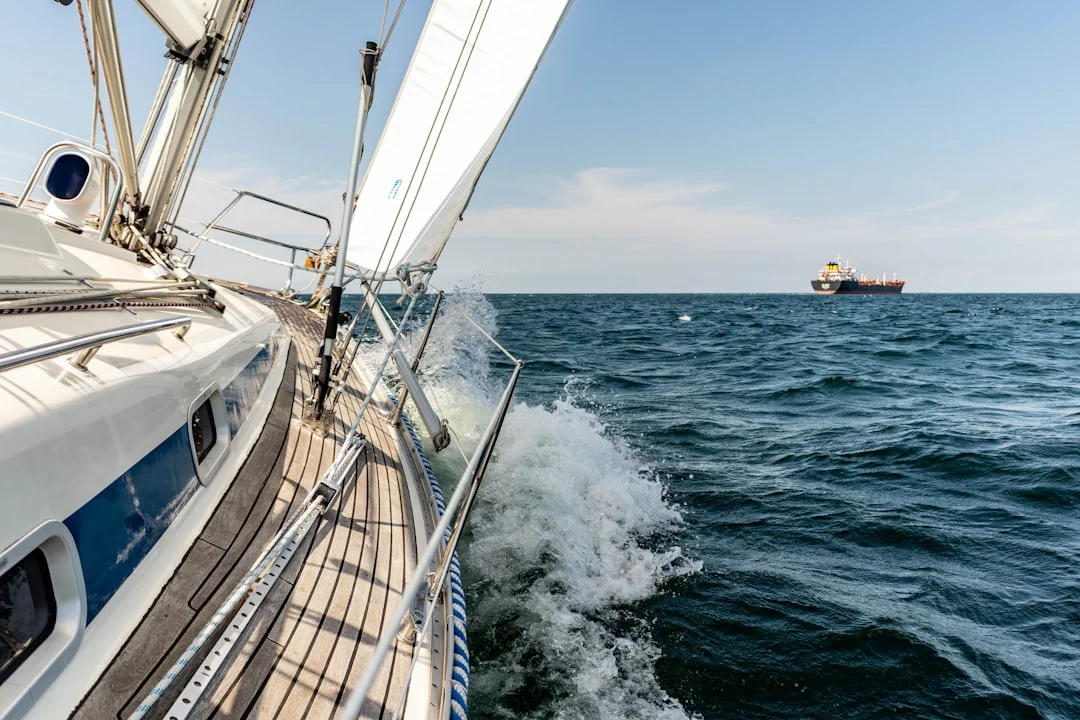
Photo by Michael Held on Unsplash
Upwind Strategy: When and Where to Tack
Knowing how to tack is one thing. Knowing when to tack is where strategy comes in.
Tacking Angles and VMG
Your Velocity Made Good (VMG) is the component of your boat speed that's actually getting you closer to your upwind destination. If you're sailing at 6 knots on a close-hauled course 45 degrees off the wind, your VMG to windward is roughly 4.2 knots (6 × cos 45°). Pinch up to 35 degrees and your boat speed might drop to 4.5 knots, but your VMG could actually be similar — 3.7 knots (4.5 × cos 35°). The math matters.
Most sailors do better sailing a bit freer and faster rather than pinching and going slowly. The exception is short tacking in a narrow channel, where every degree of pointing angle counts.
You can calculate the distance between waypoints before you leave the dock to estimate how many tacks your upwind leg will require. Knowing the total distance helps you plan rest breaks, sail changes, and crew rotations.
Wind Shifts: Lifts and Headers
This is the key to efficient upwind sailing. Wind rarely blows from a constant direction — it oscillates.
- A header is a wind shift that forces you to bear away from your target. When you get headed, tack immediately. You'll be lifted on the other tack.
- A lift is a wind shift that lets you point closer to your target. Stay on the lifted tack and enjoy the free windward gain.
The basic rule: tack on headers, ride the lifts. Sailors who follow this rule consistently gain significant ground over those who tack on a fixed schedule.
Geographic Considerations
Wind bends around headlands, accelerates through gaps, and dies in the lee of high islands. When planning an upwind passage:
- Favor the tack that takes you toward the next wind shift — often toward shore where thermal effects are strongest
- Stay in current that helps you — even half a knot of favorable current adds up over hours
- Avoid the wind shadow of land or other vessels — a wind shadow can extend 7 to 10 times the height of the obstruction
- In open ocean, watch the clouds — darker patches on the water indicate gusts; sail toward them for better pressure

Photo by Evan Smogor on Unsplash
Heavy Weather Upwind: When the Wind Fights Back
Sailing upwind in 12 knots of breeze is pleasant. Sailing upwind in 25+ knots is a different sport entirely. The waves get steep, the boat pounds, spray comes over the bow in sheets, and every tack feels like a controlled crisis.
Depowering Techniques
When it's blowing hard and you're beating to windward, you have several options to stay in control:
- Reef the main — first reef at 15–18 knots apparent, second reef at 22–25 knots. These numbers vary by boat, but don't wait until you're overpowered. The old saying holds: "If you're thinking about reefing, you should have reefed 20 minutes ago."
- Change to a smaller headsail — swap the genoa for a working jib or unfurl to a smaller area if you have roller furling. A small, flat jib is far more efficient upwind in heavy air than a partly furled genoa with a baggy shape.
- Ease the traveler — dropping the traveler to leeward reduces heel without losing much forward drive.
- Tighten the backstay — flattens the main and opens the leech, spilling wind from the top of the sail.
- Increase the outhaul and cunningham — flattens the lower main and moves draft forward.
Sea State Management
Waves are often a bigger problem than wind when going upwind. A steep, short chop will stop a boat cold. Techniques:
- Foot off slightly in big waves — sailing 5 degrees lower but maintaining speed through waves gives better VMG than pinching and slamming to a halt every time a wave hits.
- Steer actively — bear away slightly as a large wave approaches to take it at a less steep angle, then head up on the back side.
- Weight forward or aft depending on your boat — some hulls do better with crew weight aft to lift the bow over waves; others need it centered to prevent hobby-horsing.
Motoring vs. Sailing: When to Accept the Iron Genny
There's no shame in it. If you're trying to make 40 nm to windward in 30 knots of breeze and 8-foot seas, the math might simply not work under sail. You'll be exhausted, the crew will be miserable, and the boat will take a beating. Anyone who has tried beating through the Cyclades during a yacht charter in Greece knows this feeling well.
Experienced cruisers often motor-sail in tough upwind conditions — keeping the main up for stability while using the engine for forward drive. This can give you a course 20 to 30 degrees closer to the wind than pure sailing and a much more comfortable motion.
Use Breezada's sea distance calculator to check the exact nautical miles for your planned passage. Sometimes the smart move is to wait for a wind shift, take a longer route that avoids beating, or break the trip into two legs with a stop to let conditions change.
Practicing Upwind Sailing: Building Your Skills
Like most sailing skills, tacking and upwind work get better with deliberate practice. Here's how to build competence:
In light winds (5–10 knots):
- Practice tacking every 30 seconds to build muscle memory
- Experiment with telltale response — deliberately pinch too high and bear off too low to learn the limits
- Sail a triangle course: upwind, beam reach, downwind, repeat
In moderate winds (10–18 knots):
- Focus on smooth, coordinated tacks with minimal speed loss
- Practice reading wind shifts — use landmarks or a compass to track wind direction changes
- Try to hit a specific upwind target (a buoy, a landmark) in the fewest tacks possible
In heavier winds (18–25 knots):
- Practice reefing before going out — a slab reef should take under 3 minutes
- Work on depowering techniques while maintaining VMG
- Practice roll tacking (using heel to assist the turn) on smaller boats
Upwind Skill Progression
| Skill Level | Benchmark |
|---|---|
| Beginner | Can complete a tack without getting stuck in irons |
| Intermediate | Consistent tacks with less than 20% speed loss, reads telltales |
| Advanced | Tacks on headers, uses sail trim to control heel, efficient VMG |
| Expert | Reads wind shifts 2–3 minutes ahead, optimizes tacking angles for current and waves |
Frequently Asked Questions
How close to the wind can a sailboat actually sail?
Most modern cruising sailboats can sail between 40 and 45 degrees off the true wind. High-performance racing yachts can point as high as 30 to 35 degrees. No sailboat can sail directly into the wind — the practical limit depends on hull design, keel efficiency, sail shape, and sea conditions. Older full-keel designs and multihulls typically have wider no-go zones of 50 degrees or more.
What is the difference between tacking and jibing?
Tacking turns the bow through the wind — the front of the boat crosses the wind direction. You go from close-hauled on one side to close-hauled on the other. Jibing (or gybing) turns the stern through the wind — used when sailing downwind. Jibing is generally considered more dangerous because the boom swings across with significant force, while tacking is a controlled, slower transition.
Why does my sailboat get stuck in irons when I try to tack?
Getting stuck "in irons" (head-to-wind with no forward momentum) usually happens because you turned too slowly, didn't have enough boat speed entering the tack, or the waves killed your momentum mid-turn. To recover, push the jib to one side (back it) to force the bow off the wind, or let the boat drift backward and use the rudder in reverse. To prevent it, build speed before tacking and turn decisively — not too fast, not too slow.
How many tacks does it take to sail upwind to a destination?
It depends on the distance, your pointing angle, and wind shifts. For a destination 10 nm dead upwind, a boat pointing at 45 degrees would sail roughly 14.1 nm total (two equal legs of the triangle). With wind shifts and practical course adjustments, expect to actually sail 15 to 18 nm — about 1.5 to 1.8 times the straight-line distance. You can plan this ahead using a sea distance calculator.
Is it faster to tack frequently or make long tacks?
In steady wind with no shifts, fewer, longer tacks are faster because each tack costs speed — typically 0.5 to 1.5 knots lost during the maneuver, taking 30 seconds to 2 minutes to recover. However, in shifting wind, tacking on headers (even if it means more frequent tacks) produces better VMG. The optimal strategy balances minimizing tack losses against capitalizing on wind shifts.
Can a catamaran sail as close to the wind as a monohull?
Generally, no. Most cruising catamarans point to about 50 to 55 degrees off the wind, compared to 40 to 45 degrees for monohulls. This is because catamarans lack a deep ballasted keel to resist leeway. However, catamarans compensate with higher speed on all other points of sail — they can often reach a windward destination just as fast by sailing a wider angle at significantly greater speed.
About the Author
Related Articles

Bahamian Moor Guide: Tandem Anchors & Snubbers
Learn bahamian moor setup, tandem anchoring, and proper snubbers for crowded anchorages. Get step-by-step tips—read and rig it right.
By Breezada Team
Best Radar Reflector for Sailboat: Active vs Passive
Compare active vs passive radar reflectors for sailboats, mounting tips, and real-world results. Choose the best radar reflector—read now.
By Breezada Team

Sail Trim for Beginners: Main + Jib Cruising Guide
Learn sail trim for beginners with simple main + jib settings, telltales, twist, traveler & vang. Get quick wind-based trims—read now.
By Breezada Team
Sailboat Bimini Guide: Dodger & Enclosure Choices
Learn how to choose a sailboat bimini, dodger & cockpit enclosure—materials, fit, costs, and DIY vs pro. Get the right setup today.
By Breezada Team