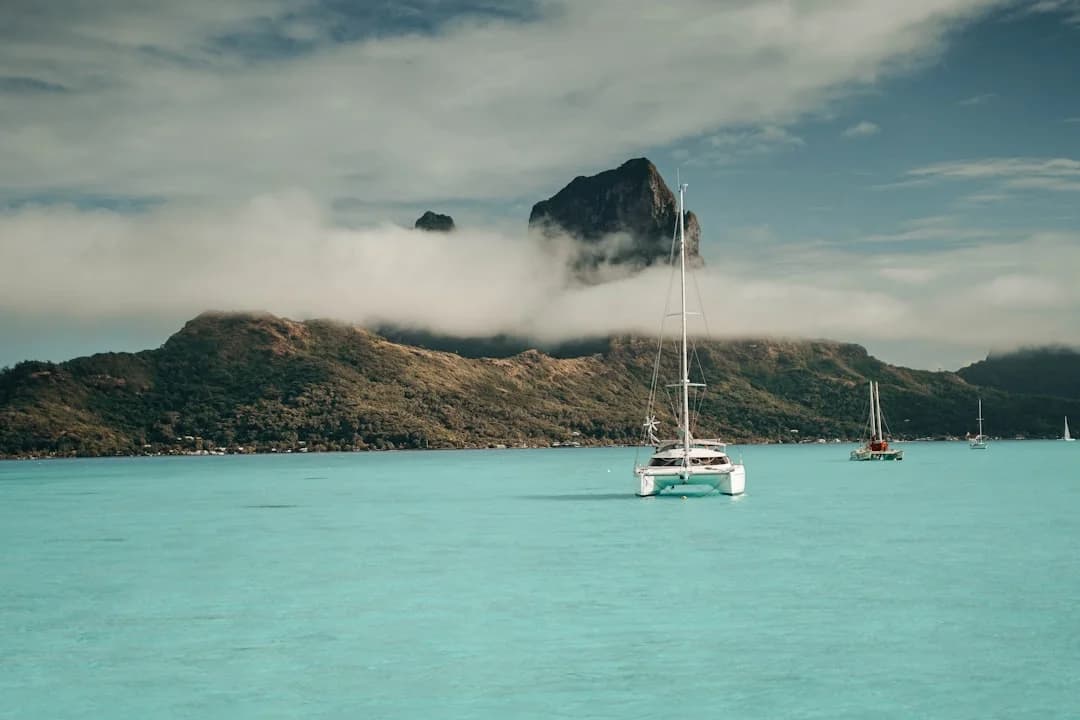
Tahiti to Bora Bora Itinerary: 7–10 Days Sailing
Tahiti looks close to Bora Bora on the brochure map. On a boat, it’s close enough to be doable in a week, and far enough to punish sloppy planning—mostly because lagoon pilotage eats time, and passes don’t care about your dinner reservation. The great-circle distance from Papeete (Tahiti) to Vaitape (Bora Bora) is about 140 nm, typically 22–30 hours at 5.0–6.5 kn, but your real “itinerary distance” is the sum of lagoon exits, tacks around acceleration zones, and detours for daylight pass entries.
Use Breezada’s plan your route using a sea distance calculator early, then use it again after you’ve chosen your passes and anchorages. In the Leewards, a “straight line” is usually a hopeful suggestion.
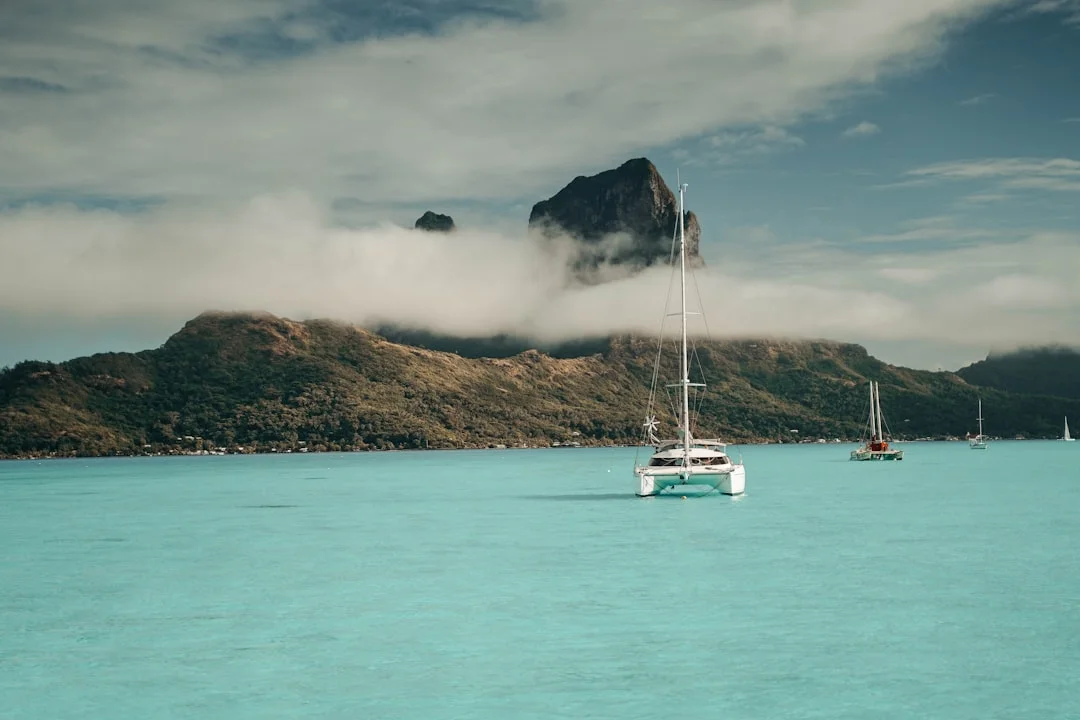
Photo by Benedikt Brichta on Unsplash
Quick-View 7–10 Day Tahiti to Bora Bora Itinerary (nm, ETAs, season)
7-day “efficient” variant: 1 overnight + short lagoon hops
If you’ve only got 7 days, the cleanest move is to accept one overnight and stop pretending you’ll “just do it in daylight” without burning half the trip on check-ins, lagoon transits, and waiting for good light. A common pattern is Tahiti (or Moorea) straight to Huahine (85–95 nm), then keep the rest as 25–30 nm hops: Huahine → Raiatea/Tahaa and 20–25 nm to Bora Bora. At 5.5 kn, that Moorea–Huahine leg is about 16–18 hours, but plan it at 4.8–5.0 kn if squalls are forecast.
The reason skippers like the longer first leg is simple: every lagoon entry/exit has a time tax. Even a “quick” pass transit can become 60–120 minutes of setup, briefing, bow lookout, and slow-speed piloting, plus the extra miles to line up with marks. Do that twice a day and you’ll be very good at moving, and not very good at enjoying Polynesia.
10-day “slow travel” variant: add Tahaa, Huahine, slack days
With 10 days, you can be honest about fatigue and daylight. You add a true Tahaa day (not just a lunch stop), a second Huahine anchorage, and at least one slack/contingency day that isn’t immediately sacrificed to “making up time.” That slack day is what keeps you from entering Bora Bora in low sun with coral heads turning invisible—an activity I don’t recommend.
A solid 10-day shape is: Tahiti/Moorea shakedown, Moorea → Huahine (overnight), Huahine → Raiatea, Tahaa lagoon day, then Raiatea/Tahaa → Bora Bora (20–25 nm) with time to wait for the best light window at the pass. You’ll still sail plenty; you’ll just stop sailing at the worst possible times.
Best season and what “typical” trades actually feel like
The dry season is roughly May–October, with SE trades commonly 12–20 kn, and gusts higher in squalls. “Typical” is a reach that turns into a lumpy motor-sail when you get an island acceleration zone or a sloppy cross-swell. Build your day around reefing early and arriving early, not around squeezing 0.4 knots more out of a tired crew.
If you want conservative ETAs, assume 4.5–5.0 kn for planning and treat 6.0–6.5 kn as a nice surprise. Remember: this is an inter-island cruising itinerary, not one long passage. Lagoon pilotage time is the hidden variable that decides whether you’re anchored by 1500—or still arguing about which bommie “looks like” the chart at 1830.
Route Planning & Sea Distances: winds, angles, and night-passage calls
Distance planning: great-circle vs sailed distance in the Leewards
On paper, Tahiti to Bora Bora is ~140 nm. In practice, the sailed distance grows because you rarely depart from “Tahiti,” you depart from a marina, then motor to a pass, then sail on a course that matches the wind angle you’re actually given. Add another few miles to approach the next pass on a sane line with good light, and you’re now planning by legs, not by brochure.
This is where Breezada’s sea distance calculator earns its keep: run the Moorea → Huahine (85–95 nm) line, then sanity-check it against your likely pass choices and any lee-side detours. If your route forces you to pinch upwind in 18–20 kn, your speed prediction should drop—because reefing and comfort decisions are speed decisions.
Wind angle reality: when it’s a reach vs a lumpy motor-sail
The SE trades are generous when the angle lines up, and unpleasant when it doesn’t. Around high islands, expect acceleration zones where 12–15 kn becomes 18–25 kn for an hour, and then a wind shadow that leaves you slatting and starting the engines. That’s normal, not a failure of your sail trim.
Treat “average speed” as a product of sail plan changes. If you reef early in squalls (you should), your average SOG drops, but your crew stays functional—especially on charter boats where the winches have seen things, and the mainsail track may not love last-second drama.
Night watch model and fatigue management for charter crews
For a charter crew, I like 2–3 hour watches at night, even with four adults aboard, because people actually stay awake. In the tropics you’ll often have 8–12 hours of darkness, which means a 50–70 nm segment can be largely night sailing if you depart late. Plan your departure so you arrive at the next pass in daylight, not so you “get a full day” and then arrive when the water turns metallic and unreadable.
Before any dusk-to-dawn segment, verify navigation lights per ABYC A-16, and then verify them again by looking back from the dinghy dock or a buddy boat. COLREGs don’t care that the charter base “checked it last week.”
Go/no-go triggers: squalls, reefing thresholds, sea state
A practical go/no-go is built on thresholds the crew can follow. If squall lines are organized and gusts are consistently 10+ kn above the forecast, plan on reefs in early and a reduced target speed. If the sea state is short and steep enough that the boat is hobby-horsing and the off-watch can’t sleep, you’re not “making good time”—you’re burning tomorrow.
I frame this with a SOLAS V mindset: voyage planning, proper lookout, and a plan that survives reality. Add AIS discipline if fitted, keep a working VHF watch, and accept that postponing a departure by 2–3 hours to improve arrival light can be the best performance upgrade you’ll ever buy.
Photo by Meg von Haartman on Unsplash
Day-by-Day Leeward Islands Sailing Route (Tahiti/Moorea → Huahine → Raiatea/Tahaa → Bora Bora)
Days 1–2: Papeete/Marina Taina setup, Moorea shakedown options
Day 1 is base day: paperwork, provisioning, and systems checks. In Papeete (often Marina Taina), I do a short sea trial even if the briefing was slick: run engines to temp, check charging, confirm autopilot, and test nav lights before the first sunset. If you’re planning any overnight, this is non-negotiable.
If the crew needs a gentle start, hop to Moorea for the first night rather than charging straight into an overnight passage with an untested crew dynamic. It’s also a decent time to confirm your real-world motoring burn rate; twin 40–57 hp diesels often sit around 1.5–3.0 L/hr per engine at low cruise, but boats are individuals.
Days 2–4: Moorea → Huahine (overnight) and lagoon time
Depart Moorea in time to get clean water and settled before dark. The 85–95 nm run to Huahine is the “work” leg of this itinerary; done well, it buys you days of easy cruising later. Use check the nautical miles for your planned route to compute a conservative ETA at 4.8–5.0 kn, then add buffer for reefing and squalls.
Aim to arrive with high sun, because Huahine’s lagoon work is easiest when the coral reads clearly. Once inside, keep day hops short: lagoon time is for swimming and shore, not for running the engine at 1800 rpm for two hours because someone “thought the anchorage was right there.”
Days 4–6: Huahine → Raiatea/Tahaa (short hop) + anchor/motu strategy
Huahine to Raiatea/Tahaa is typically 25–30 nm, which is a civilized day sail even with a slow start. It’s also where people get complacent and arrive late, tired, and impatient—right when the pilotage demands patience. Pick your pass timing so you’re not staring into low-angle glare at 1630.
Raiatea is the practical hub: fuel, water, and sometimes better stock for groceries. If you’re on a power-hungry cat with big fridges and light solar, a marina night here can reset the batteries without grinding engines for 2–4 hours.
Days 6–10: Raiatea/Tahaa → Bora Bora + contingency day plans
Raiatea/Tahaa to Bora Bora is usually 20–25 nm, but it’s the leg where people rush and then botch the lagoon entry. Make Bora Bora a morning arrival with overhead sun if you can; if not, stop outside and wait, or burn a contingency day. Coral doesn’t care that your flight home is fixed.
Contingency planning is not pessimism; it’s competence. Build one day that can absorb: squalls, a fouled anchor, a sick crewmember, or simply waiting for the pass to look friendly. You’ll still get your postcard anchorage—just without the “why did we do this to ourselves” meeting in the cockpit.
Photo by Simone Jo Moore on Unsplash
Practical captain’s tip: Plan departures around pass light windows, not around breakfast. If you enter a pass at the wrong sun angle, you’re essentially piloting by faith and vibes.
Moorings vs Anchoring by Island: rules, fees, and ground tackle setup
Choosing mooring vs anchor: coral protection and holding quality
In the Society Islands, anchoring etiquette is environmental protection with teeth. Use sand patches, keep a bow lookout in clear water, and relocate if there’s any coral contact risk. “It’ll probably be fine” is how reefs get destroyed, one tired skipper at a time.
From a gear standpoint, most 38–45 ft boats run a 20–25 kg primary anchor (Rocna/Mantus class), with 8–10 mm chain and 60–100 m of total rode. In 4–8 m depth, 5:1 scope means 20–40 m out; in squally conditions or exposed spots, 7:1 is more realistic if swinging room allows.
Bora Bora focus: paid moorings, spacing, and practical expectations
Bora Bora is where moorings and rules get serious, especially in high season. Budget 3,000–8,000 XPF/night for paid moorings where offered, with price influenced by boat size and season. Availability can be the real constraint; arriving early matters more than arguing politely on the radio.
Before you load a mooring overnight, inspect the pendant and pickup lines for chafe, UV damage, and questionable splices. If it looks tired, rig your own chafe gear, and don’t be shy about adding a backup line if the setup allows it.
Scope, snubbers, and squall prep in 4–15 m lagoon depths
Lagoon squalls are when good anchoring becomes obvious. Set an anchor alarm radius that matches your swing circle, not your optimism, and allow for gust-driven shear. On cats, use a bridle; on monos, use a snubber to reduce shock loads and keep chain noise from driving everyone mad at 0300.
If you’re anchoring in 10–15 m (it happens at lagoon edges), your rode requirement climbs fast. That’s why I like having 60–100 m available, even if you rarely deploy it all. Also: check shackles, seizing wire, and swivels before the trip, because “hardware shopping” mid-itinerary is a slow, expensive hobby.
Photo by Meg von Haartman on Unsplash
| Island | Typical night options | Indicative fee range (XPF) | Depth band (m) | Holding notes |
|---|---|---|---|---|
| Tahiti (Papeete/Marina area) | Marina / limited anchoring | 8,000–18,000 (marina) | 3–10 | Marina is easiest for power/water; anchoring can be tight or restricted. |
| Moorea | Anchoring / some moorings | 0–5,000 | 4–12 | Often good sand patches; avoid coral and cables; gusts funnel off valleys. |
| Huahine | Anchoring | 0–3,000 | 4–15 | Generally straightforward if you pick sand; watch for bommies near edges. |
| Raiatea | Marina / anchoring | 8,000–18,000 (marina) | 4–12 | Practical resupply; marina helps reset batteries and water. |
| Tahaa | Anchoring | 0–3,000 | 4–15 | Motu anchorages are great—until a squall line arrives; set alarms and chafe. |
| Bora Bora | Paid moorings / limited anchoring | 3,000–8,000 | 4–15 | High demand; plan early arrival; mooring inspection and backups matter. |
Permits, clearances & compliance: charter paperwork, customs, VHF, safety
International arrival vs inter-island cruising on charter
If you’re arriving internationally on a private yacht, you clear in at a designated port—commonly Papeete—and you’ll hear talk of cruising permits and formalities. On a local charter, much of the inter-island authorization is handled by the operator, but you still carry the documents that prove you and the vessel belong together.
When documents are ready, clearance is often 1–3 hours in Papeete. If you’re short on time, tired from passage-making, or dealing with language friction, an agent can be worth it at €150–€500, especially if a mistake would cost you a day.
Who checks what: Port Captain, Customs, Gendarmerie maritime
Don’t expect constant inspections, but do expect that authorities can ask for paperwork at inconvenient moments. The Port Captain, Customs/Immigration, and maritime enforcement (often framed as Gendarmerie maritime) may want passports, crew list, and vessel details. If you’re on charter, the contract and boat papers are your lifeline.
Have digital and printed copies of: passports, charter contract, insurance details, radio license if applicable, and any clearance paperwork from international arrival. A missing hull ID or mismatched crew list is the kind of small problem that becomes an afternoon.
Safety checks framed by ABYC + COLREG expectations
Night sailing between islands is real navigation, not “just keep the island on the left.” COLREGs require proper lookout and correct lights, and ABYC A-16 is a good reminder to actually verify navigation lights before you commit to darkness. If your tricolor is intermittent, you’ll find out when a freighter calls you “unidentified” on VHF—never flattering.
Before an overnight, I run a quick systems check aligned with ABYC E-11 (charging loads, inverter habits) and ABYC H-33 (diesel filters, leaks, shutoffs). On a charter boat, assume the basics work, and still confirm them, because assumptions are expensive offshore.
Photo by Meg von Haartman on Unsplash
Realistic Costs & Budget (XPF/EUR): charter, fuel, moorings, activities, deposits
Fixed costs: charter rates, skipper/hostess, deposits and insurance
Society Islands charter costs swing hard by season and boat age. For a 40–45 ft cat, expect roughly €5,500–€12,000/week; for a 38–45 ft monohull, €3,500–€8,500/week is common. Bareboat usually means a security deposit in the €3,000–€8,000 range, and it’s not theoretical money if you’re rough on dinghies.
If you add crew, budget €200–€350/day for a skipper and €180–€300/day for a hostess/cook, plus their food and a cabin. That can be the difference between a restful trip and a week of quiet resentment over who’s always on the bow in the pass.
Deposit insurance can run €250–€600/week, depending on hull value and deductible. Read exclusions carefully; dinghy/outboard damage is a common “surprise,” and reef-related incidents can get ugly fast.
Variable costs: fuel, marinas/moorings, provisioning and dining
Diesel is often around 160–220 XPF/L, and a realistic itinerary burn might be 30–120 L total, depending on how often you motor-sail, how much you run engines to charge, and how long your lagoon transits are. With 10–20 engine-hours across a week, that’s not a fortune, but it’s enough to matter if you’re trying to keep a tight budget.
Provisioning is where people either plan well or suffer. For 4 adults over 7–10 days, 90,000–180,000 XPF is a realistic band if you mix supermarkets with local markets and keep restaurant nights limited. A mid-range dinner for two is often 8,000–15,000 XPF, mains 2,500–5,000 XPF, and yes, the baguette is still the best-value morale booster at 60–120 XPF.
Activity pricing: lagoon tours, diving, and what drives costs
Bora Bora is spectacular, and it prices itself accordingly. Lagoon tours commonly run 12,000–18,000 XPF per person, and scuba can be 12,000–20,000 XPF per dive unless you buy packages. The cost drivers are boat time, guide ratio, and fuel—not how charmingly you ask for a discount.
A good budgeting method is to decide what you care about: private lagoon tours versus self-guided snorkeling, restaurant nights versus cockpit meals, and moorings versus anchoring. Then add a contingency of 5–10% for the stuff you didn’t know you’d want until you arrived.
Photo by Meg von Haartman on Unsplash
| Scenario (7 days) | Charter (EUR) | Crew (EUR) | Local spend (XPF) fuel+food+fees | Activities (XPF) | Contingency | Approx total (EUR)* |
|---|---|---|---|---|---|---|
| Low | 5,500 | 0 | 130,000 | 40,000 | 5% | 7,200 |
| Medium | 8,500 | 0 | 220,000 | 90,000 | 7% | 9,900 |
| High | 12,000 | 2,100 (skipper 7d) | 320,000 | 180,000 | 10% | 16,200 |
| Scenario (10 days) | Charter (EUR) | Crew (EUR) | Local spend (XPF) fuel+food+fees | Activities (XPF) | Contingency | Approx total (EUR)* |
|---|---|---|---|---|---|---|
| Low | 8,000 | 0 | 180,000 | 60,000 | 5% | 9,800 |
| Medium | 11,000 | 0 | 300,000 | 140,000 | 7% | 13,400 |
| High | 15,000 | 3,000 (skipper 10d) | 450,000 | 250,000 | 10% | 21,000 |
*EUR totals are approximate because XPF→EUR rates move; use your current exchange rate and treat these as planning ranges, not promises.
Lagoon Navigation Technical Guide: passes, currents, charts, and under-keel clearance
Pass (passe) strategy: light, current, and traffic management
A pass transit is not “entering a harbor.” It’s piloting through moving water next to hard coral, sometimes with traffic and standing waves when conditions stack up. Currents can run several knots, and that changes everything from steerage to your ability to stop the boat if the picture doesn’t match the plan.
My rule is simple: transit in good light, ideally with sun overhead, and don’t be shy about waiting 30–90 minutes for the sun angle to improve. If the pass is breaking, confused, or full of outbound swell against current, you don’t force it for convenience.
Pilotage roles onboard: bow lookout, helm, and navigation cross-checks
Assign roles before you enter the lagoon: helm focuses on steering and speed, nav runs chart/depth cross-checks, and a bow lookout calls water color changes and bommies. Polarized sunglasses aren’t fashion here; they’re safety gear. Keep speed slow enough to read the water but fast enough to steer cleanly—usually a careful balance around 3–6 kn depending on conditions.
Cross-check electronic charts with depth trends, satellite overlays where reliable, and what your eyes see. If any two disagree, you slow down and reassess. Coral can rise abruptly from ~10 m to <2 m, and your sounder will not apologize after the fact.
Bora Bora lagoon navigation: bommies, routes, and conservative margins
Bora Bora’s lagoon is stunning and littered with coral heads that can look like “dark patches” until they’re suddenly “impact.” Keep a conservative under-keel clearance policy: I like ≥1.0 m margin as a minimum for charter crews, more if you don’t know your tide state or your depth instrument offset is suspect.
When in doubt, favor marked routes and avoid shortcuts that look tempting on the screen. Screens are great at confidence and terrible at consequences. If you must deviate, do it with a bow lookout and strict abort criteria: any uncertainty about position, any loss of bottom clarity, or any sudden shoaling trend means stop, back out, and try again.
Dinghy and snorkel ops: reboarding safety and prop/reef hazards
Snorkel-heavy trips have a quiet risk: people get tired, currents surprise them, and reboarding becomes harder than expected. Inspect ladders and reboarding aids daily, tied to ABYC H-41 expectations. If the ladder is loose, missing steps, or painful to use, fix it before you put people in the water.
For dinghy ops, carry a waterproof handheld VHF and keep the mothership monitoring. Around swimmers: engines in neutral early, engine off when people are close, and no “just a little thrust” near coral. Prop scars on reefs last longer than your vacation.
Packing & Boat Systems for 7–10 Days: water, power, spares, and waste planning
Water and energy budgeting on a 40–45 ft charter cat
Most charter cats in this area carry 400–800 L of water. Without a watermaker, target 20–40 L/person/day including conservative showers, dishwashing discipline, and “rinse with seawater, finish with fresh.” If you’re four adults and you’re doing full freshwater showers twice a day, you’ll learn new vocabulary by day five.
Electrical systems vary, but a modern charter cat may have 400–800 Ah at 12 V (or 200–400 Ah at 24 V) and 400–1,000 W of solar. Treat ABYC E-11 as your mental model: don’t overload shore power, don’t run high-draw appliances on marginal inverters, and don’t assume yesterday’s charging behavior will work after two cloudy squall days.
Spare parts and consumables that prevent trip-stoppers
The islands are not the place to discover you need a specific impeller or filter. Carry spare diesel filters (primary and secondary), an impeller, spare fuses, spare shackles, seizing wire, chafe gear, and a basic sail repair kit. Add mask straps and fin straps; these fail at the exact moment someone is already cranky.
For the dinghy, carry 10–20 L spare fuel in an approved jerry can, and budget 1,500–4,000 XPF refills every few days depending on lagoon mileage. Also bring a real pump, a patch kit, and a spare drain plug—because losing one is a universal tradition.
Reef-safe operations: sunscreen, lines, and waste discipline
Bring reef-safe sunscreen, but also bring clothing that reduces sunscreen dependence. Rash guards and long-sleeve sun shirts cut both cost and chemical load. Keep lines organized in the dinghy and on deck; snagging a painter on coral is an easy way to turn “quick snorkel” into a prop fouling.
Waste planning is part of seamanship. Minimize plastic up front, keep trash contained so it doesn’t blow overboard, and follow local guidance on black/grey water practices. The Leewards are paradise; act like you want them to stay that way.
Frequently Asked Questions
For a 40–45 ft charter cat averaging 5.0–6.5 kn, what are realistic ETAs (including reefing buffers) for Moorea→Huahine (85–95 nm) and Raiatea→Bora Bora (20–25 nm)?
For Moorea → Huahine (85–95 nm), at 5.5 kn you’re looking at about 15.5–17.3 hours, but with reefing/squalls I plan it at 4.8–5.0 kn, giving roughly 17–20 hours. For Raiatea → Bora Bora (20–25 nm), expect 3.5–5 hours depending on whether you motor-sail and how much time you spend lining up for the pass and slowing for pilotage.
When transiting a lagoon pass (passe) with ‘several-knot’ currents, what helm speed-through-water and abort criteria should you use to maintain control without losing depth-reading accuracy?
Aim for a controlled speed that preserves steerage—often 3–6 kn through the water—while keeping enough time to interpret water color and depth trends. Abort if you lose visual bottom clarity, if you see unexpected standing waves or breaking in the channel, if your depth trend shoals rapidly toward your ≥1.0 m under-keel margin, or if traffic forces you off the planned line.
What scope and rode length are appropriate for a 38–45 ft boat anchoring in 4–8 m over sand (5:1 vs 7:1), and how should you set an anchor alarm radius to account for swing in squalls?
In 4–8 m, 5:1 scope typically means 20–40 m of rode out, which is often fine in settled conditions with good holding. In squalls or if the anchorage is open, 7:1 is safer if you have room, and having 60–100 m total rode gives you options. Set the anchor alarm to slightly less than the maximum swing radius (rode length plus bow offset), then reassess after the boat settles—squalls can increase yaw and widen the swing.
How do paid Bora Bora moorings typically price by boat size/season (3,000–8,000 XPF/night), and what inspection steps should you do on pickup lines/pendants before loading the system overnight?
Expect roughly 3,000–8,000 XPF/night, with higher pricing and tighter availability in peak season and for larger boats. Before trusting it overnight, inspect the pendant for UV damage, chafe, thin spots, and questionable splices; check the pickup line condition; add your own chafe gear; and, if practical, rig a backup line to a second point or through a separate attachment to reduce single-point failure risk.
For international arrivals clearing in Papeete, what documents and vessel details most commonly slow Customs/Immigration/Port Captain processing (typical 1–3 hours), and when does using an agent (€150–€500) meaningfully reduce risk?
Delays usually come from incomplete crew lists, passport mismatches, missing boat registration/insurance details, or unclear arrival/departure info. When you arrive tired, near closing hours, with language barriers, or with any paperwork complexity (multiple owners, recent registration changes), an agent in the €150–€500 range can reduce the risk of losing a day—especially if your schedule is tight and you need to start your inter-island plan immediately.
About the Author
Related Articles
Puget Sound Cruising Guide to Gulf Islands Routes
Plan routes, anchorages, and weather windows with this Puget Sound cruising guide for the Gulf Islands & San Juans. Read now and start plotting.
By Breezada Team
Sailing Amalfi Coast Guide: Ports, Anchorages & Rules
Sailing Amalfi Coast guide to Capri, Positano & Amalfi: best ports, anchorages, fees, VHF and rules. Plan your route—read now.
By Breezada Team
Dry Tortugas Sailing: Routes, Anchoring & Permits
Plan Dry Tortugas sailing from Key West with routes, weather windows, anchoring/moorings, and permits. Read the guide and plan your trip.
By Breezada Team
Sailing Galapagos Islands: Permits, Costs & Rules
Understand sailing Galapagos Islands permits, costs, and rules—plus clear-in steps, routes, and biosecurity. Plan your yacht trip now.
By Breezada Team