Docking a Catamaran: Maneuvers, Springs & Crew
Docking a catamaran isn’t “hard,” but it is unforgiving of sloppy planning and steady-throttle habits. A 40‑footer with a 21–24 ft beam presents more windage, more corner contact points, and more ways to look silly in front of the marina office. The good news is that twin engines give you real authority—if you stop trying to steer it like a monohull and start treating docking as energy and drift management.
Photo by Vidar Nordli-Mathisen on Unsplash
What’s Different About Docking a Catamaran
Beam, windage, and the “two corners” problem
On a typical 40 ft cruising cat, the beam is often ~21–24 ft, and that changes where you hit first. Monohulls usually “kiss” amidships if something goes wrong; cats tend to contact at a forward or aft quarter because the hulls are separated and the boat presents two big corners to the dock. Those corners also swing wide when you pivot, which is why you can be “clear” at the bow and still clip something aft.
Windage is the other tax you pay for all that living space. Large coachroof sides and high freeboard mean the boat can slide sideways faster than your brain wants to accept, especially in 10–15 kt of crosswind. If you plan for ~0.5–1.5 kt of sideways set, you’ll rarely be surprised; if you plan for zero, you’ll be educated publicly.
Twin engines vs rudder authority at dead slow
Many cats feel under-steered at idle because rudders need flow. At 700–900 RPM idle, a lot of saildrive cats will still make ~2–4 kt in flat water when left in gear, which is far too much “commitment” for tight fairways. The engines—specifically short, controlled bursts and differential thrust—are your steering wheel at dead slow, not the helm.
This is also where marina discipline matters. USCG Navigation Rules aren’t just offshore wallpaper: Rule 5 (Look-out) and Rule 6 (Safe speed) apply in the parking lot, too. A safe docking speed target is roughly 0.5–1.0 kt relative to the dock, because doubling that speed roughly quadruples impact energy. Gelcoat doesn’t care that you “barely touched.”
Space planning in real marinas (fairways, slips, pivots)
A common marina fairway width is ~1.5–2.0× LOA. For a 40 ft cat, that’s about 60–80 ft of practical approach/turning space—assuming no one parked a center-console in the middle like a decorative hazard. Wide-beam cats often can’t pivot inside slips laid out for monohulls without using differential thrust and/or spring lines, so you plan the geometry before you enter. For longer repositioning legs between ports, it also helps to calculate the distance between ports so your route and arrival window match the marina conditions you’re trying to dock in.
My rule: decide your abort criteria outside the fairway, when your pulse is still useful. Pick a “commitment line” (often the point where you no longer have 60–80 ft to turn away cleanly), and brief the crew that an abort is normal seamanship, not failure. Pre-rig fenders and lines before you turn in; the marina is not the place for interpretive knot-tying.
Practical takeaway: Treat docking as managing lateral set + kinetic energy. Pre-rig everything, choose an abort point, and aim for 0.5–1.0 kt at the moment of contact—because “slow” is cheaper.
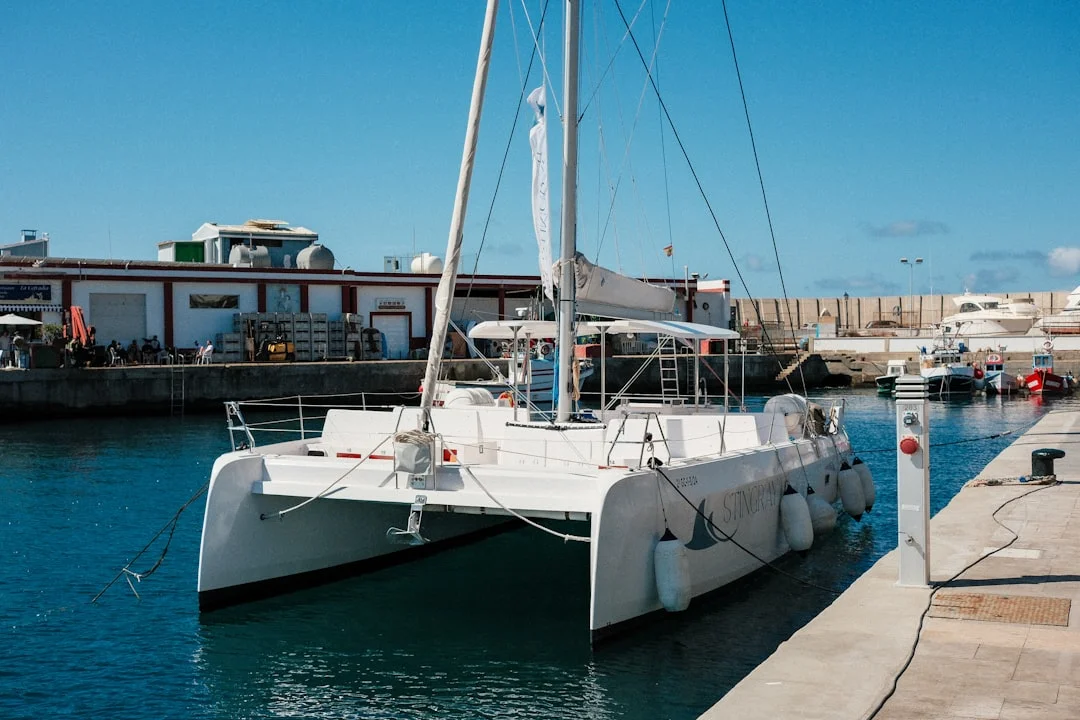
Photo by Dhiemas Afif Febriyan on Unsplash
Close-Quarters Control: Neutral Time, Bursts & Pivoting
Neutral as a tool: stopping the build-up of speed
Neutral isn’t what you do between mistakes; it’s what prevents them. If your cat makes 2–4 kt at idle in gear, leaving it in forward while you “think” is how you arrive at the dock with momentum you didn’t order. Neutral time lets the boat’s speed bleed off while you assess bow clearance, stern clearance, and drift angle without adding energy.
In tight quarters, I want the boat spending more time in neutral than in gear. If your crew thinks nothing is happening, that’s usually because you’re doing it correctly. The cat is still moving—just not accelerating.
Short throttle bursts and timing (instead of steady power)
Here’s the cadence that works on most 38–45 ft cruising cats with 2×30–57 hp diesels: burst → neutral → assess → correct. Training metrics that hold up in real marinas are 1–2 second bursts to about 1200–1800 RPM, then straight back to neutral. You’re using prop wash and thrust to reposition, not to “drive.”
Steady throttle creates speed, and speed creates panic. Panic creates shouting, and shouting creates line handlers doing creative things with fingers near loaded cleats. If you want a quiet boat, keep it slow enough that corrections can be small.
Differential thrust patterns: pivot, crab, and stern kick
Differential thrust dominates at very low speed, especially in crosswind set. The basic pivot is one engine ahead and the other astern with short bursts, keeping forward motion minimal while rotating the boat around a point between the hulls. Expect the stern to “walk” outward during a pivot because each prop is producing sideways components in disturbed water; your wide beam magnifies the clearance problem at the corners.
Crabbing is asymmetric thrust without opposite gear: for example, a brief ahead burst on the upwind engine to hold the boat up, then neutral to stop speed build. Stern-kick is a single short astern burst on one engine to move the stern laterally—useful when the bow is committed but the stern is drifting toward trouble. Keep rudder angles modest during bursts; hard-over can increase drag and slow response.
Scan discipline matters more than heroics. Don’t stare at the spot you want to land; look at the three things that hurt you: bow corner, stern corner, and sideways drift. If you can’t keep all three in view, put someone where they can—and require clear, short calls.
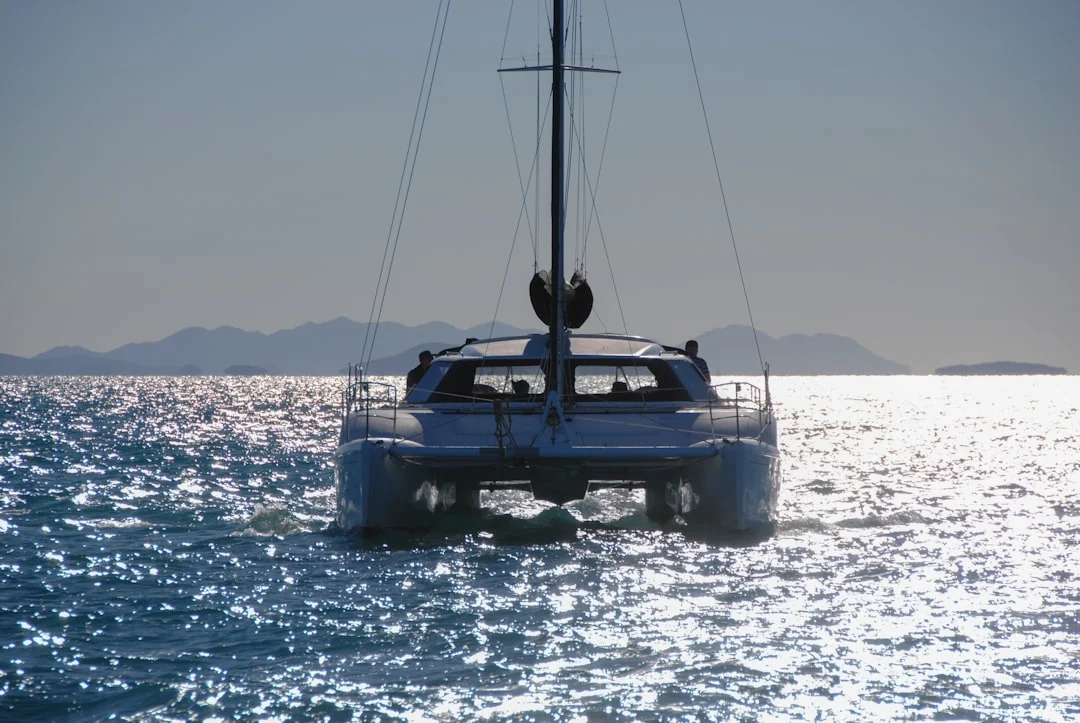
Photo by Bart van Griensven on Unsplash
Prop Walk Myths on Cats: Saildrives vs Shafts
What prop walk actually is (and when you’ll feel it)
Prop walk is a predictable sideways tendency from propeller rotation and asymmetric thrust, usually most noticeable in reverse on single-screw boats. On cats, it’s frequently blamed for what is actually wind-driven bow blow-off or current-induced set. If the boat is sliding sideways before you even apply meaningful reverse thrust, that’s not prop walk—it's the environment collecting its fee.
You’ll feel real prop walk when the boat shows a consistent lateral tendency under the same conditions, same RPM, same time-in-gear. The problem is that docking rarely provides “same conditions,” which is why dock-talk about prop walk is often more folklore than diagnostics.
Why many saildrive cats show less consistent walk
Many cruising cats in the 38–45 ft range use saildrives, and they often show less consistent walk than shaft-drive boats. Saildrives put the prop in a different geometry relative to hulls, mini-keels, and rudders, and the flow can be disturbed by the hull shape. Add different props—fixed, folding, feathering—and the reverse bite changes again.
Twin engines also mask or cancel walk. If both props are matched and you apply symmetric thrust, the lateral components tend to cancel. If one engine is doing most of the work, or if your bursts aren’t matched, you’ll create a “phantom effect” that feels like walk but is really your own asymmetry.
Reverse behavior, prop rotation, and “phantom effects”
Reverse thrust asymmetry is real: props generally have less efficiency and bite in reverse, and the boat can lag in response while you’re in neutral waiting for speed to decay. That lag often gets misread as “it’s walking,” when it’s actually drift plus delayed thrust. Standardizing your RPM and time-in-gear is the quickest way to stop blaming the wrong culprit.
If you want to test for prop walk, do it like an adult: flat water, minimal wind, no current, plenty of room. Back both engines at the same RPM—say 1200 RPM for 3–4 seconds—then neutral, repeat, and observe whether the boat consistently shifts laterally in the same direction. If it doesn’t repeat, it isn’t prop walk; it’s conditions, technique, or both.
Photo by Oscar Davila on Unsplash
The Spring Line Playbook for Side-To Docking
Rigging before the fairway: lines, chafe, cleats
Spring lines are the catamaran skipper’s third engine. They stop fore-and-aft motion and let you “pin” the boat alongside without grinding your gelcoat into a marina brochure. For 35–45 ft boats, 5/8 in (16 mm) double-braid nylon is common; 3/4 in (19 mm) is worth it on heavier displacement cats or consistently windy docks.
On a 40‑footer, I like at least two dedicated 50–60 ft springs, because spring lengths of ~1.0–1.5× LOA (40–60 ft) actually reach cleats or pilings with useful angles. Pre-run the working spring outside the lifelines, remove twists, and coil it so it pays out cleanly—because a line that dumps a knot at the wrong moment is a practical joke you play on yourself.
Check dock cleats, too. Many slips use 10–12 in cleats, and your spliced eyes should fit without stacking dangerously. ABYC H‑40 and ISO 15084 both steer you toward using properly backed strong points and correct lead routing; in plain language, don’t load up a stanchion base and act surprised when it complains.
Spring geometry: lead angles that actually control the boat
Springs control surge (forward/back). Bow and stern lines control position (where you sit). The angle matters: a spring led around ~20–45° relative to the dock tends to bite and hold without sawing itself to death on a chock. Too steep and you mostly pull the boat sideways while creating chafe; too shallow and you lose control authority.
High docks and pilings complicate this because the vertical lead increases chafe and can lift the line. Use chafe gear ($10–$40 a pair), and route through proper chocks or fairleads, not over random edges. If you’re routinely docking at pilings, add at least one ball fender and a longer spring so you can reach around a post without turning the line into a cheese wire.
Step-by-step: “spring line first” alongside landing
The most repeatable side-to arrival for a wide-beam cat is “spring first.” Approach at 0.5–1.0 kt with fenders already set, and aim to land the forward quarter gently, not perfectly parallel. The first crew job is to place the pre-rigged spring over a dock cleat—no jumping—and confirm “spring on” clearly.
Once that spring is on, you use it to control the boat with engines at idle bursts. With the spring leading aft (a forward spring), a gentle ahead burst against the spring will bring the stern in; with the spring leading forward (aft spring), a gentle astern burst can bring the bow in. Either way, the spring creates a controlled pivot without speed, which is the whole point.
Only after the boat is stabilized do you add the remaining lines. Bow line next if the bow is wandering, stern line next if the stern is wandering, then the opposite spring. You’re building a system, not racing the neighboring skipper’s smartphone camera.
Load paths and hardware: what ABYC/ISO imply in practice
Springs can load cleats harder than simple breast lines, particularly in crosswind where the boat wants to saw forward and aft. ABYC H‑40 and ISO 15084 are essentially reminders that cleats and strong points must be installed for real loads with proper backing. If you’re on a charter boat, assume nothing is overbuilt; if you own the boat, inspect backing plates and fasteners before relying on a spring as your “third engine.”
Keep hands off cleats under load, and never take wraps around hands or wrists. If you must ease a loaded line, do it by adding turns on a cleat or using a winch as a controlled friction device—slowly, with communication. The ocean is dangerous, but docks are where most sailors get injured, usually because they tried to be helpful too quickly.
Photo by Sean Dogjani on Unsplash
Crosswind & Current Docking: Angles, Set, and Abort Rules
Estimating set: drift angle and timing windows
Crosswind docking starts with admitting the obvious: your cat is a sail, and the wind is in charge unless you plan for it. In 10–15 kt of crosswind, a 40‑footer can need countering roughly 0.5–1.5 kt of sideways drift, depending on freeboard, load, and whether the fairway funnels gusts. If you see your bow falling off faster than your engines can correct with short bursts, you’re already behind.
Use visual transits in the fairway—dock pilings lined up with a cleat, a light pole with a shed—to detect sideways motion early. If you have chartplotter distance/bearing, it can help, but your eyes are faster at 30 feet. Save electronics for confirming, not discovering.
Crosswind approaches: upwind bias vs controlled slide
There are two reliable strategies: land with an upwind bias, or land with a controlled downwind slide onto fenders. Upwind bias means you approach slightly into the wind so you can ease off and settle; it demands space and good neutral discipline. Controlled slide is often safer in tight fairways because you accept the drift and manage it, aiming the fendered quarter as the first contact point.
The key is bow swing management. If you let the bow blow off, your stern will swing the other way and that aft corner will hunt for trouble. Use differential thrust to keep the bow from running away, and keep the boat slow enough that you can stop the slide with neutral and a spring.
Current in the fairway: when “slow” is not safe
Current changes everything because it affects rudder flow and your ability to stop. If there’s 1–2 kt of current in the fairway, you may need brief higher bursts than 1200–1800 RPM to regain control authority, but the discipline stays the same: short bursts, then neutral. “Slow” relative to the water can still be fast relative to the dock if the dock is fixed and the water is moving.
Current also shifts your approach geometry. If the current is pushing you down the fairway, you may need to start your turn earlier and use a wider setup, even if the wind is light. I’ll often use a sea-distance tool to estimate arrival timing before arrival to sanity-check route timing and fuel planning, because showing up at slack water instead of max ebb is the cheapest docking upgrade you can buy.
Abort/reset protocol: neutral, clear, and try again
An abort is a maneuver, not a confession. If your approach angle exceeds what your spring can catch, if speed builds above ~1.0 kt near the dock, or if you lose a clear escape lane, go neutral and back out cleanly. USCG Nav Rules Rule 9 (Narrow channels) is good marina etiquette: don’t block the fairway while you argue with physics.
My reset routine is boring on purpose: neutral to kill speed, stern clear of hazards, then a controlled exit with short bursts. Circle back outside the fairway where you have room, brief the crew again, and re-enter with a new plan. If you’re planning a longer hop between marinas, you can also estimate your fuel needs based on the voyage distance so you’re not tempted to rush in at arrival because the tanks (or daylight) are tighter than expected.
Photo by Raimond Klavins on Unsplash
Fenders, Lines, and Med-Moor vs Side-To Setups
Fender strategy for multihulls: height, spacing, and corners
Cats generally need more fenders because the beam increases the chance of a quarter contacting during a sideways slide. For 35–45 ft cats, typical cylindrical fenders run 8×20 in to 10×30 in, and many owners carry 6–10 fenders so both forward and aft quarters are protected. Set fenders for the dock you actually have: floating docks want mid-hull height, fixed docks can demand higher placement, especially at low tide.
Corner protection matters more than midships perfection. Put your best fender at the “first-touch” corner—often the forward quarter on the docking side—then fill in along the hull. For pilings or rough dock faces, a ball fender earns its keep quickly.
Med-moor on a wide-beam cat: stern lines, lazy lines, and prop clearance
Med-mooring (stern-to) adds two big concerns: line management and prop clearance. Lazy lines love to drift toward leeward props, especially when you’re using reverse to control sternway. The solution is procedural: keep reverse bursts short, keep someone watching the waterline by each hull, and don’t let loose line float free near the props.
If you’re arriving in current, treat it as a timing problem. You need enough sternway control to hold position, but not so much power that you suck a lazy line toward a prop. Brief the crew on who is responsible for each lazy line pickup and where it gets secured immediately—no “temporary” wraps.
Side-to vs Med-moor line plan (comparison)
| Setup | Lines used (minimum) | Typical lengths on a 40 ft cat | First controlling line (best practice) | Notes |
|---|---|---|---|---|
| Side-to docking catamaran | 2 springs + 1 bow + 1 stern (add spares) | Springs 50–60 ft; bow/stern 35–45 ft | Forward or aft spring (pre-rigged) | Springs led 20–45° reduce surge and pin boat gently. |
| Med moor catamaran | 2 stern lines + 2 bow lines to mooring/lazy lines | Stern 40–60 ft; bow 40–60 ft | Stern line (windward first if possible) | Keep lazy lines clear of leeward prop; short reverse bursts. |
| Pilings/high dock side-to | 2 long springs + 2 breast lines + extra fenders | Springs 60 ft preferred | Long spring around piling | Add chafe gear; ball fender often required. |
Pre-rig inventories for charter vs owner-ops
A sensible baseline inventory is 2 long springs + 2 bow lines + 2 stern lines (often 6 total), plus one spare line that can become anything. For line costs, expect $25–$80 for a 35–50 ft double-braid nylon line, and $60–$140 for a 50–60 ft, 3/4 in line. Fenders typically run $20–$45 for 8×20 in and $45–$120 for 10×30 in, and they’re cheaper than fiberglass work by several orders of magnitude.
Crew Roles, Commands, and Docking CRM (2–3+ Crew)
Role assignments and where each person stands (safe zones)
Docking failures are usually communication failures wearing fiberglass costumes. Good docking CRM is simple: one decision-maker (helm), one communicator/line lead, and one floater if you have them. The goal is to keep crew out of pinch points and keep the helm from being spammed with opinions.
Safe zones are predictable: inside the lifelines, feet planted, lines led out cleanly with no wraps around hands. A boat hook (6–8 ft, $25–$90) is not a sign of weakness; it’s a way to avoid the classic dock injury where someone tries to “catch” a piling with their shoulder.
Scripted calls and hand signals for the last 60 seconds
In the last minute, run a sterile cockpit. That means only essential calls: distance, drift, line status, and neutral confirmations. USCG requires an adequate sound-producing device (33 CFR 83), but that doesn’t mean your primary docking tool should be shouting over diesels and wind; a handheld VHF or a simple headset system ($250–$1,200) reduces errors fast.
Standard hand signals help when the helm can’t hear. I use: flat palm down = neutral/stop, finger forward = ahead, thumb back = astern, fist = hold, arms crossed = abort/reset. The humor here is that the only signal everyone invents naturally is “panic,” and it’s never the right one.
2-person vs 3-person docking roles (comparison)
| Crew size | Helm tasks | Line lead tasks | Floater tasks | Primary first line |
|---|---|---|---|---|
| 2-person team | Engines, cadence, abort lane, scan both corners | Pre-rig spring, place on cleat, confirm “spring on,” then bow/stern | N/A | Pre-rigged spring (do not chase perfection) |
| 3-person team (ideal) | Same + manage differential thrust timing | Spring + stern control side | Bow clearance + fender watch + bow line | Spring first, then stern/bow as needed |
| 4+ crew | Same + maintain “one voice” discipline | Dedicated spring handler | Dedicated bow handler | Fender adjuster, lookout |
No-injury rules: no jumping, no ‘hand-as-fender,’ no wraps
Three rules that keep people out of the emergency room: no jumping to the dock, no using hands/feet as fenders, and no wraps around fingers or wrists. If the boat isn’t close enough to step safely, it isn’t close enough—full stop. If a line is loading up, treat it like a winch: control it with turns, not grip strength.
Brief the abort authority, too. I want any crew member to be able to call “abort” if they see a line in the water near a prop, a person off balance, or a corner about to make contact. Rehearse it once outside the marina; it feels silly until it saves you.
If you’re planning a longer cruise with multiple marina arrivals, build docking into your passage plan. Breezada’s sea distance calculator is useful for estimating run times so you’re not arriving at peak crosswind or max current just because lunch ran long.
Frequently Asked Questions
In a twin-screw catamaran, what burst RPM and time-in-gear window best limits speed build while still creating rudder wash (e.g., 1200–1800 RPM for 1–2 seconds), and how should it change in current?
For many cats, 1200–1800 RPM for 1–2 seconds, then back to neutral, is the sweet spot for control without speed buildup. In current (especially 1–2 kt in a fairway), you may need slightly higher RPM or a slightly longer burst to regain authority, but keep the same cadence and watch speed relative to the dock, not the water.
How do saildrives vs shaft drives change reverse thrust symmetry and perceived prop walk, and what on-water test isolates prop walk from wind/current set?
Saildrives often produce less consistent “walk” than shafts because prop geometry and flow interaction differ, and twin screws can cancel effects when thrust is symmetric. To isolate prop walk, test in flat water with minimal wind/current: apply equal reverse thrust on both engines (same RPM, same duration—e.g., 1200 RPM for 3–4 seconds), repeat several times, and see if lateral motion is consistent and repeatable.
What spring line lead angle (in degrees) provides reliable surge control without excessive chafe, and how should the lead change with high docks or pilings?
A practical target is ~20–45° to the dock for effective surge control and manageable chafe. With high docks or pilings, increase line length (often closer to 60 ft on a 40‑footer) to reduce vertical angle, use proper chocks, and add chafe gear where the line bears.
For a 40 ft cat with 21–24 ft beam, how do you calculate minimum fairway/turning space (as a multiple of LOA) and choose an abort point before committing?
Use the planning metric ~1.5–2.0× LOA for fairway/turning space; for 40 ft, that’s roughly 60–80 ft of workable room. Choose an abort point outside the commitment zone—typically before you pass the last place you can turn away cleanly without blocking traffic—and brief the crew that if speed rises above ~1.0 kt near the dock or the angle gets too steep for a spring catch, you reset.
When med-mooring a catamaran, how do you manage lazy-line pickup and reverse propulsion without fouling a line in the leeward propeller?
Keep reverse bursts short and controlled, and assign one crew member to watch each hull’s waterline for floating line. Pick up lazy lines early, keep them tensioned and immediately secured to a cleat, and never allow slack line to drift near the leeward prop while you’re using reverse to hold position.
If you want a repeatable system: plan the space, pre-rig fenders and long springs, use short differential-thrust bursts with disciplined neutral time, treat prop walk as conditional, and run docking like CRM—clear roles, scripted calls, and a no-drama abort/reset protocol. That’s how you dock a catamaran consistently, even when the marina audience is doing what marina audiences do: watching.
About the Author
Related Articles
Best Stove for a Sailboat: Propane vs Diesel vs Induction
Compare propane, diesel, and induction stoves for cruising safety, cost, and power needs—use our guide to choose the best stove for your sailboat.
By Breezada Team
Single Handed Docking Sailboat: Line Methods & Drills
Learn single handed docking sailboat line-first methods, setup, and drills for crosswind/current. Practice safely—get the step-by-step plan now.
By Breezada Team
Sailboat Propane System Safety: Lockers & Tests
Learn sailboat propane system safety—locker rules, solenoids, and leak tests. Use this checklist to inspect your setup and upgrade safely.
By Breezada Team
Folding Propeller Sailboat Guide: Fixed vs Feathering
Compare fixed, folding & feathering sailboat props for speed, power and cost. Choose the right setup—use our decision guide now.
By Breezada Team